Open abdominal aortic aneurysm (AAA) repair: an OR 101 guide
Reviewed by Rodnie Oro, cath lab charge nurse · Last reviewed: October 2026 · Education only, not medical advice
Open AAA repair in one minute
What it is: major surgery to replace a swollen section (aneurysm) of the aorta in the abdomen with a fabric graft.
Who it is for: people with a large or growing aneurysm, or a rupture (emergency), when open surgery is the best option.
Main risks: bleeding, heart attack, kidney problems, bowel problems, infection, death.
Usually: under general anaesthetic, 3–5 hours, often 7–10 days in hospital including intensive care.
On this page: What is open AAA repair? · Who is it for? · When is it done? · Step by step · Recovery · Risks · Kit list · First time in theatre? · FAQ
What is open AAA repair?
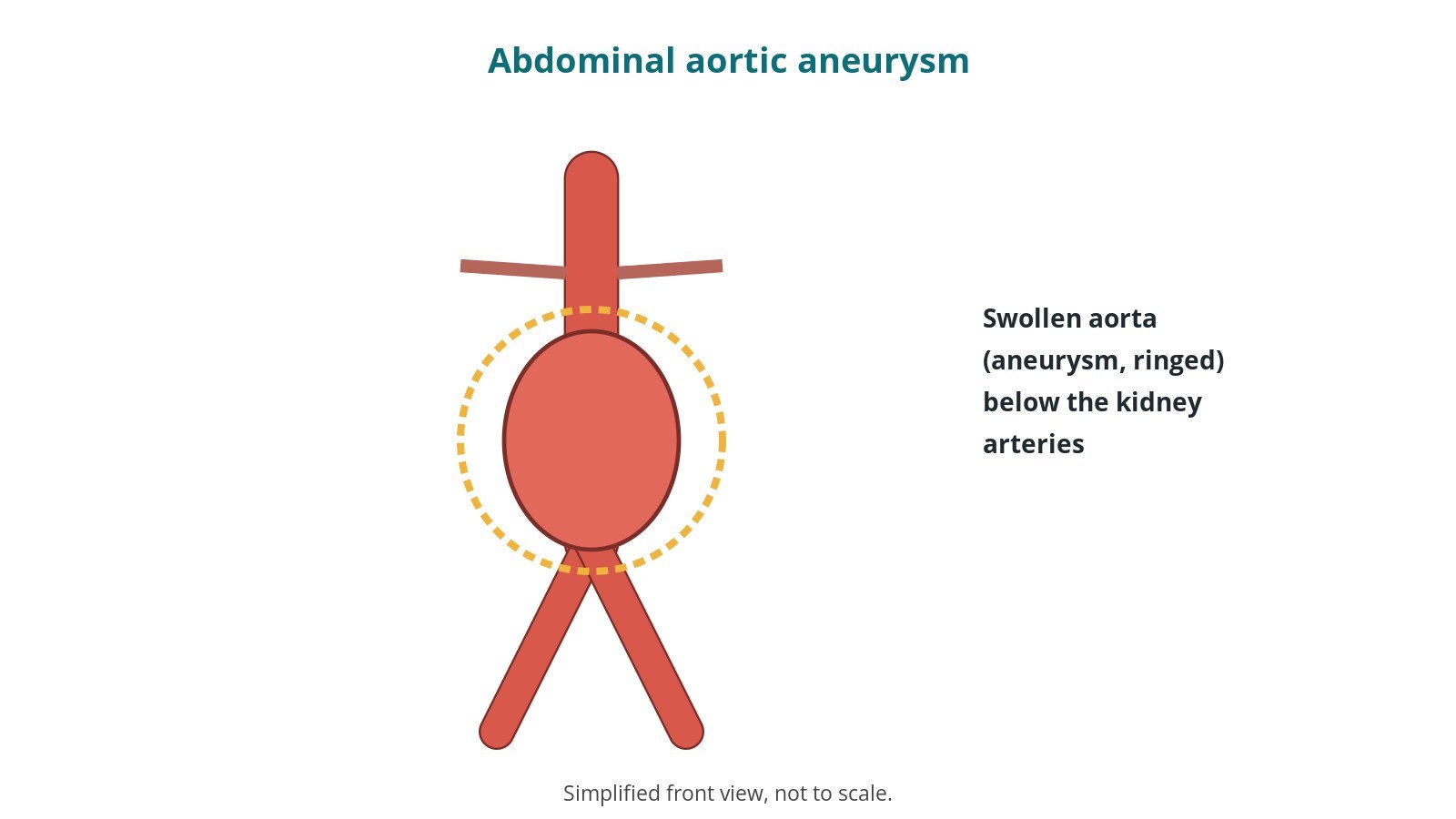
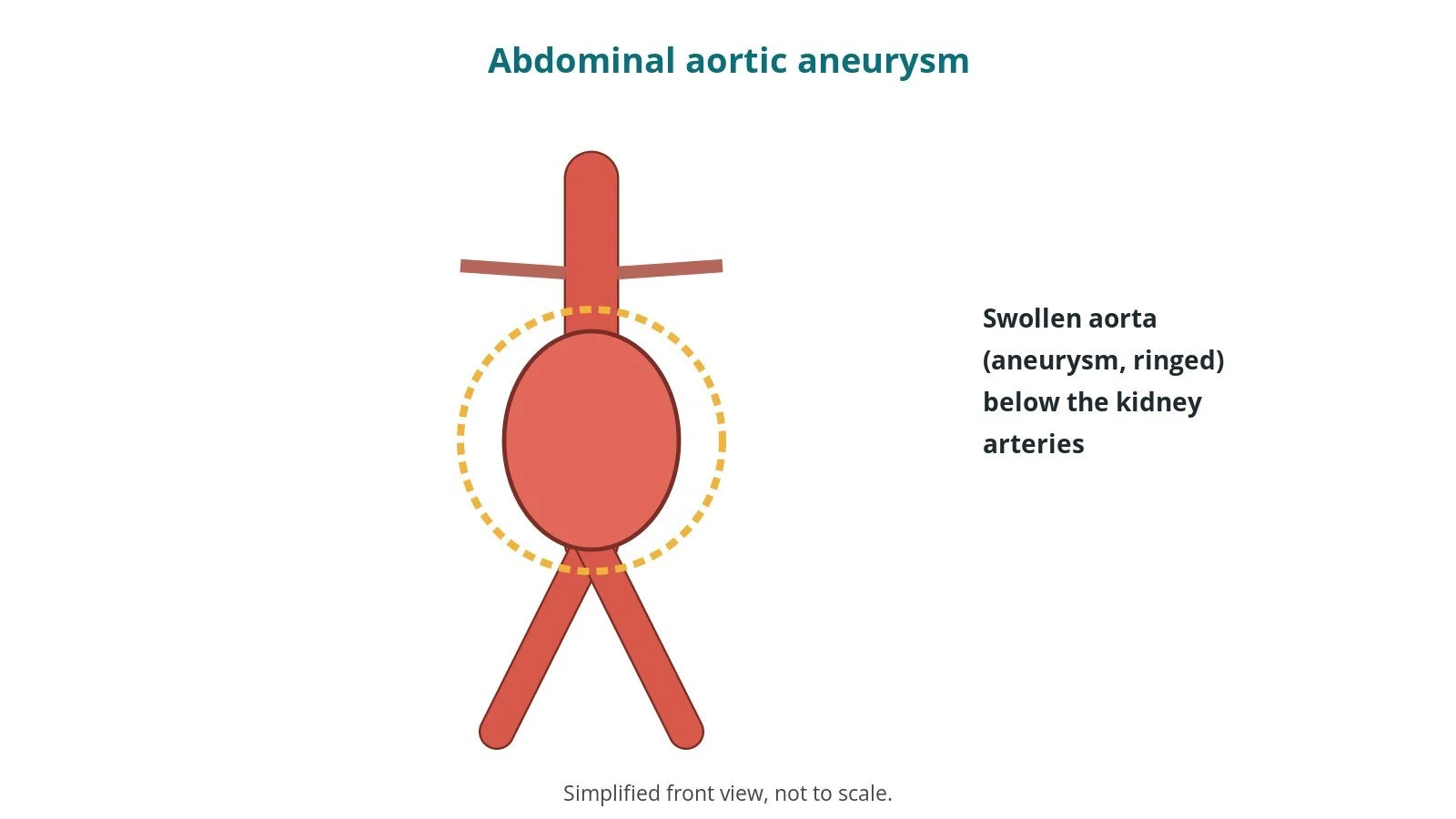
The aorta is the main artery from the heart. In the abdomen it can weaken and swell into an abdominal aortic aneurysm (AAA). Large aneurysms can burst (rupture), which is life-threatening.
In open repair the surgeon:
- opens the abdomen (or the side of the abdomen)
- clamps the aorta above and the arteries below the aneurysm, after heparin
- opens the aneurysm and sews in a tube or bifurcated graft, size per device and operator
- wraps the old aneurysm wall around the graft
An alternative is endovascular repair (EVAR), using a stent graft through the groin. The choice depends on anatomy and health.
New to the acronyms? See the Cath Lab Abbreviations A–Z.
Who is it for?
It may be considered for people with:
- a large aneurysm, usually 5.5 cm or more in men (thresholds per national guidance)
- an aneurysm growing quickly or causing symptoms
- a ruptured aneurysm (emergency)
- anatomy not suitable for EVAR
The decision is made by your vascular team, who will talk through the reasons, the alternatives (including EVAR) and the risks with you.
When is it done?
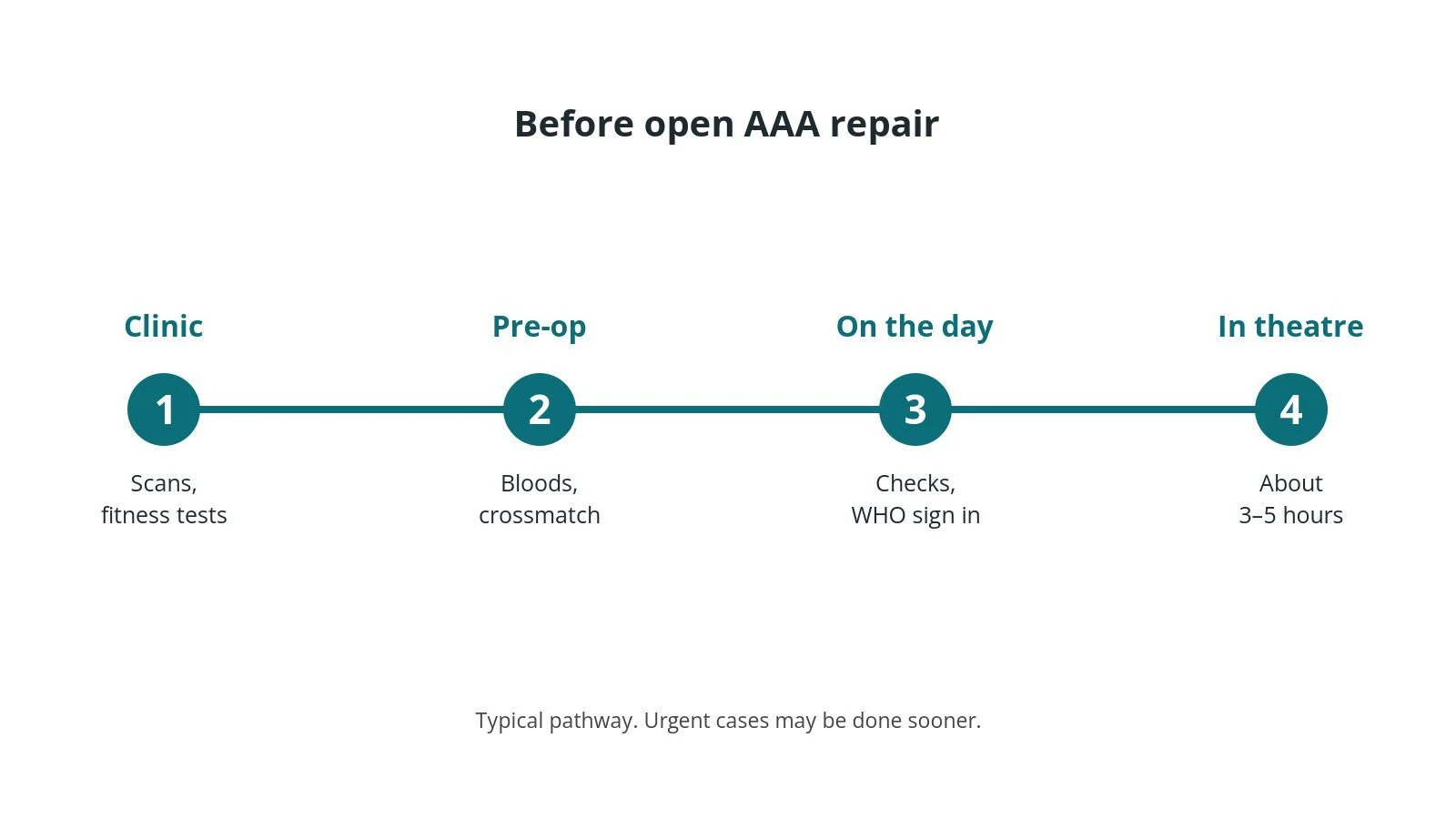
Most operations are planned; some are urgent. Before it, you usually have:
- a CT scan of the aorta
- blood tests, crossmatch, ECG, and heart and lung tests
- a fitness assessment, sometimes an exercise test
- a review of your medicines, as per centre protocol
- a chance to ask questions and give consent
Step by step
1. Getting ready
Team brief and WHO checklist first, including the side and site marking and the graft or patch check. The anaesthetic team and ODP give the anaesthetic (general, often with an epidural, as per centre protocol) and place an arterial line and other lines as needed; antibiotics and clot prevention are given as per centre protocol. The circulating practitioner checks positioning, pressure areas, the diathermy plate and warming. The scrub practitioner sets up the vascular trolley with clamps, fine sutures and heparinised saline, and does the first count. A urinary catheter and warming are placed; cell salvage and blood products are ready, per centre.
2. Access
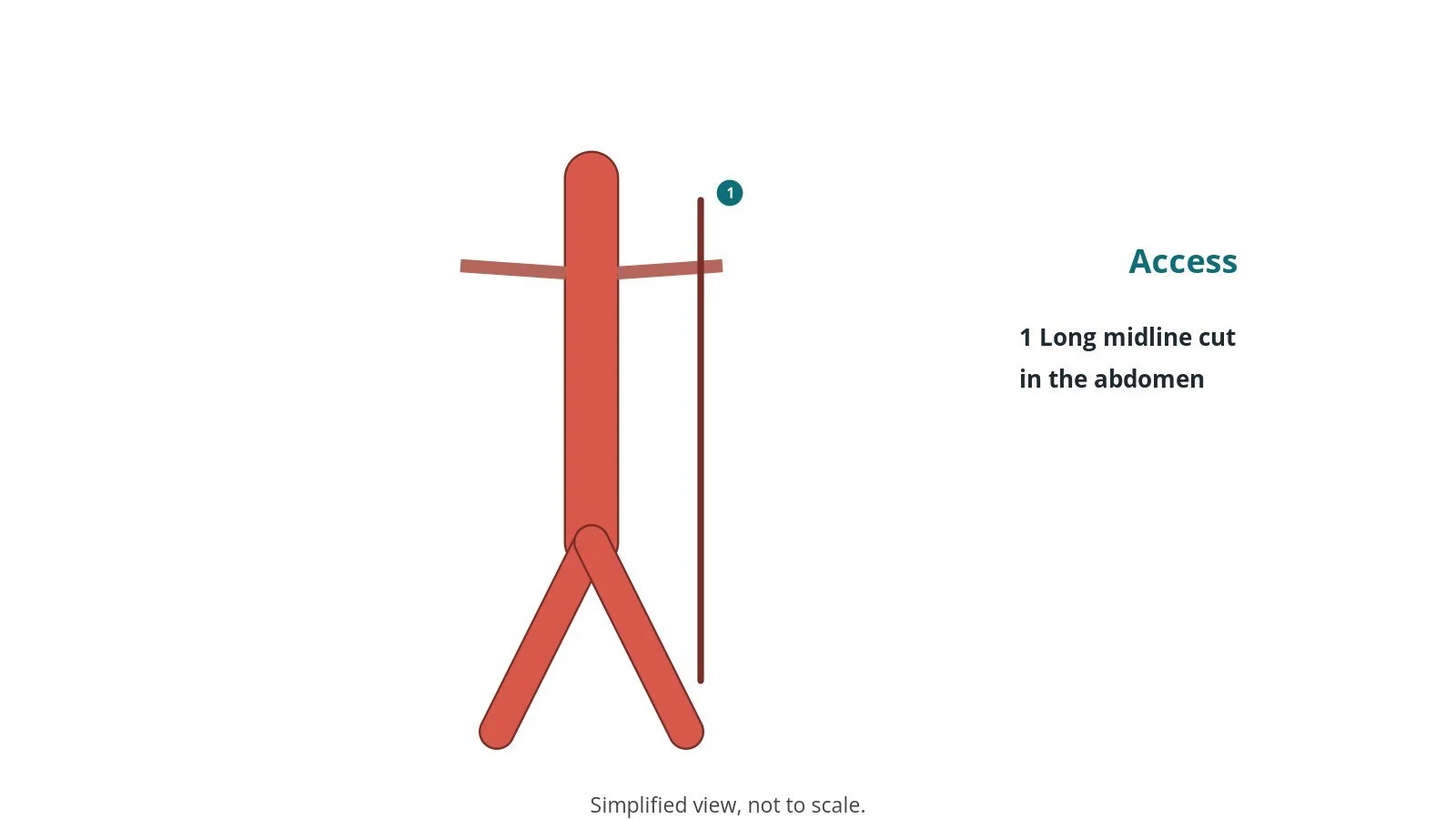
Usually a long midline cut in the abdomen, or a cut on the left side (retroperitoneal), per surgeon.
3. Replacing the aorta
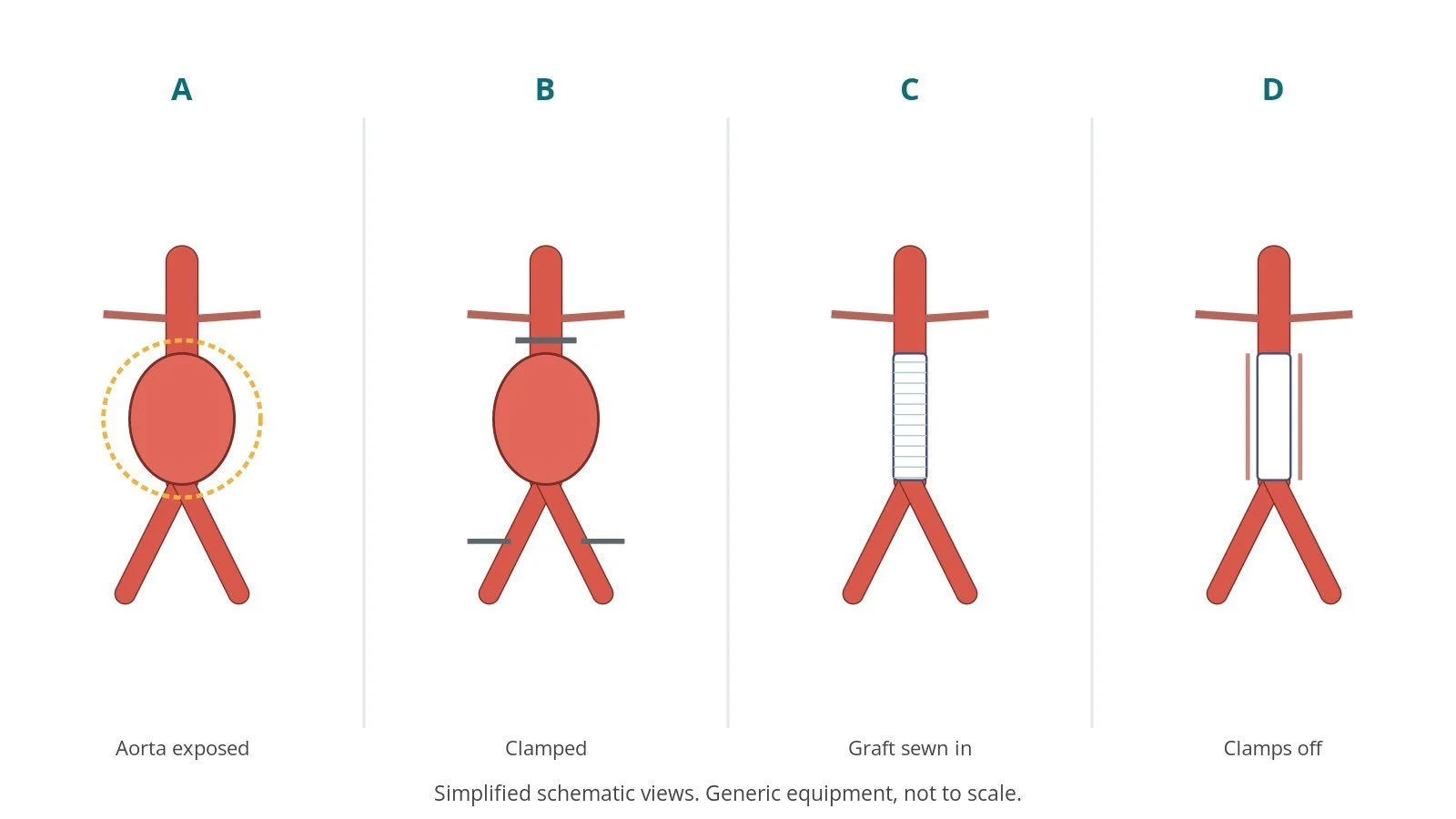
- A. Aorta exposed. The bowel is moved aside and the aorta and iliac arteries exposed.
- B. Clamped. Heparin is given (as per centre protocol) and the aorta and iliac arteries clamped.
- C. Graft sewn in. The aneurysm is opened and the graft sewn in at each end.
- D. Clamps off. Clamps are released slowly with the anaesthetist, and the aneurysm wall closed over the graft.
Releasing the clamps can drop blood pressure; the surgeon and anaesthetist coordinate this closely.
4. Finishing
Leg pulses are checked. The abdomen is closed in layers. Final counts are confirmed, the graft logged, and the patient goes to intensive or high-dependency care with a full handover.
Recovery and aftercare
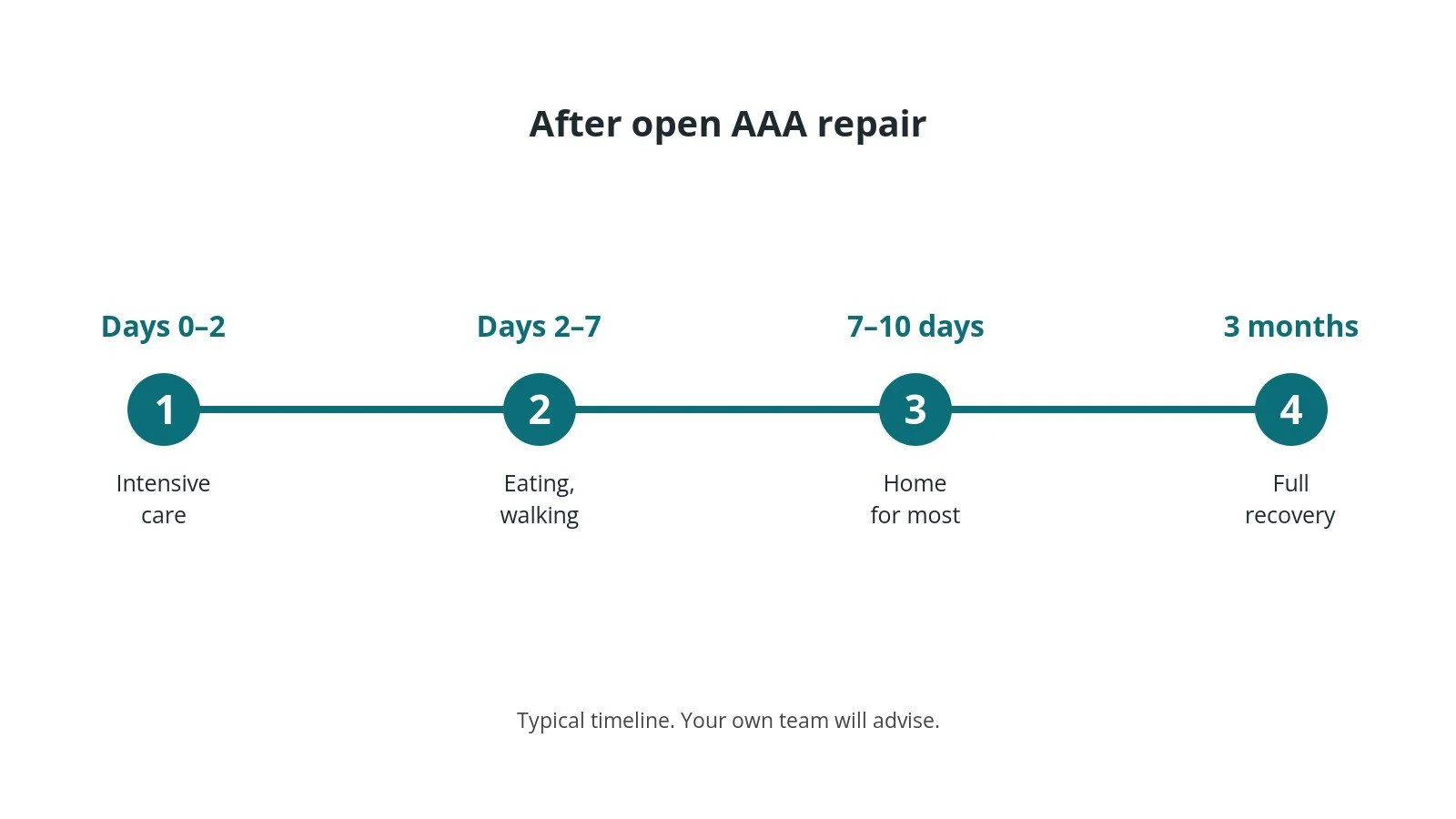
- First days: intensive or high-dependency care; pain relief, fluids and monitoring.
- Eating: drinking and eating as the bowel recovers.
- Walking: physiotherapy and walking early.
- Going home: often 7–10 days.
- Activity: no heavy lifting for about 6–12 weeks.
- Follow-up: clinic review and scans, as per centre protocol.
Call 999 if you have chest pain, sudden breathlessness, signs of a stroke (face drooping, arm weakness, speech problems), sudden severe pain, or a cold, pale or numb leg. Contact your team if a wound becomes red, hot, leaky or swollen.
Risks and complications
Your team will explain the risks that apply to you. Possible problems include:
- bleeding, needing transfusion
- heart attack or heart rhythm problems
- kidney problems
- poor blood flow to the bowel or legs
- chest infection
- wound infection or hernia later
- graft infection (rare)
- death
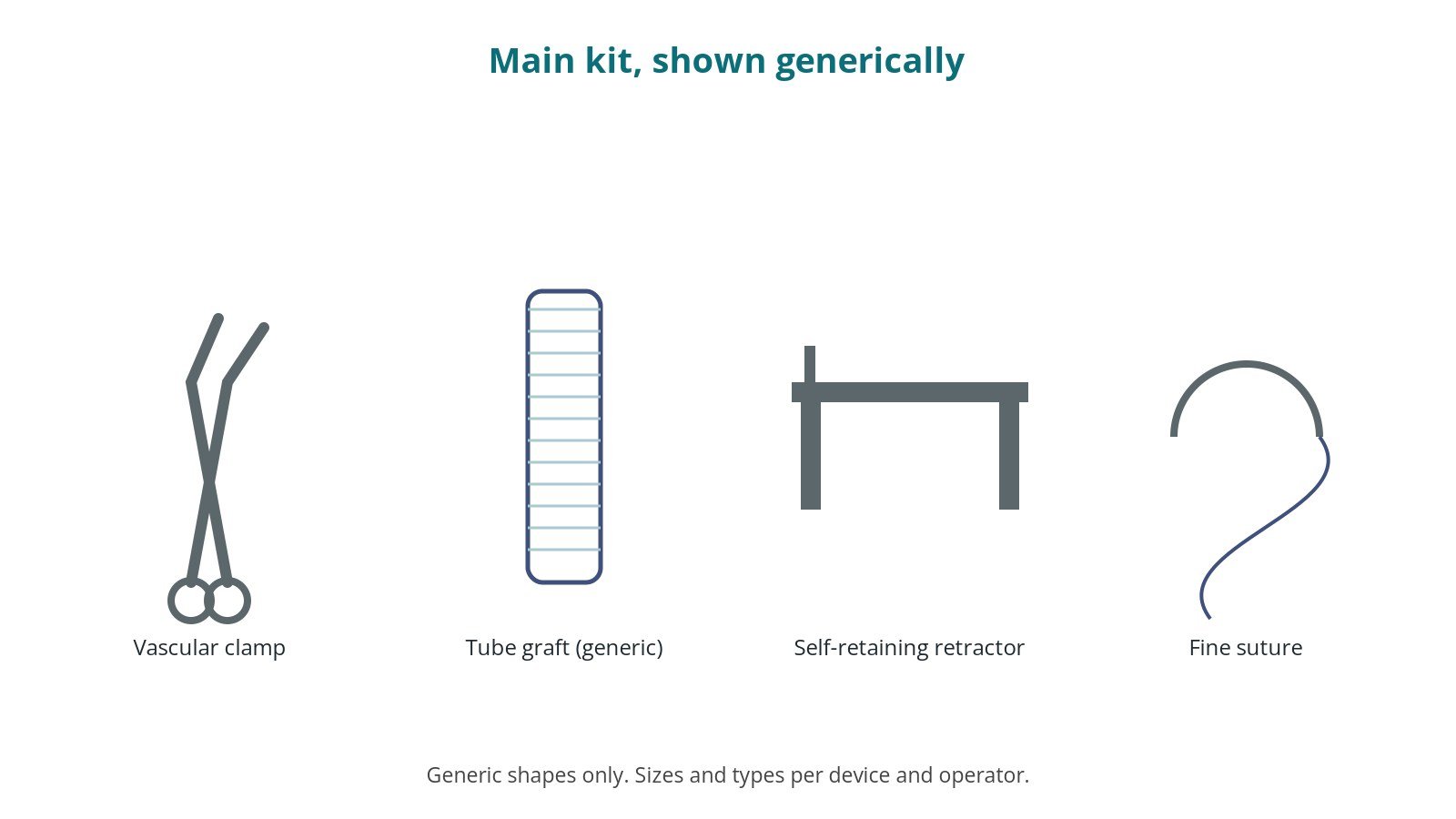
Theatre kit list (printable)
Example kit list
Every theatre has its own protocol, and sizes and doses vary.
- major vascular laparotomy set and self-retaining retractor
- aortic and iliac clamps
- tube or bifurcated graft, size per device and operator
- fine vascular sutures
- heparin and heparinised saline, as per centre protocol
- cell salvage and rapid infuser, per centre
- balloon catheters for clot removal, sizes per device and operator
- strong closure sutures and dressings
Procedural steps
- Team brief, WHO sign in; graft check; blood availability; anaesthesia, lines, epidural
- Supine; catheter; warming; prep and drape; count
- Incision; aorta and iliacs exposed
- Heparin; clamps (time noted); aneurysm opened; back-bleeding controlled
- Graft sewn in; slow clamp release with anaesthetist
- Sac closed over graft; leg pulses checked; closure; counts; graft log; sign out and handover to ICU
First time in theatre?
💡 First-time tip
- Know your role. Scrub, circulating, anaesthetic and ODP each have their own checks; ask at the team brief.
- Counts matter. Swabs, needles and instruments are counted before, during and at closure; speak up if one is missing.
- Blood ready. Know the blood availability, cell salvage and rapid infuser plan.
- Clamp times. Note when clamps go on and come off and call times out if asked.
- Heparin. Know when heparin is given and when its effect is checked, as per centre protocol.
- Graft check. Read back the graft or patch type and size before opening, and log it.
FAQ
Why not have keyhole (EVAR)?
It depends on the shape of the aneurysm and your health; your team will discuss.
How long is recovery?
Often 3 months to feel fully recovered.
Will I need scans afterwards?
Usually some follow-up; less than after EVAR.
Related guides
Sources
All checked on 14 October 2026. Each page's own date is shown where it gives one.
- NICE. Abdominal aortic aneurysm: diagnosis and management (NG156). nice.org.uk/guidance/ng156
- NHS. Abdominal aortic aneurysm. nhs.uk/conditions/abdominal-aortic-aneurysm
- StatPearls (NCBI Bookshelf), search: abdominal aortic aneurysm. ncbi.nlm.nih.gov/books
- World Health Organization. Surgical Safety Checklist. who.int
Disclaimer
Education only. This page is for general education for healthcare students, theatre staff and curious readers. It isn't medical advice and doesn't replace advice from your own doctor, surgical team or local unit protocols. Equipment and medicines are described generically. No product or manufacturer is recommended. If you think someone is having a medical emergency, call 999.
Disclosure: I work for a company that makes a device used in this procedure. This page is independent education, isn't sponsored or reviewed by any company, and doesn't recommend any product.
All diagrams on this page are original illustrations created for rodnieoro.com.