Transurethral resection of the prostate (TURP): an OR 101 guide
Reviewed by Rodnie Oro, cath lab charge nurse · Last reviewed: October 2026 · Education only, not medical advice
TURP in one minute
What it is: surgery to remove part of an enlarged prostate through the urethra, with no cuts on the skin.
Who it is for: men with troublesome urinary symptoms or urine retention from a benign enlarged prostate when medicines have not helped.
Main risks: bleeding, infection, retrograde ejaculation, incontinence (uncommon), TUR syndrome from fluid absorption (rare).
Usually: under spinal or general anaesthetic, about 1 hour, 1–3 days in hospital with a catheter.
On this page: What is a TURP? · Who is it for? · When is it done? · Step by step · Recovery · Risks · Kit list · First time in theatre? · FAQ
What is a TURP?
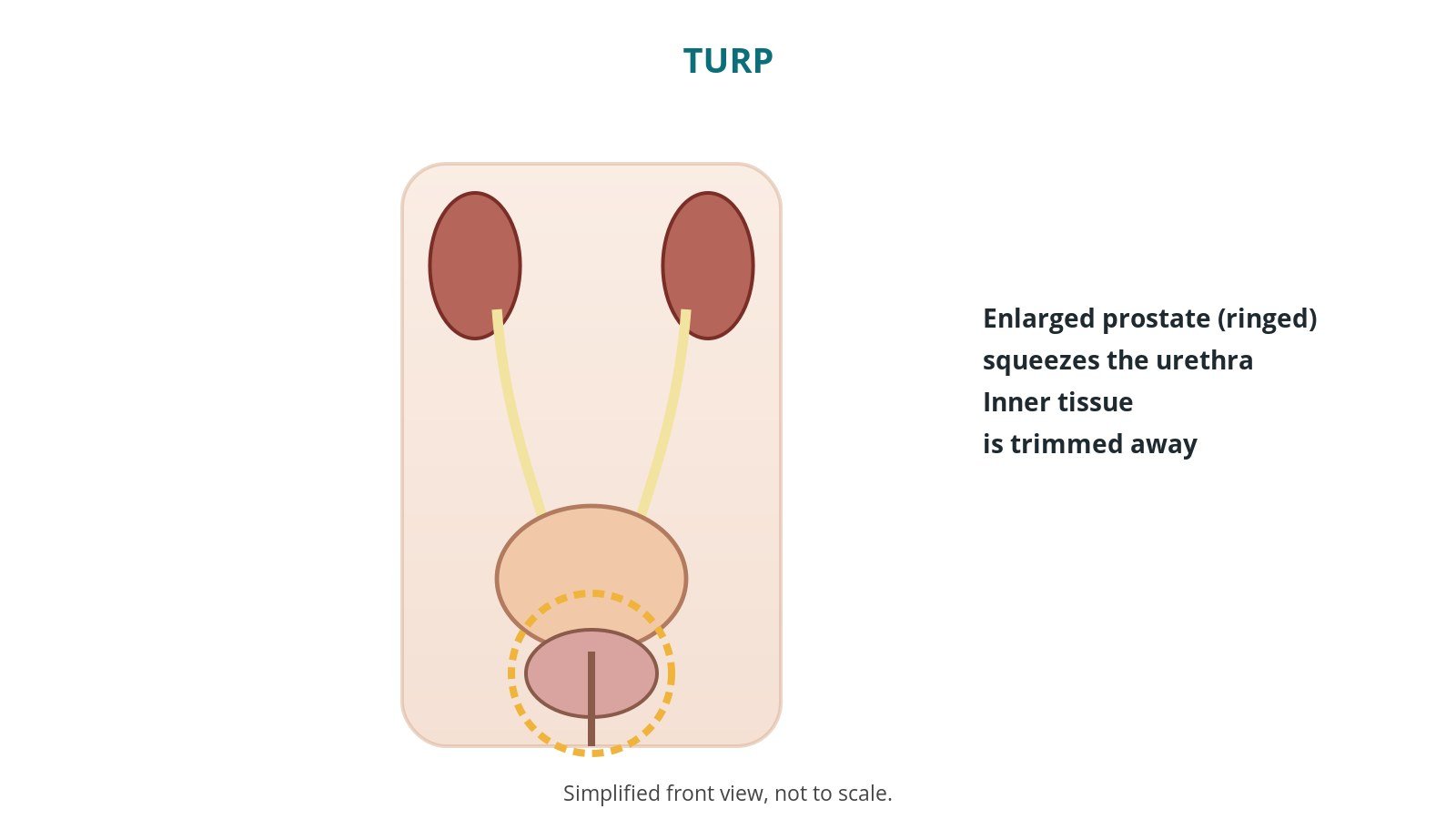
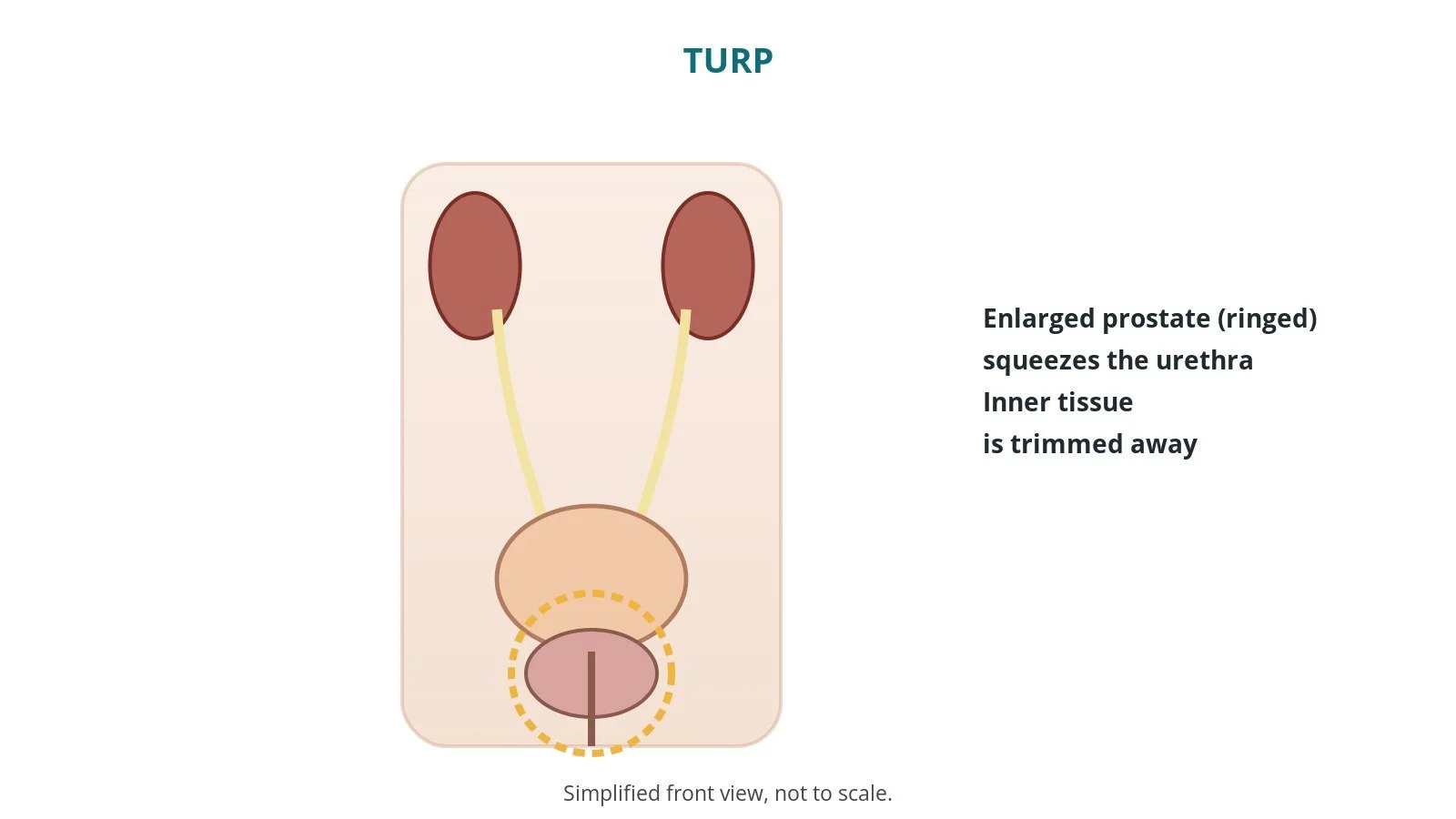
The prostate sits below the bladder and surrounds the urethra. As men age it often enlarges (benign prostatic enlargement) and can squeeze the urethra, making it hard to pass urine.
In a TURP the surgeon:
- passes a resectoscope (a camera scope with an electric wire loop) up the urethra
- trims away the inner prostate tissue in small pieces (chips) to open the channel
- seals bleeding points with the loop
- washes out the chips and sends them to the lab
Irrigation fluid flows continuously so the surgeon can see. A catheter is left in afterwards. Other options include laser and other minimally invasive treatments.
New to the acronyms? See the Cath Lab Abbreviations A–Z.
Who is it for?
It may be considered for people with:
- bothersome urinary symptoms not helped by medicines
- urine retention needing a catheter
- complications such as recurrent infection, bleeding, bladder stones or kidney effects
The decision is made by your urology team, who will talk through the reasons, the alternatives and the risks with you.
When is it done?
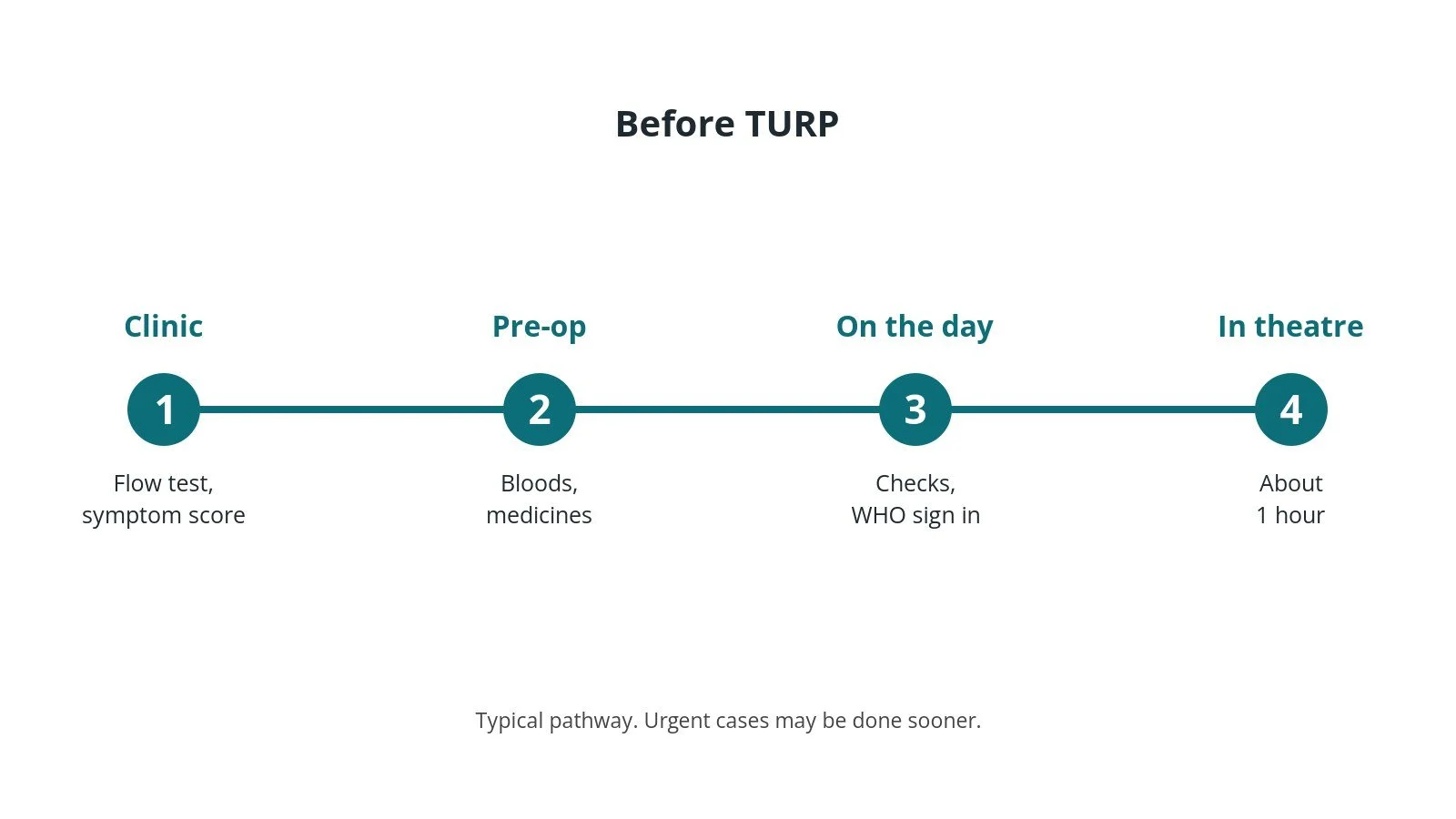
Most operations are planned; some are urgent. Before it, you usually have:
- a symptom score, urine flow test and sometimes a bladder scan or cystoscopy
- blood tests, including kidney function
- a review of your medicines, especially blood thinners, as per centre protocol
- a chance to ask questions and give consent
Step by step
1. Getting ready
Team brief and WHO checklist first, including the side and site where relevant. The anaesthetic team and ODP give the anaesthetic (usually spinal, or general, as per centre protocol); antibiotics are given as per centre protocol. The circulating practitioner checks positioning in stirrups (lithotomy), pressure areas, warming, the camera stack and the irrigation fluid. The scrub practitioner sets up the endoscopy trolley and does the first count. The irrigation fluid type is confirmed for the resection system, as per device and operator.
2. Access
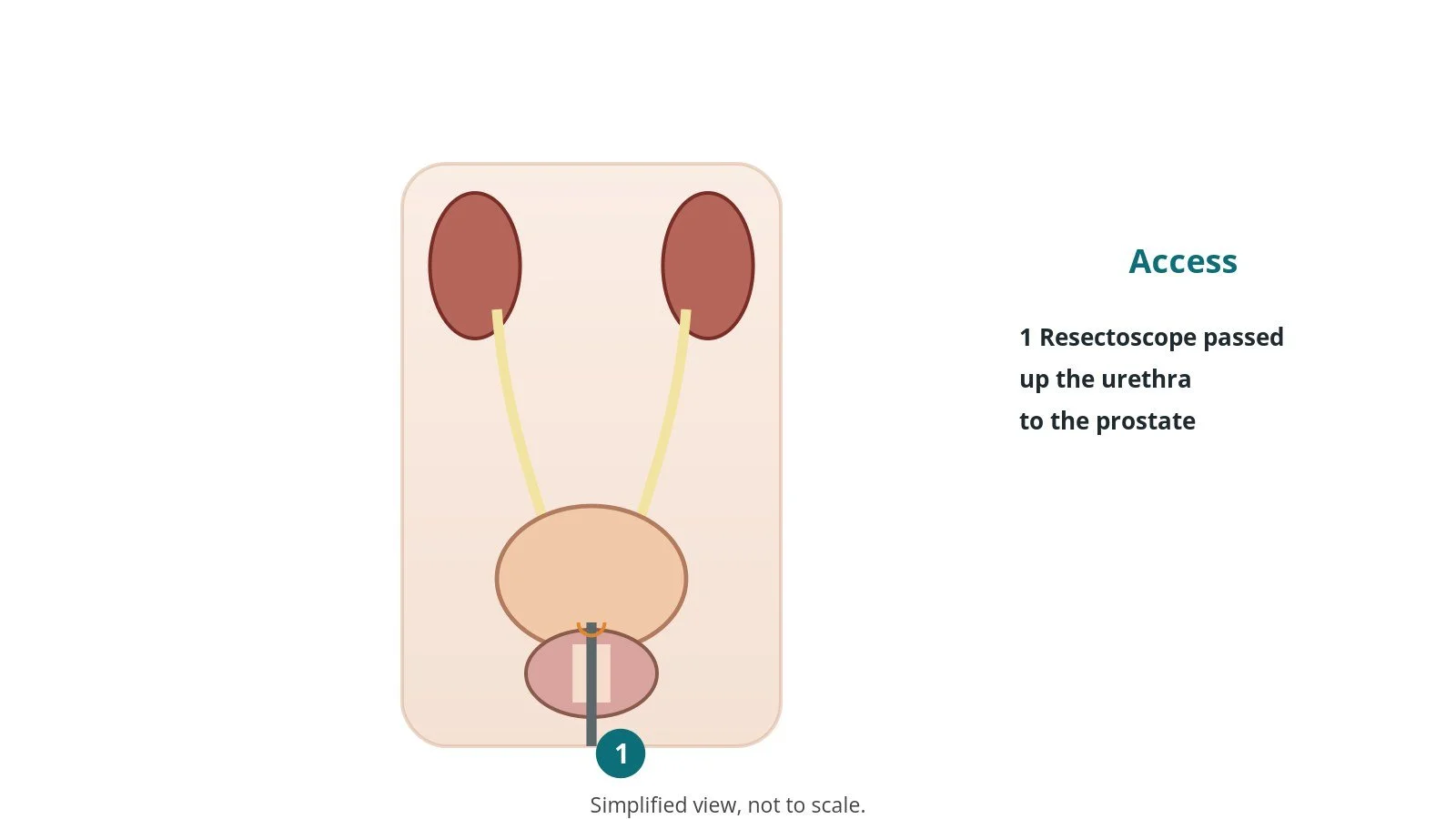
No skin cuts: the resectoscope is passed up the urethra into the bladder.
3. Opening the channel
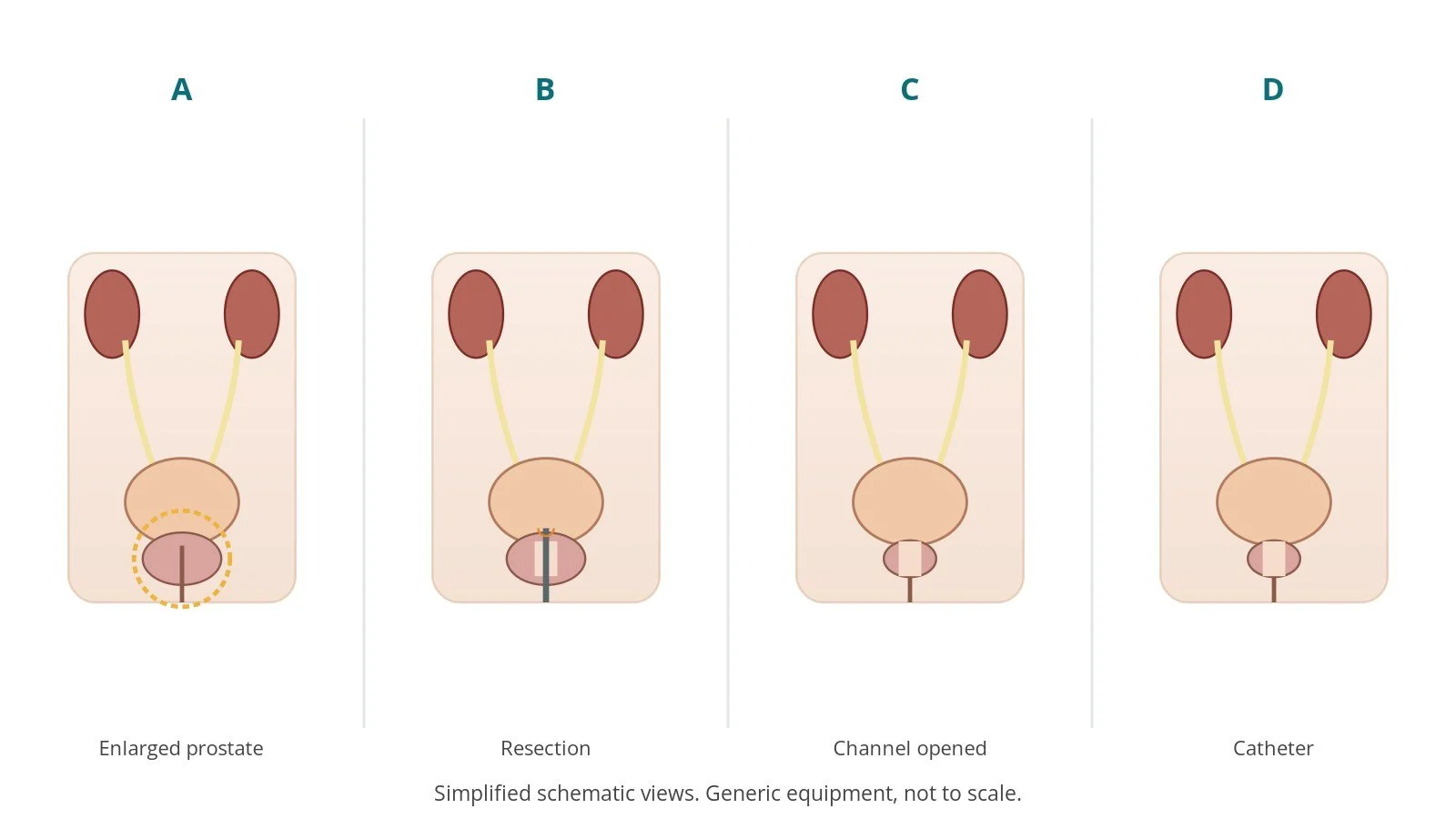
- A. Enlarged prostate. The bladder and prostate are inspected with the scope.
- B. Resection. Prostate tissue is trimmed away in chips with the loop.
- C. Channel opened. Bleeding points are sealed; the chips are washed out.
- D. Catheter. A three-way catheter is placed with bladder irrigation.
The anaesthetist watches for signs of fluid absorption, and the team tracks fluid in and out throughout.
4. Finishing
The chips are collected and sent to the lab. A three-way catheter is placed with continuous bladder irrigation, as per centre protocol. Final counts are confirmed and the patient goes to recovery with a full handover, including fluid balance.
Recovery and aftercare
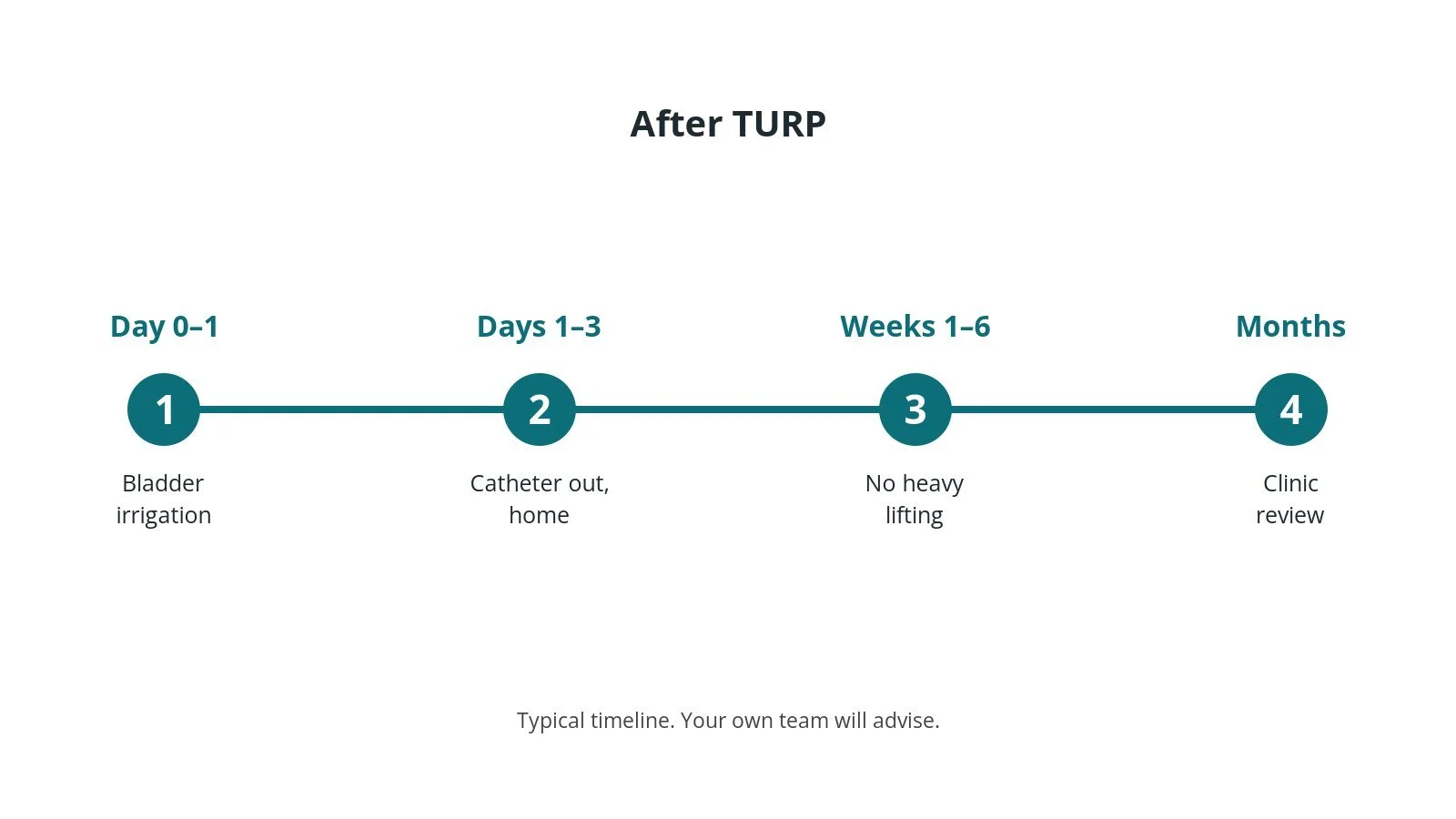
- First day: bladder irrigation through the catheter; some blood in the urine is normal.
- Catheter: usually removed after 1–3 days, then a check that you can pass urine.
- Going home: often 1–3 days.
- Drink plenty: to keep urine flowing.
- Activity: avoid heavy lifting and straining for a few weeks.
- Late bleeding: some blood around 10–14 days can happen; seek help if heavy.
Call 999 if you have chest pain, sudden breathlessness or collapse. Contact your team urgently if you cannot pass urine, pass large clots, have a high temperature or shivering, or have severe pain.
Risks and complications
Your team will explain the risks that apply to you. Possible problems include:
- bleeding, sometimes needing a return to theatre
- urine infection
- retrograde ejaculation (semen goes into the bladder), very common
- erection problems (uncommon)
- incontinence, usually temporary
- urethral narrowing later
- TUR syndrome from fluid absorption (rare)
- not passing urine after catheter removal
Theatre kit list (printable)
Example kit list
Every theatre has its own protocol, and sizes and doses vary.
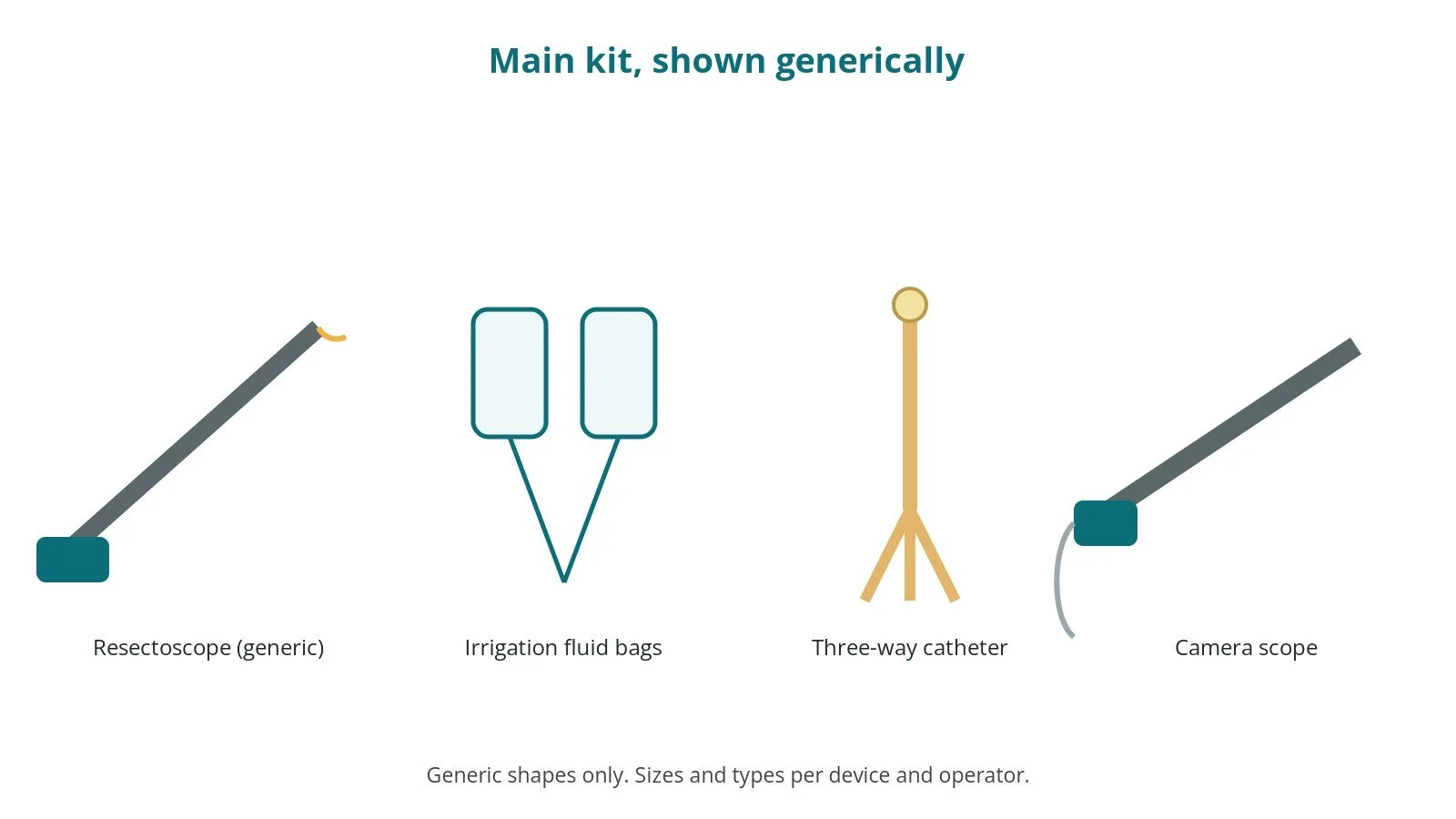
- cystoscopy and resection stack: camera, light source, monitor
- resectoscope with loop electrode, per device and operator
- electrosurgical generator, settings per device and operator
- irrigation fluid and giving set, type per device and operator
- evacuator for chips
- three-way catheter and irrigation, size per centre
- lithotomy stirrups and pressure care
Procedural steps
- Team brief, WHO sign in; irrigation fluid confirmed; anaesthesia
- Lithotomy positioning; prep and drape; count
- Cystoscopy: bladder and prostate inspected
- Resection with loop; fluid in and out tracked
- Haemostasis; chips evacuated and sent
- Three-way catheter and irrigation; counts; sign out and handover
First time in theatre?
💡 First-time tip
- Know your role. Scrub, circulating, anaesthetic and ODP each have their own checks; ask at the team brief.
- Counts matter. Swabs, needles and instruments are counted before, during and at closure; speak up if one is missing.
- Specimens. Label every specimen with site and side, and check it with the scrub practitioner before it leaves theatre.
- Fluid balance. Track irrigation fluid in and out and tell the anaesthetist about large differences, as per centre protocol.
- Camera ready. White-balance and focus the camera, and keep irrigation bags topped up.
FAQ
Will there be cuts?
No; it is done through the urethra.
How long will the catheter stay?
Usually 1–3 days.
Will it affect sex?
Most men have retrograde ejaculation afterwards; ask your team about other effects.
Related guides
Sources
All checked on 14 October 2026. Each page's own date is shown where it gives one.
- NICE. Lower urinary tract symptoms in men: management (CG97). nice.org.uk/guidance/cg97
- NHS. Transurethral resection of the prostate (TURP). nhs.uk/conditions/transurethral-resection-of-the-prostate-turp
- StatPearls (NCBI Bookshelf), search: transurethral resection of the prostate. ncbi.nlm.nih.gov/books
- British Association of Urological Surgeons. Patient information leaflets. baus.org.uk
- World Health Organization. Surgical Safety Checklist. who.int
Disclaimer
Education only. This page is for general education for healthcare students, theatre staff and curious readers. It isn't medical advice and doesn't replace advice from your own doctor, surgical team or local unit protocols. Equipment and medicines are described generically. No product or manufacturer is recommended. If you think someone is having a medical emergency, call 999.
Disclosure: I work in the medical device industry. This page is independent education and isn't sponsored or reviewed by any company.
All diagrams on this page are original illustrations created for rodnieoro.com.