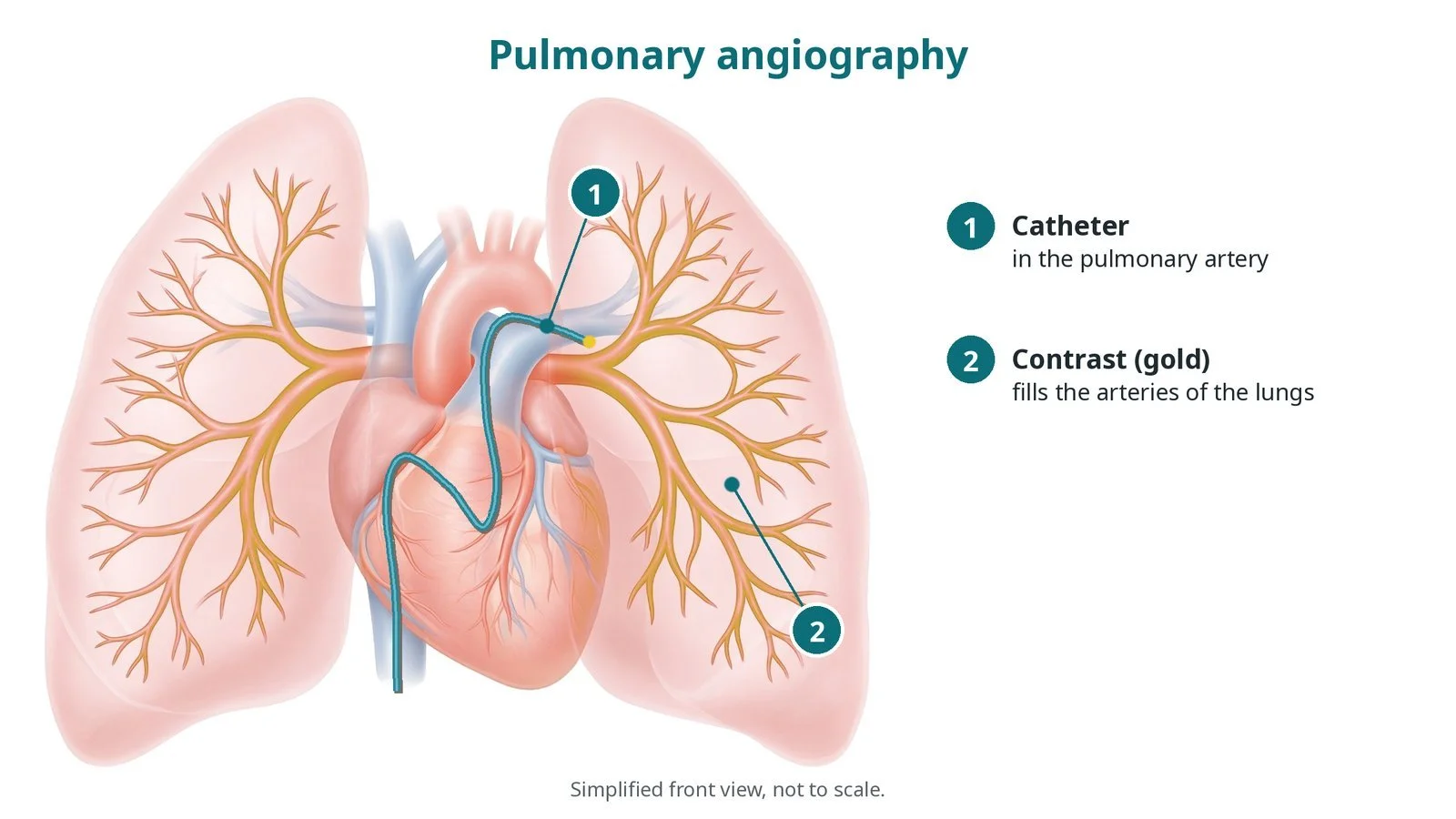
Pulmonary vasoreactivity testing: a Cath Lab 101 guide
Reviewed by Rodnie Oro, cath lab charge nurse · Last reviewed: November 2026 · Education only, not medical advice
Pulmonary vasoreactivity testing in one minute
What it is: A test during a right heart catheter. Pressures in the lung arteries and the heart's output are measured, then measured again while you breathe a gas (usually nitric oxide) that can relax the lung arteries.
Who it is for: People with idiopathic, heritable, or drug- or toxin-induced pulmonary arterial hypertension (PAH), as decided by a pulmonary hypertension (PH) centre.
Main risks: Bleeding or bruising at the vein, heart rhythm disturbance, and rarely breathlessness from fluid on the lungs. Your team will explain your own risk.
Usually: Awake, under local anaesthetic, about 45 to 60 minutes; home the same day for most.
On this page: What is pulmonary vasoreactivity testing? · Who is it for? · When is it done? · Step by step · Recovery · Risks · Kit list · First time in the lab? · FAQ
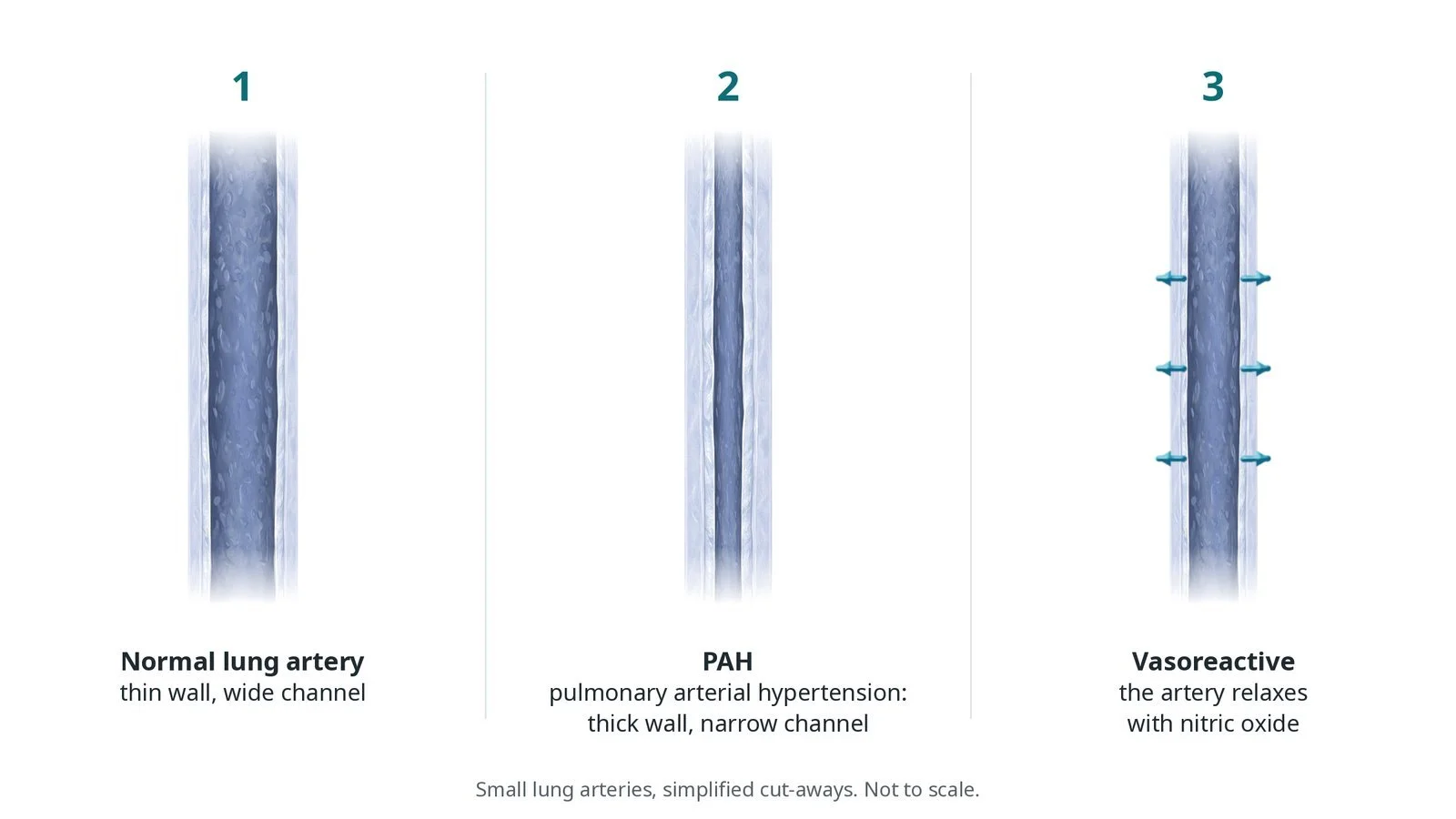
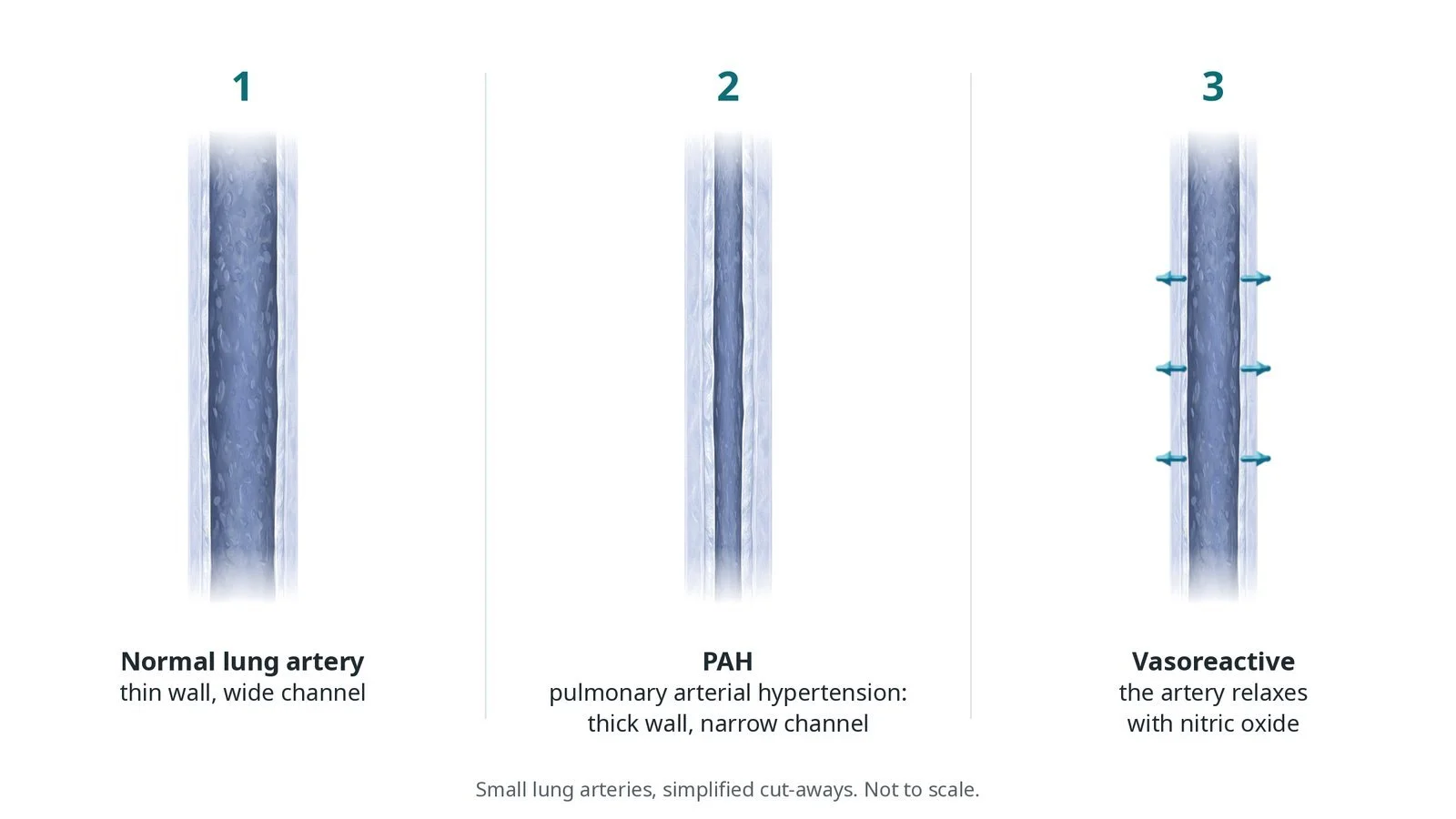
Small lung arteries: (1) a normal artery with a thin wall and wide channel; (2) in pulmonary arterial hypertension the wall thickens and the channel narrows; (3) in a vasoreactive patient the artery relaxes with nitric oxide.
What is pulmonary vasoreactivity testing?
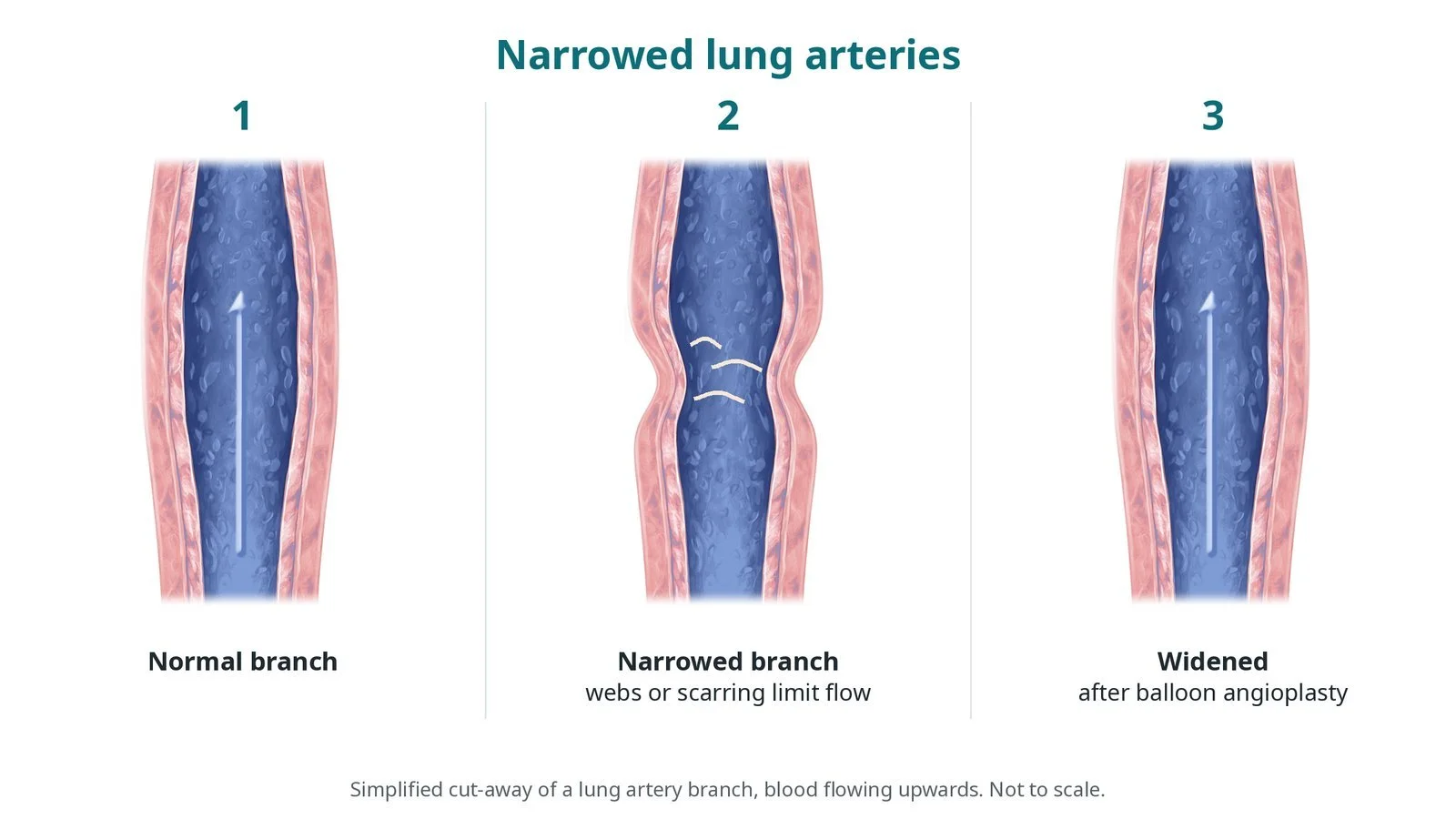
Blood is pumped from the right ventricle through the pulmonary artery to the lungs. In pulmonary arterial hypertension (PAH), the small lung arteries become thick-walled and narrow, so the pressure in them rises and the right ventricle has to work harder.
In a small minority of people with PAH, part of the narrowing is from muscle tightening that can still relax. These people are called vasoreactive. They may do well on high-dose calcium channel blockers, which are not helpful, and can be harmful, in people who are not vasoreactive.
The test measures pressures in the right heart and lung arteries, the wedge pressure and the cardiac output at rest, then repeats them while a short-acting vasodilator is given. Inhaled nitric oxide is the usual choice; other agents are used in some centres. A clear fall in the mean lung artery pressure to a low enough level, with the cardiac output kept up, counts as a response; the exact definition is applied by the PH centre.
New to the acronyms? See the Cath Lab Abbreviations A–Z.
Who is it for?
The 2022 ESC/ERS pulmonary hypertension guideline recommends vasoreactivity testing for people with idiopathic, heritable, or drug- or toxin-induced PAH, to find those who may respond to calcium channel blockers. It is usually done at the diagnostic right heart catheter in a PH centre.
Who it may not suit: It is not used for other types of pulmonary hypertension, such as that caused by left heart disease or lung disease. People with high left-sided filling pressures or suspected pulmonary veno-occlusive disease may develop fluid on the lungs with nitric oxide, so the PH team decides.
The decision is made by your heart team, who will talk through the reasons, the alternatives and the risks with you.
When is it done?
As part of a planned right heart catheter. Before it the team checks blood tests, scans and medicines, and whether any PAH treatment has already started.
gives you a chance to ask questions and give consent
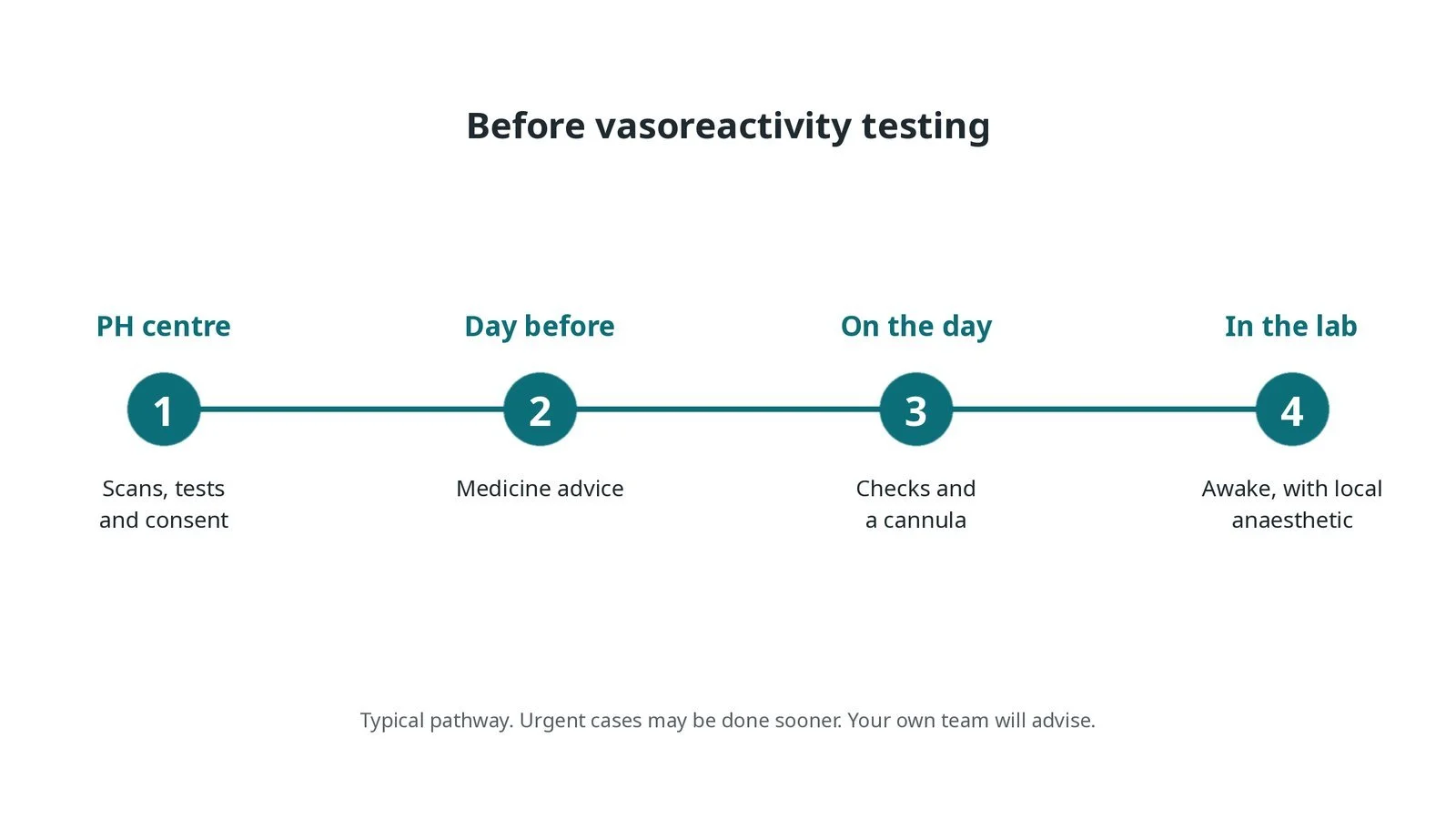
Before vasoreactivity testing: scans, tests and consent at the PH centre; medicine advice; checks and a cannula on the day; awake with local anaesthetic.
Step by step
1. Getting ready
You lie flat with ECG, blood pressure and oxygen monitoring. The transducer is zeroed and levelled with the middle of the chest. The nitric oxide delivery system is checked, as per centre protocol.
2. Access
Under ultrasound and local anaesthetic, a sheath is placed in a vein: the femoral vein in the groin, or a neck or arm vein. A balloon-tipped catheter is floated through the right atrium and right ventricle into the pulmonary artery.
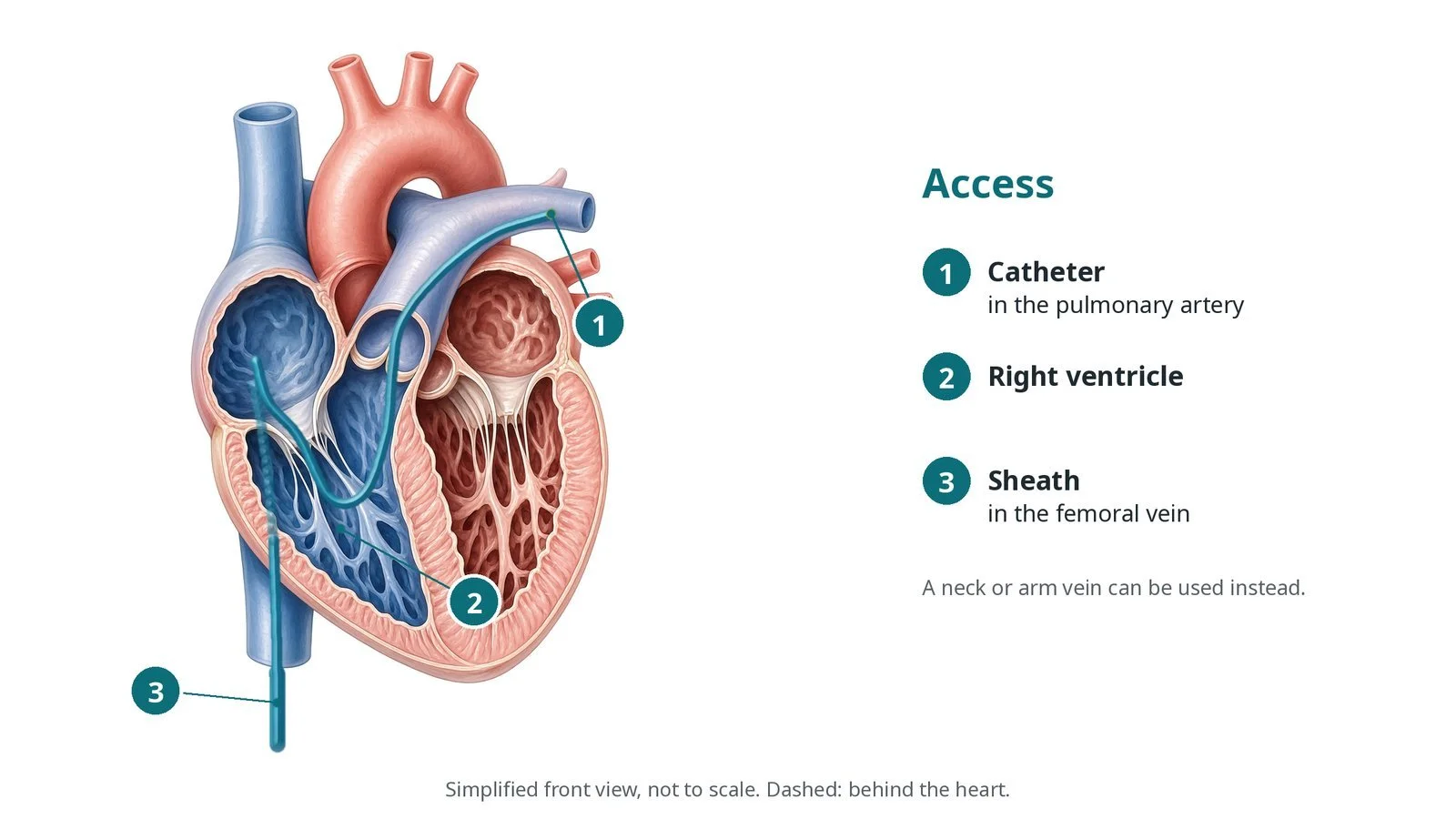
Access: (1) catheter in the pulmonary artery; (2) right ventricle; (3) sheath in the femoral vein. A neck or arm vein can be used instead.
3. Testing
A. Baseline. Pressures are recorded in the right atrium, right ventricle and pulmonary artery, with the wedge pressure. Cardiac output is measured, and blood samples check oxygen levels.
B. Nitric oxide. You breathe nitric oxide through a mask or mouthpiece for a set time, as per centre protocol.
C. Repeat. The same measurements are repeated while it is breathed.
D. Response? The team compares the values. Whether there is a response is decided by the PH centre's definition.
Watch: New breathlessness, falling oxygen levels or crackles during nitric oxide may mean fluid on the lungs. Tell the operator; the gas is usually stopped.
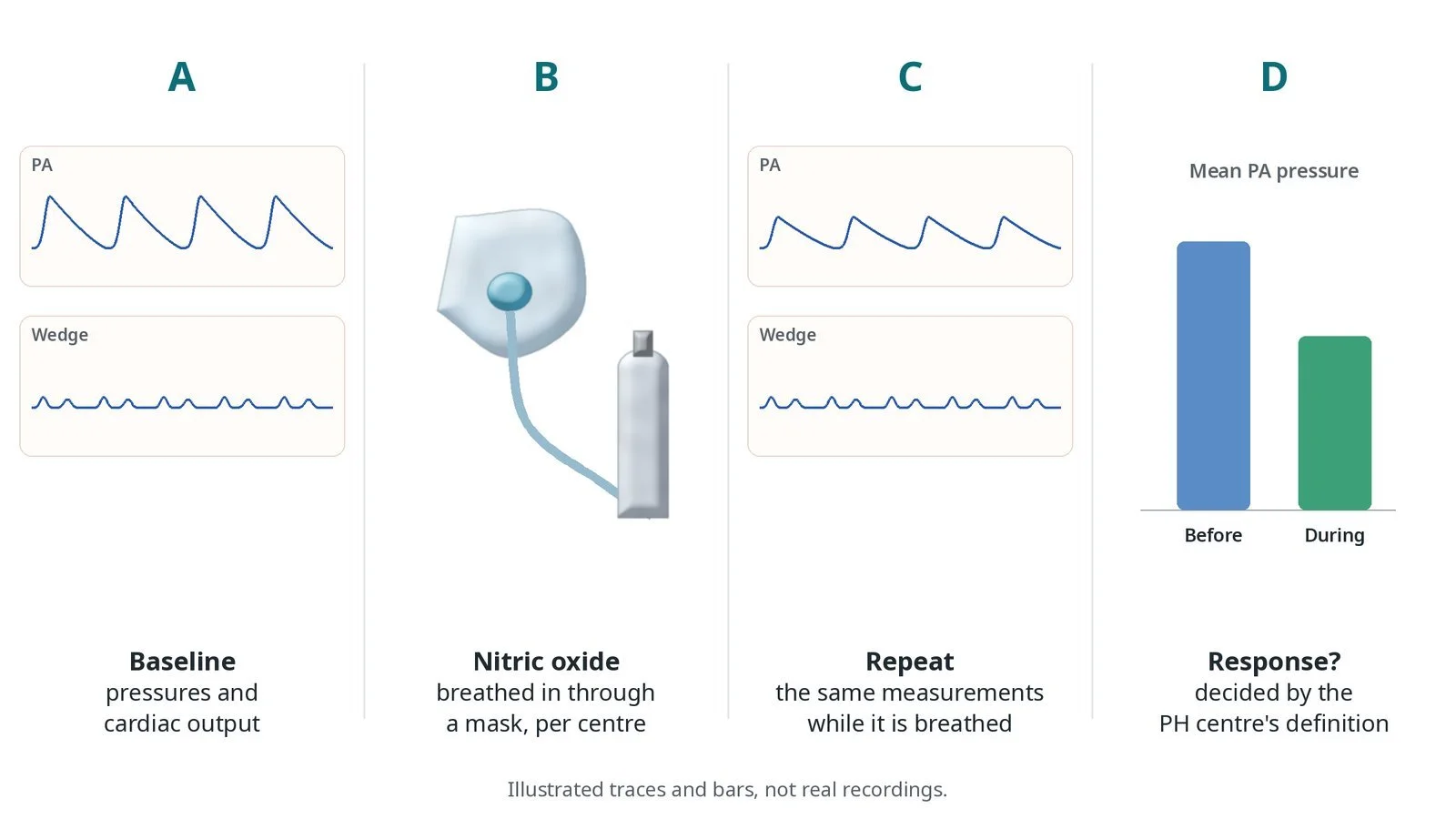
A: baseline pressures and cardiac output. B: nitric oxide breathed in through a mask, per centre protocol. C: the same measurements repeated while it is breathed. D: whether there is a response is decided by the PH centre's definition.
4. Finishing
The nitric oxide is turned off as per protocol. The catheter is removed and pressure applied to the vein until bleeding stops.
5. Results and next steps
The PH team explains what the results mean. Responders may be started on a calcium channel blocker and must be followed closely, because the response does not always last; non-responders are offered other PAH treatments.
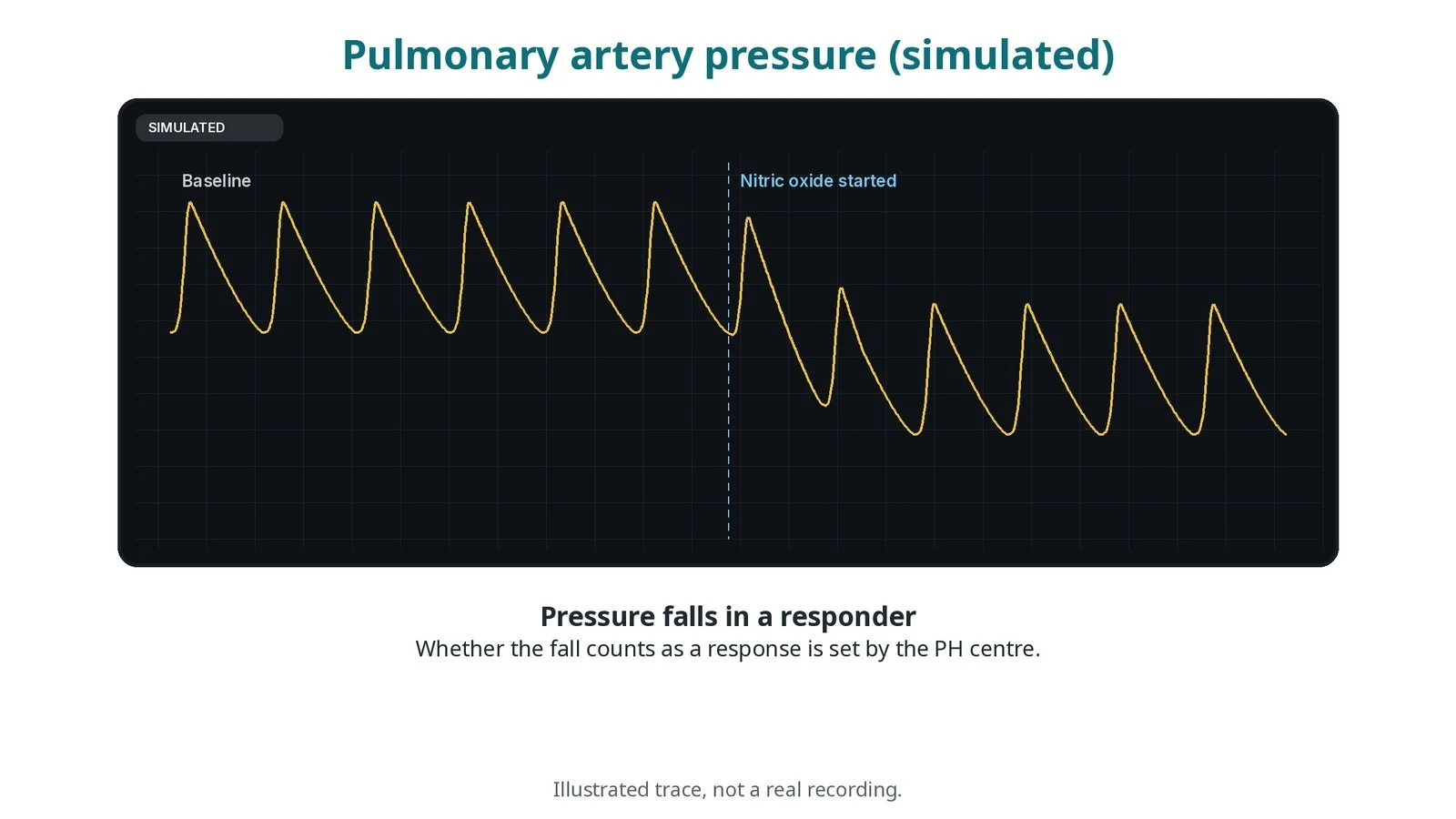
Illustrated trace, not a real recording: pulmonary artery pressure at baseline and after nitric oxide is started. In a responder the pressure falls; the PH centre sets what counts as a response.
Recovery and aftercare
First hours: access site, heart rhythm and blood pressure checks, as per centre protocol.
Going home: the same day for most.
Medicines: do not start or change medicines until the PH team advises.
Results: the PH team explains what the test means for your treatment.
Activity: avoid heavy lifting for a day or two, or as advised.
Follow-up: regular review at the PH centre; responders on calcium channel blockers are rechecked to make sure the response lasts.
Call 999 if you have chest pain, severe breathlessness, fainting or heavy bleeding.
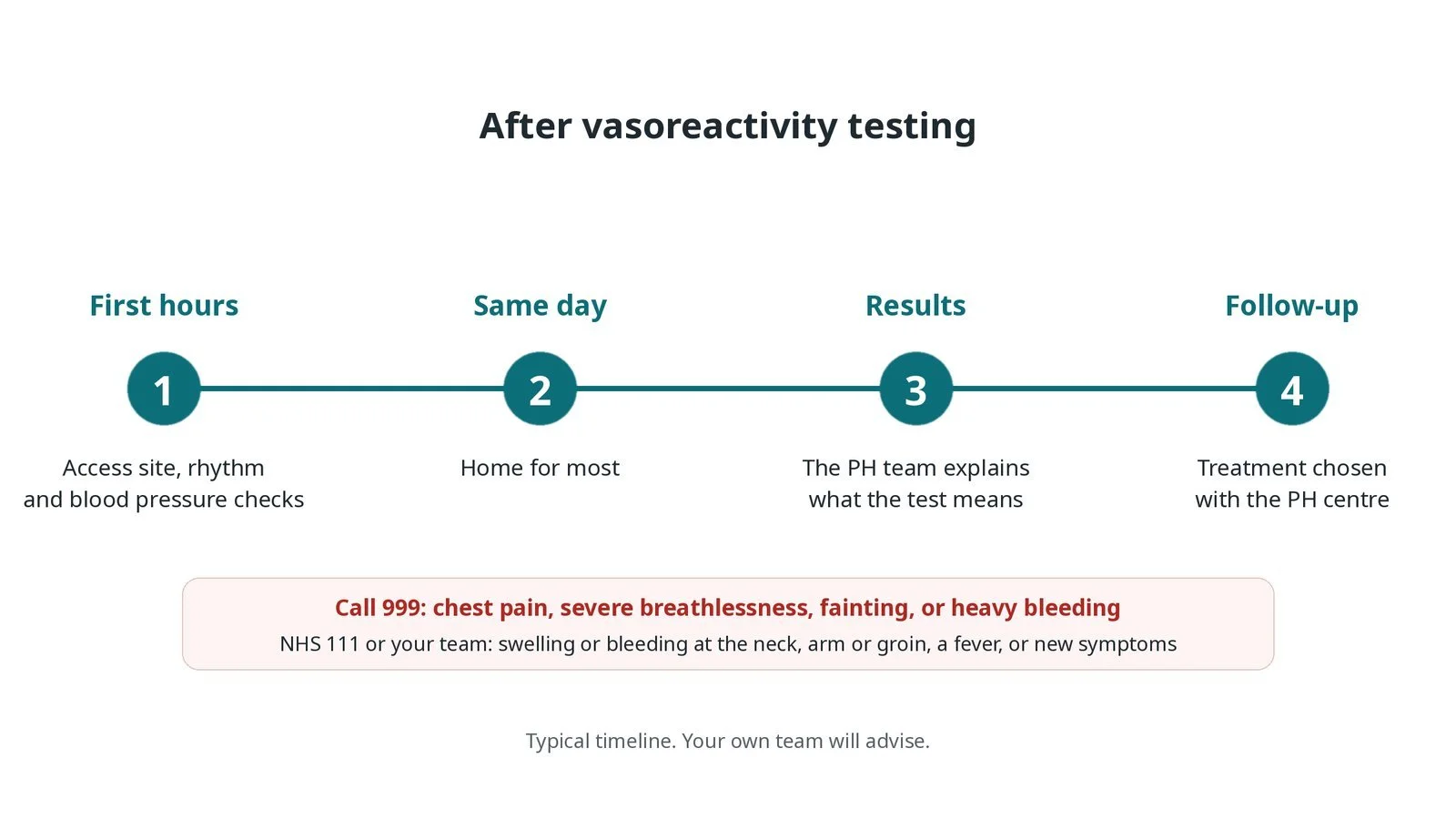
After vasoreactivity testing: (1) access site, rhythm and blood pressure checks; (2) home the same day for most; (3) the PH team explains what the test means; (4) treatment chosen with the PH centre.
Risks and complications
Your team will explain the risks that apply to you. Possible problems include:
Bleeding or bruising at the vein
Heart rhythm disturbance as the catheter passes (uncommon): Usually brief.
Fluid on the lungs during nitric oxide (rare)
Puncture of an artery during vein access (uncommon)
Lung artery injury from the balloon (rare)
Cath lab kit list (printable)
Barts example kit list
An example from one UK centre, written generically. Every lab has its own protocol, and sizes and doses vary.
ultrasound with a sterile probe cover
venous sheath, size per operator
balloon-tipped pulmonary artery catheter, per operator
pressure transducers, zeroed and levelled
cardiac output equipment (thermodilution or Fick), per centre
blood gas syringes for oxygen samples
nitric oxide delivery system with nitrogen dioxide monitoring and scavenging, per centre
mask or mouthpiece and tubing
emergency drugs and oxygen
Procedural steps (Barts example)
Getting ready
Access
Testing
Finishing
Results and next steps
First time in the cath lab?
Know your gas system. Nitric oxide needs a checked delivery system, monitoring and scavenging; learn your centre's checklist.
Zero and level every time. Small errors in the transducer level make a big difference to low pressures.
Label every reading. Baseline and test values look similar; time-stamp each one.
Watch for breathlessness. Fluid on the lungs is rare but serious during nitric oxide.
Check the nitric oxide cylinder, regulator, monitoring of nitrogen dioxide and the gas scavenging before the patient arrives.
Record each set of measurements with the time and what was being given, so baseline and test values are not mixed up.
Measure the wedge pressure and pulmonary artery pressure at end-expiration, as per centre protocol.
FAQ
Why test rather than just try a tablet?
Calcium channel blockers only help the small number who respond and can be harmful in others, so the test comes first.
What does nitric oxide feel like?
Most people feel nothing; it is breathed through a mask for a short time.
How many people respond?
Only a minority of people with PAH.
Will I need more tests?
Yes. PAH is followed closely at the PH centre, and responders are checked again on treatment.
Related Cath Lab 101 guides
Exercise and fluid-challenge right heart catheterisation (coming soon)
CardioMEMS pulmonary artery pressure sensor (coming soon)
Sources
All checked on 12 November 2026. Each page's own date is shown where it gives one.
Humbert M, et al. 2022 ESC/ERS Guidelines for the diagnosis and treatment of pulmonary hypertension. Eur Heart J 2022
StatPearls (NCBI Bookshelf), search: pulmonary arterial hypertension. ncbi.nlm.nih.gov/books
StatPearls (NCBI Bookshelf), search: right heart catheterization. ncbi.nlm.nih.gov/books
Disclaimer
Education only. This page is for general education for healthcare students, cath lab staff and curious readers. It isn't medical advice and doesn't replace advice from your own doctor, heart team or local unit protocols. Equipment and medicines are described generically. No product or manufacturer is recommended. If you think someone is having a heart emergency, call 999.
Disclosure: I work in the medical device industry. This page is independent education and isn't sponsored or reviewed by any company.
All diagrams on this page are original illustrations created for rodnieoro.com.