Cerebral embolic protection during TAVI: a Cath Lab 101 guide
Reviewed by Rodnie Oro, cath lab charge nurse · Last reviewed: November 2026 · Education only, not medical advice
Cerebral embolic protection during TAVI in one minute
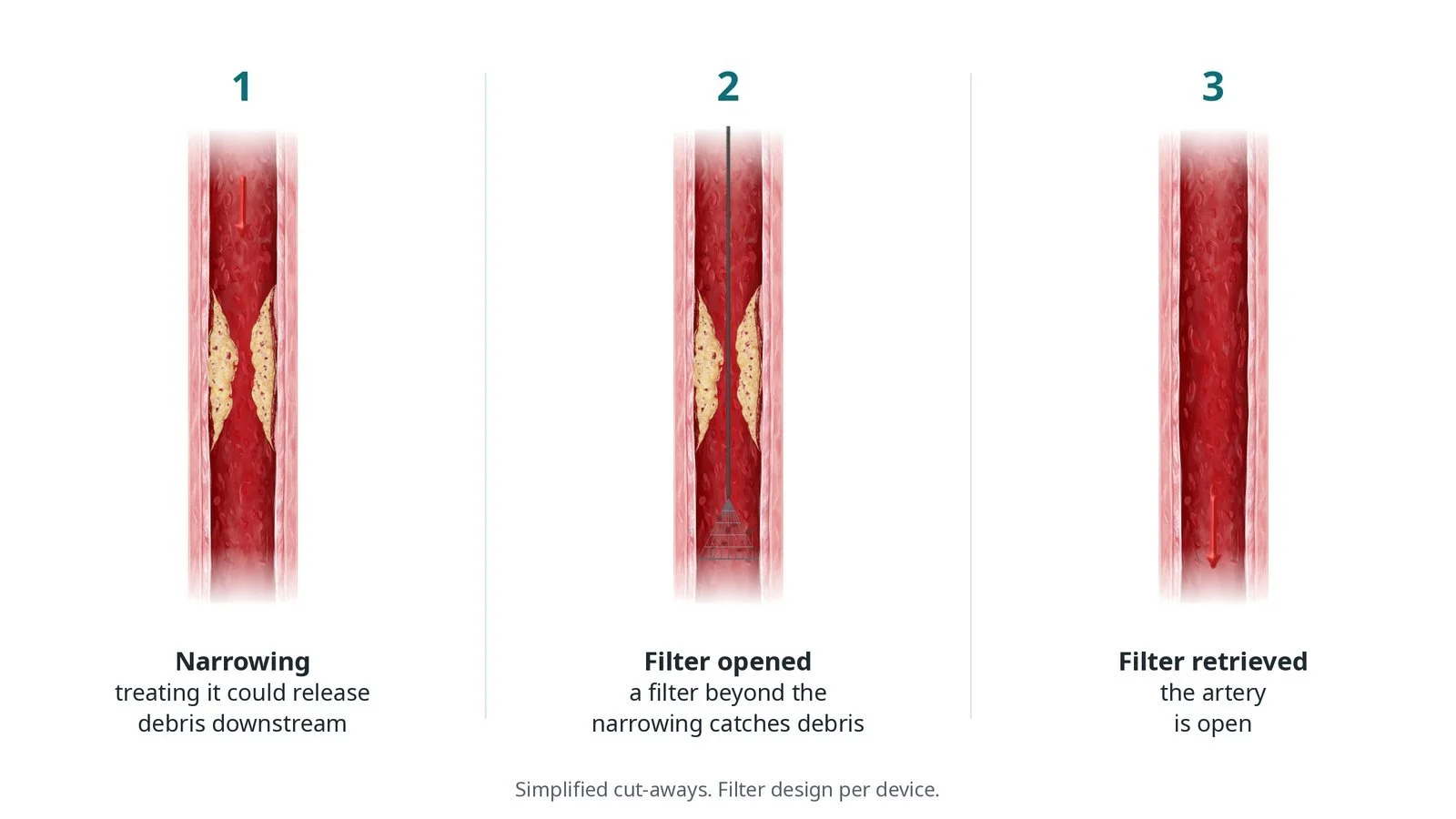
What it is: During TAVI, small pieces of calcium and tissue can break off and travel to the brain. A dual-filter device, placed through the right radial artery, sits in the brachiocephalic and left common carotid arteries to catch them, and is removed at the end.
Who it is for: Selected people having TAVI, chosen by the heart team. The BHF PROTECT-TAVI trial (7,635 patients, 2025) found no reduction in stroke at 72 hours, so routine use is not recommended.
Main risks: Bleeding or a blocked artery at the wrist, damage to the arteries of the arch or neck, and a slightly longer procedure. Your team will explain your own risk.
Usually: Added at the start of a TAVI; it takes a few extra minutes and does not change how long you stay.
On this page: What is cerebral embolic protection during TAVI? · Who is it for? · When is it done? · Step by step · Recovery · Risks · Kit list · First time in the lab? · FAQ
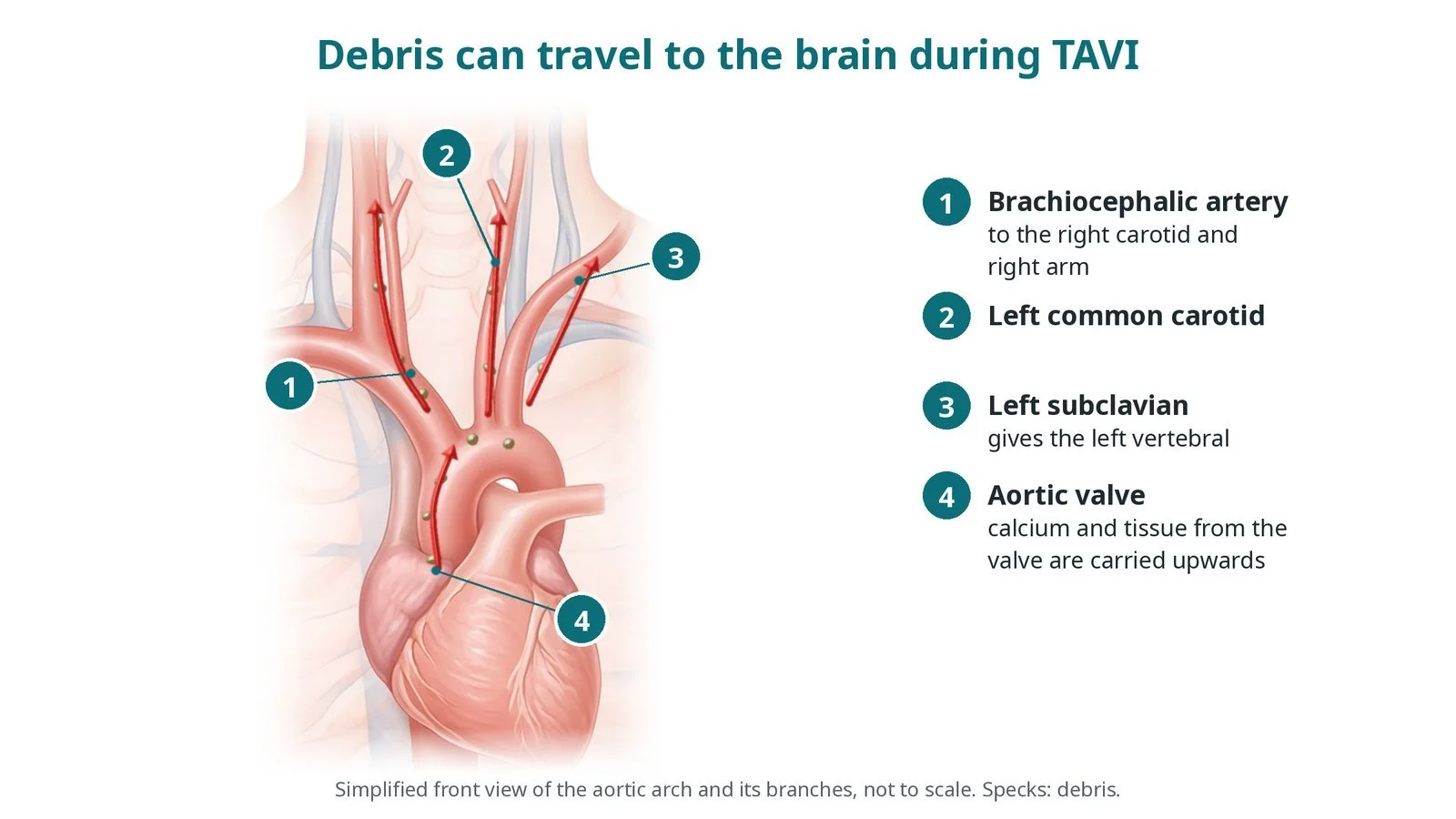
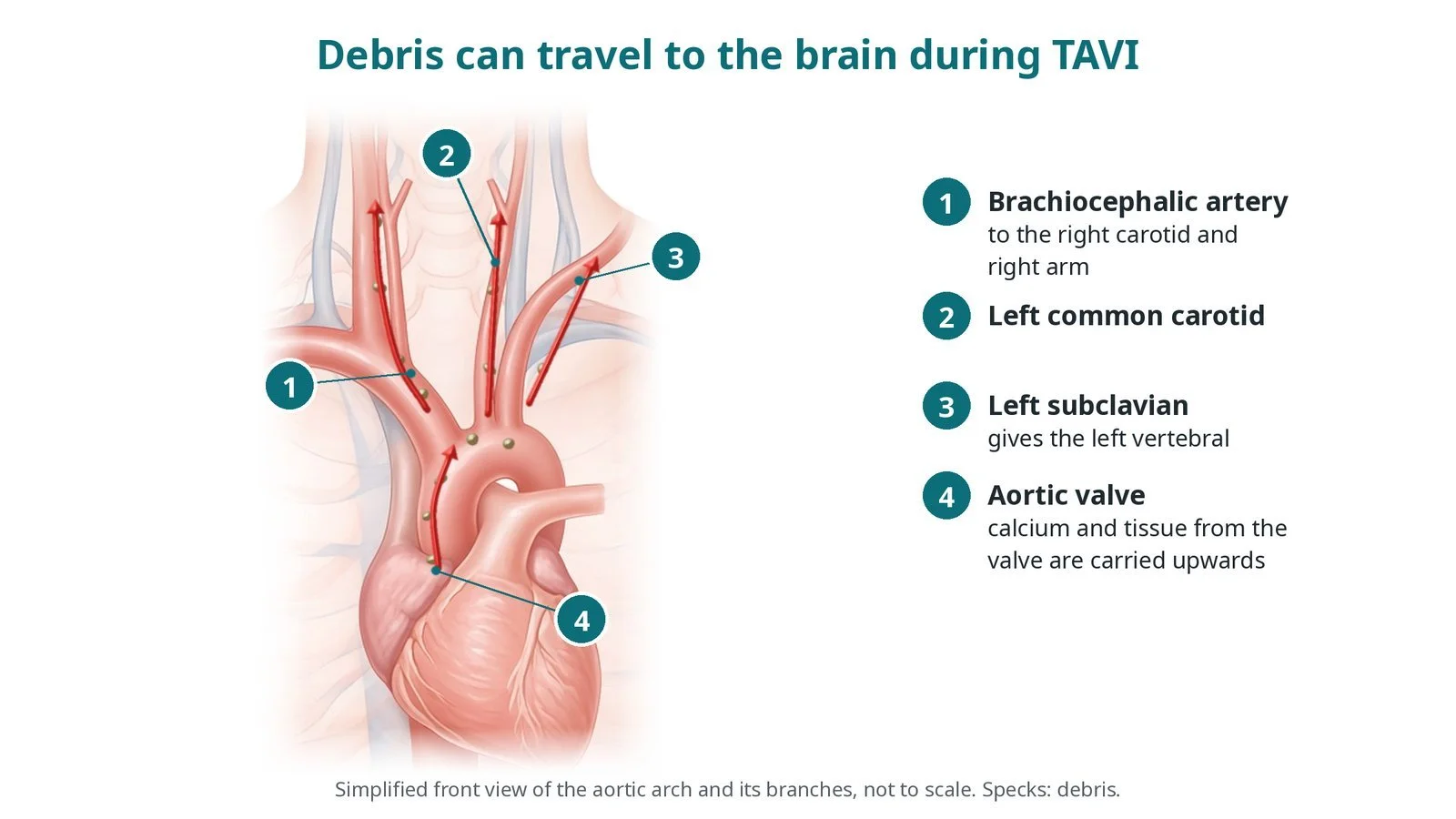
Debris from the aortic valve can travel to the brain during TAVI: (1) brachiocephalic artery; (2) left common carotid; (3) left subclavian, which gives the left vertebral; (4) aortic valve.
What is cerebral embolic protection during TAVI?
Three large arteries leave the top of the aortic arch. The brachiocephalic artery divides into the right subclavian and right common carotid arteries (the right vertebral comes off the subclavian). Next is the left common carotid, then the left subclavian, which gives off the left vertebral artery.
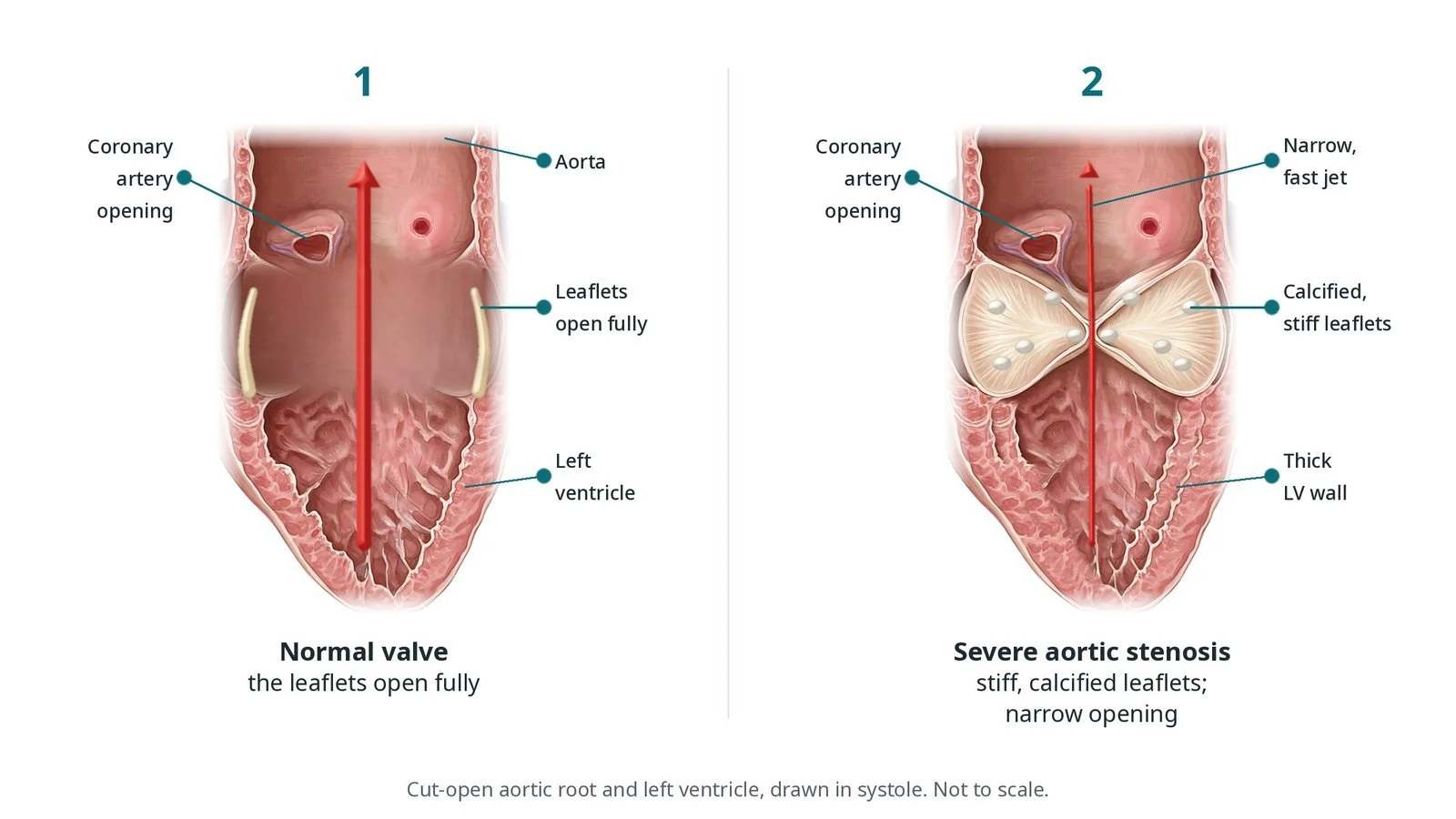
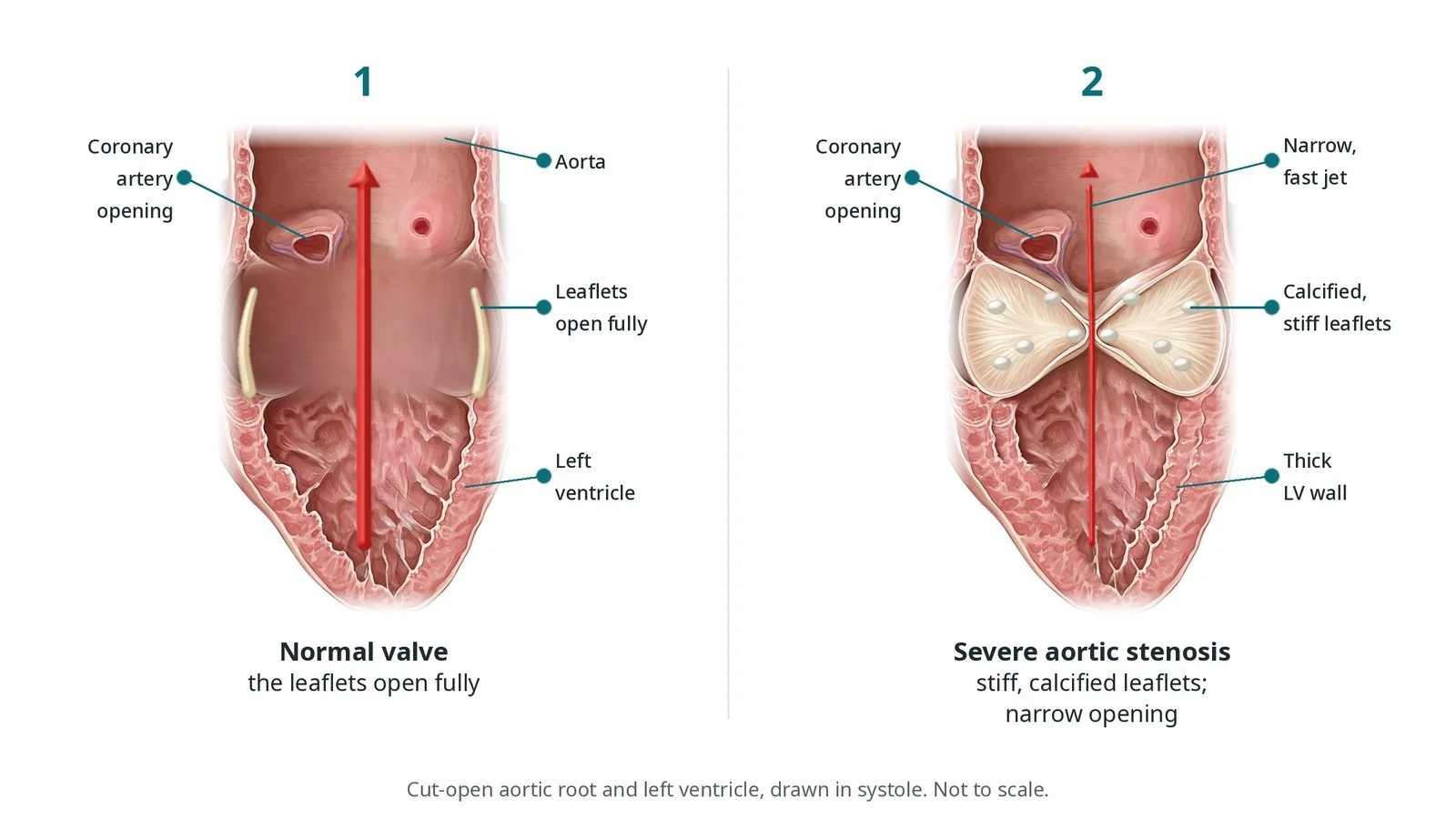
When the TAVI catheter crosses the valve and the new valve pushes the calcified leaflets aside, debris can be released. Brain scans after TAVI often show small new spots, although most cause no symptoms. A stroke after TAVI is uncommon but serious.
The most widely used system has two filters on one catheter from the right wrist: a proximal filter in the brachiocephalic artery and a distal filter in the left common carotid. The left vertebral artery is not covered. Filters often contain debris at the end, but in BHF PROTECT-TAVI this did not translate into fewer strokes overall.
New to the acronyms? See the Cath Lab Abbreviations A–Z.
Who is it for?
The heart team may consider it case by case, for example when they judge the risk of debris to be high. It needs:
a right radial and arm artery large enough for the sheath
suitable arch and neck arteries on CT
no severe narrowing of the brachiocephalic or left carotid arteries
Who it may not suit: People with small or diseased arm arteries, a difficult arch, or severe carotid disease. After BHF PROTECT-TAVI, it is not used routinely for everyone.
The decision is made by your heart team, who will talk through the reasons, the alternatives and the risks with you.
When is it done?
At the start of TAVI, before the valve is crossed, and removed at the end.
gives you a chance to ask questions and give consent
arranges blood tests, including kidney function and a blood count, and an ECG
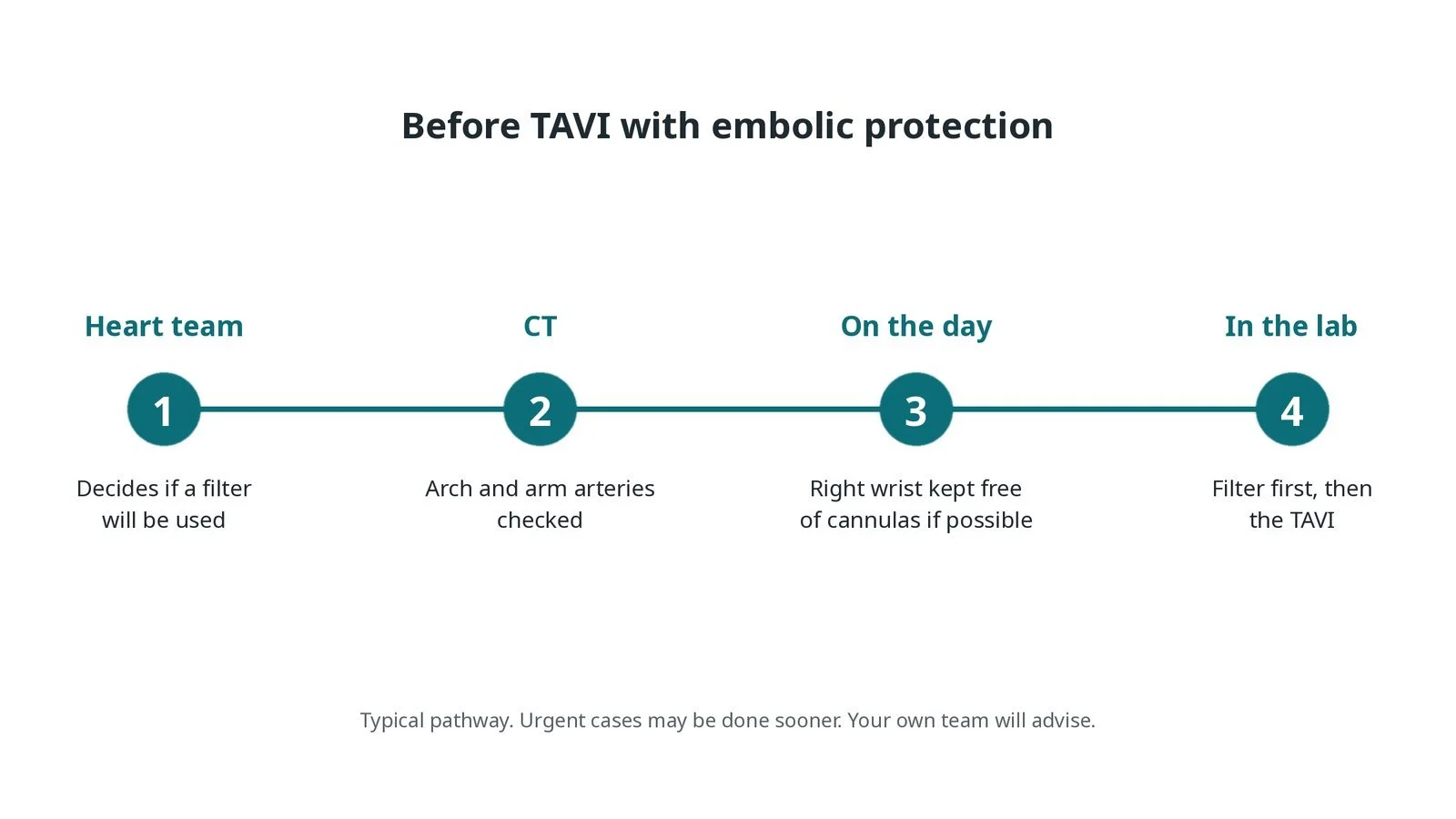
Before TAVI with embolic protection: the heart team decides if a filter will be used; CT checks the arch and arm arteries; the right wrist is kept free of cannulas; filter first, then the TAVI.
Step by step
1. Getting ready
The right wrist is prepared as well as the groins. If possible the right radial artery has not been used for cannulas or blood gases on the day.
2. Access
A sheath is placed in the right radial artery under local anaesthetic. Sizes are per device and operator. Heparin is given as per centre protocol, usually before the filters are deployed.
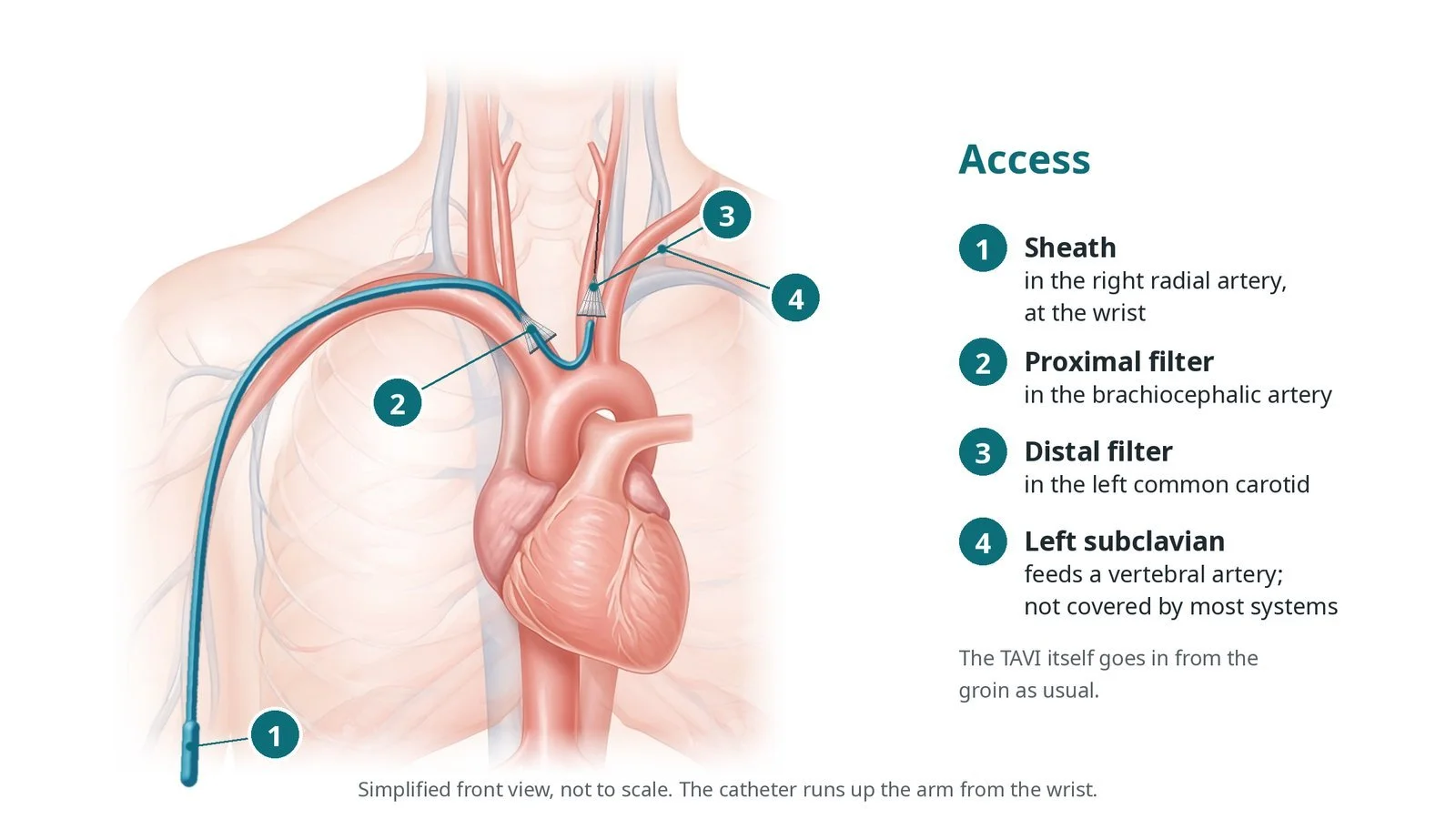
Access: (1) sheath in the right radial artery; (2) proximal filter in the brachiocephalic artery; (3) distal filter in the left common carotid; (4) the left subclavian, not covered by most systems.
3. Placing the filters
A. Catheter. The filter catheter goes up the arm into the brachiocephalic artery.
B. Proximal filter. The first filter is opened in the brachiocephalic artery.
C. Distal filter. The articulating tip is steered into the left common carotid and the second filter is opened.
D. After the TAVI. When the valve is in, both filters are closed back into the catheter and removed, often with debris inside.
Watch: New weakness, speech change or confusion in a sedated patient: possible stroke. Tell the operator straight away; the stroke pathway may be needed.
4. The TAVI
The TAVI then goes ahead from the groin as usual, with the filters in place.
5. Finishing
The radial sheath is removed and a compression band applied, as per centre protocol. Hand circulation is checked.
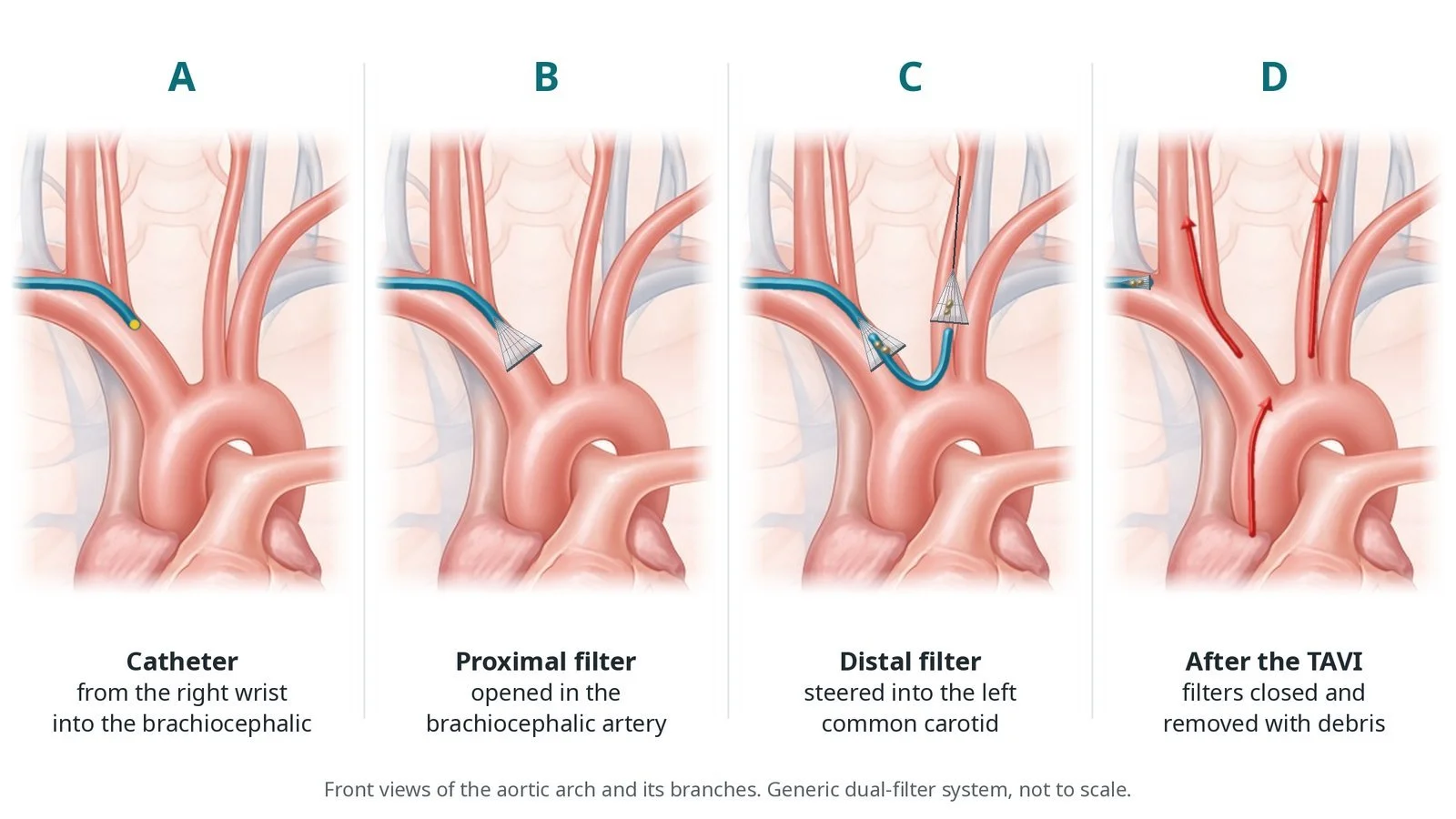
A: catheter from the right wrist into the brachiocephalic artery. B: proximal filter opened. C: distal filter steered into the left common carotid. D: after the TAVI, filters closed and removed.
Recovery and aftercare
First hours: checks of the wrist, hand, groin, heart rhythm, blood pressure and stroke signs, as per centre protocol.
Going home: after 1 to 3 days for most, as for TAVI.
Wrist: keep the band on as advised; avoid heavy use of the hand for a few days.
Medicines: blood thinners as your TAVI team advises.
Driving: as advised after TAVI, usually not for at least a week; check DVLA rules.
Follow-up: TAVI clinic and echo.
Call 999 if you notice face drooping, arm weakness or speech problems, or have chest pain or heavy bleeding.
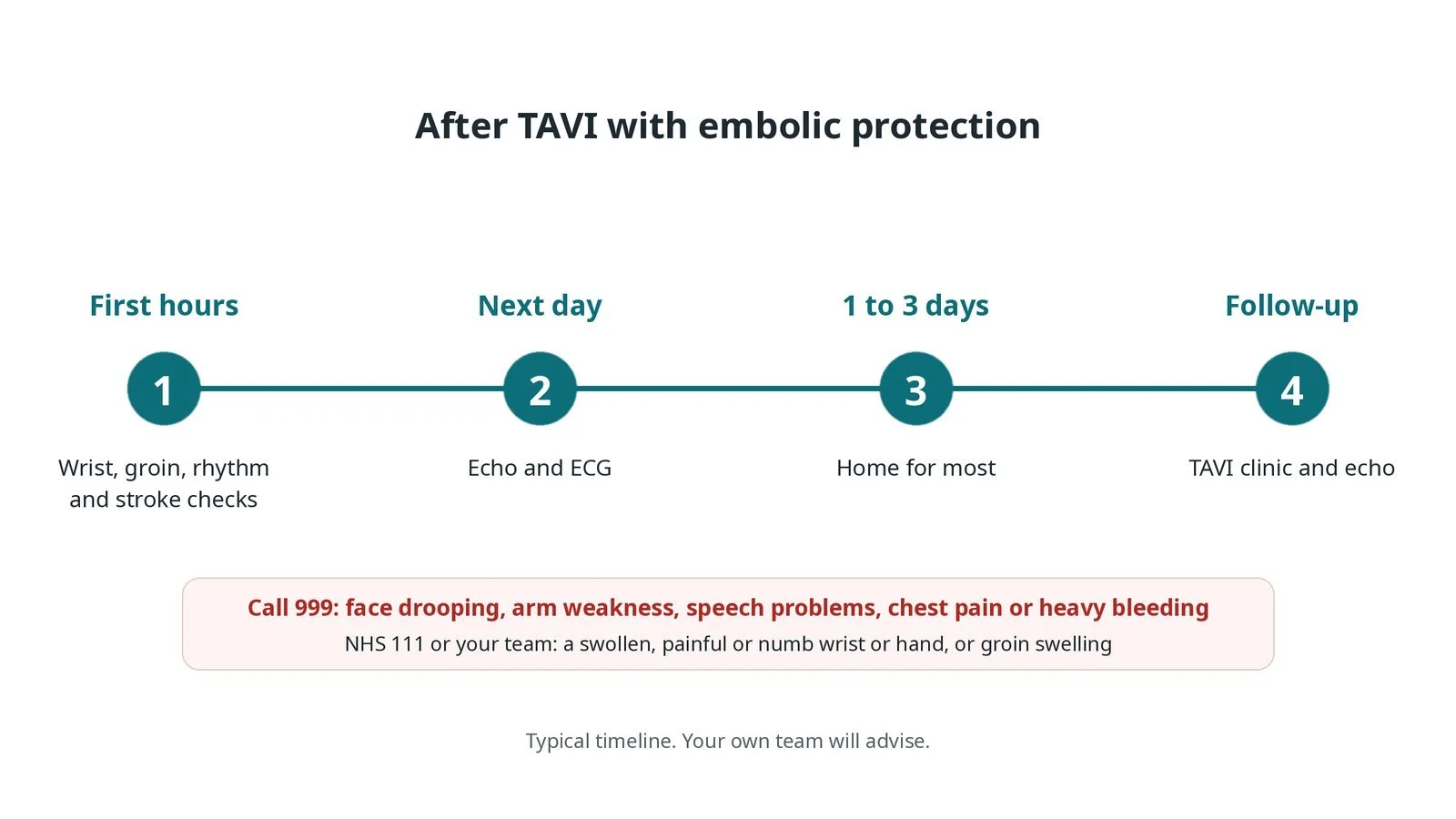
After TAVI with embolic protection: (1) wrist, groin, rhythm and stroke checks; (2) echo and ECG the next day; (3) home for most in 1 to 3 days; (4) TAVI clinic and echo.
Risks and complications
Your team will explain the risks that apply to you. Possible problems include:
Bleeding, bruising or a blocked artery at the wrist
Damage to the arteries of the arch or neck (rare)
Stroke, which filters do not reliably prevent
Slightly longer procedure and more contrast
Filter not able to be placed because of anatomy (uncommon)
Cath lab kit list (printable)
Barts example kit list
An example from one UK centre, written generically. Every lab has its own protocol, and sizes and doses vary.
radial artery sheath, size per device
dual-filter cerebral embolic protection system, per device
guidewire, per operator
contrast and syringes
heparin and local anaesthetic, as per centre protocol
radial compression band
full TAVI kit as usual
stroke assessment pathway details
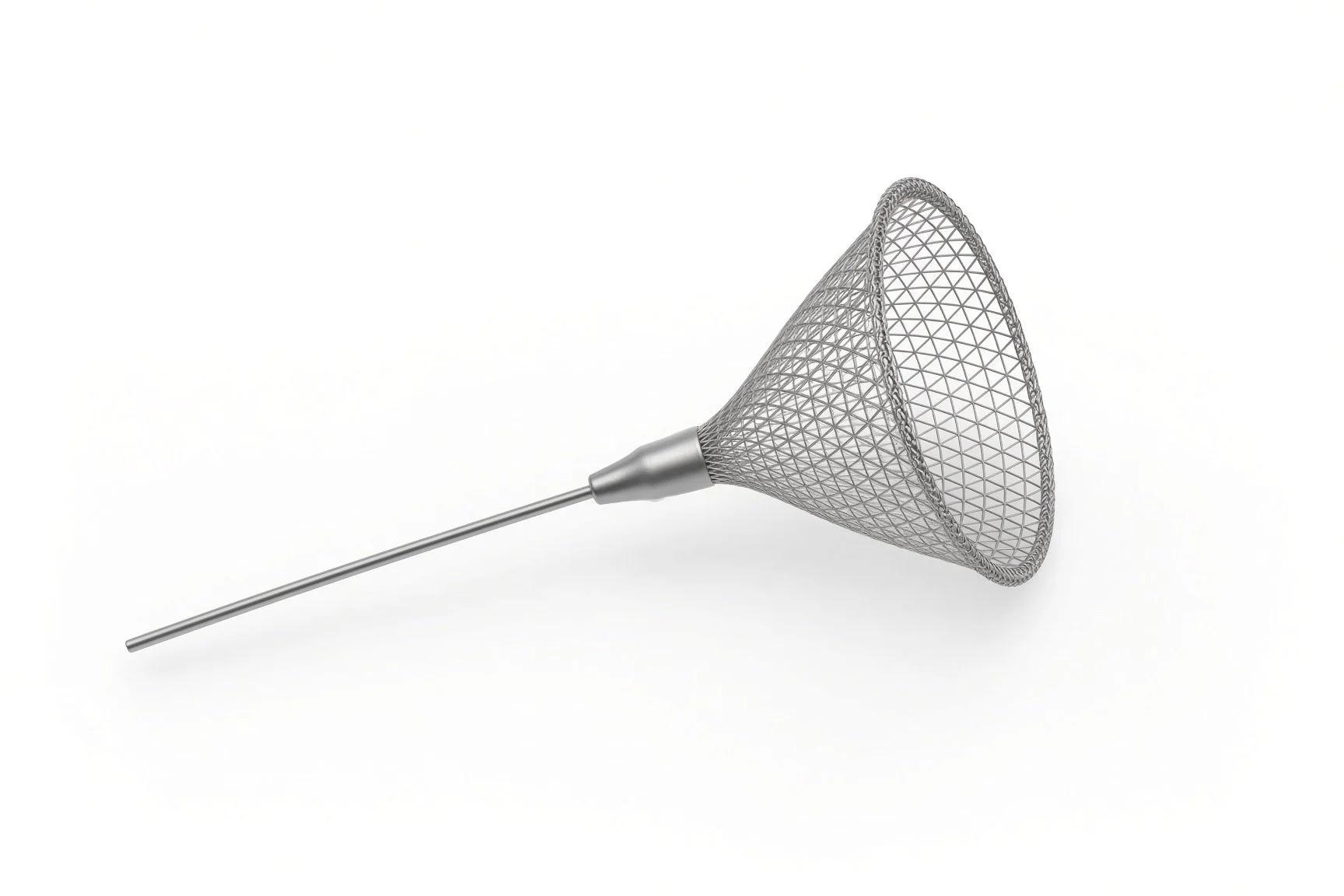
Dual-filter protection system.
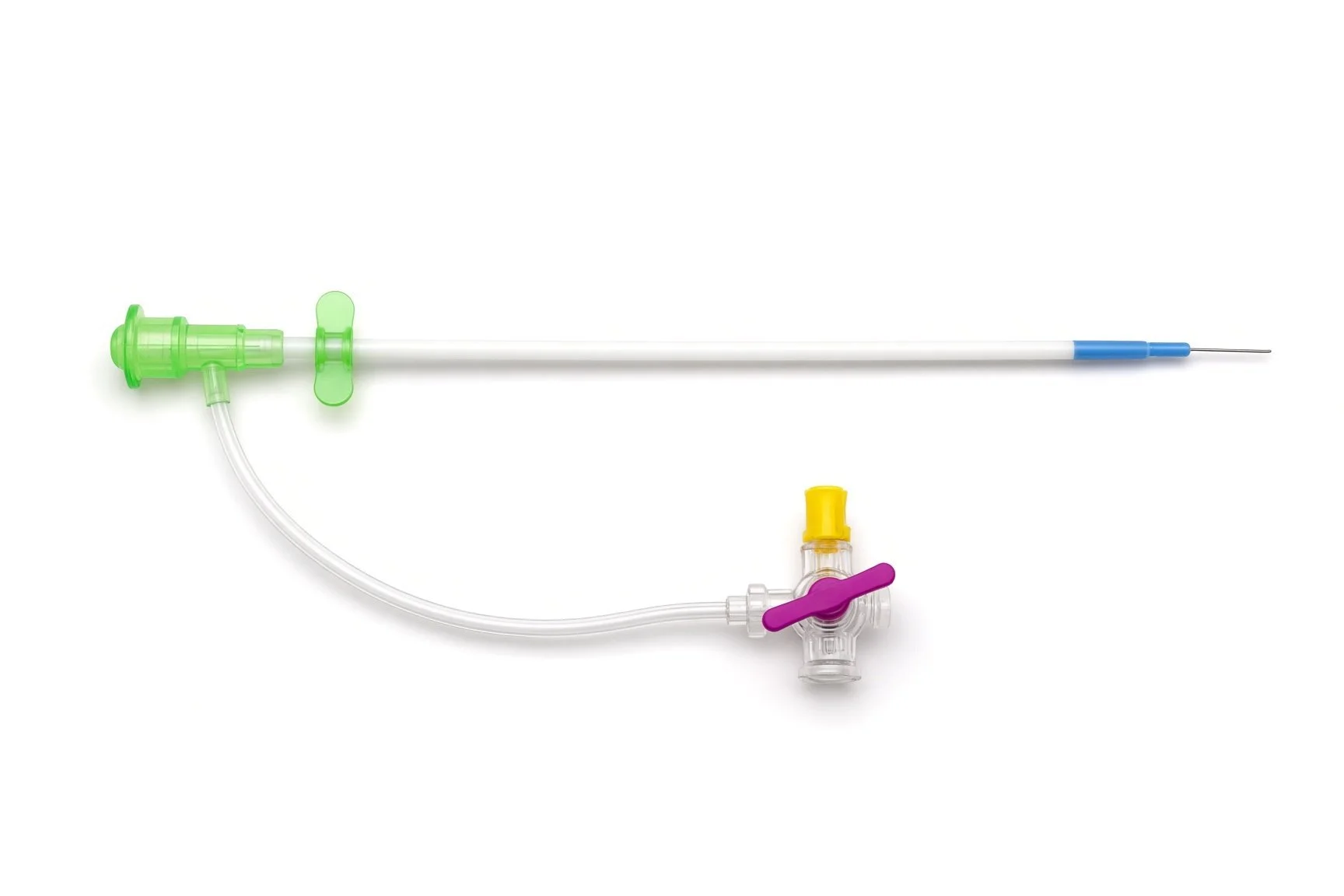
Radial artery sheath.
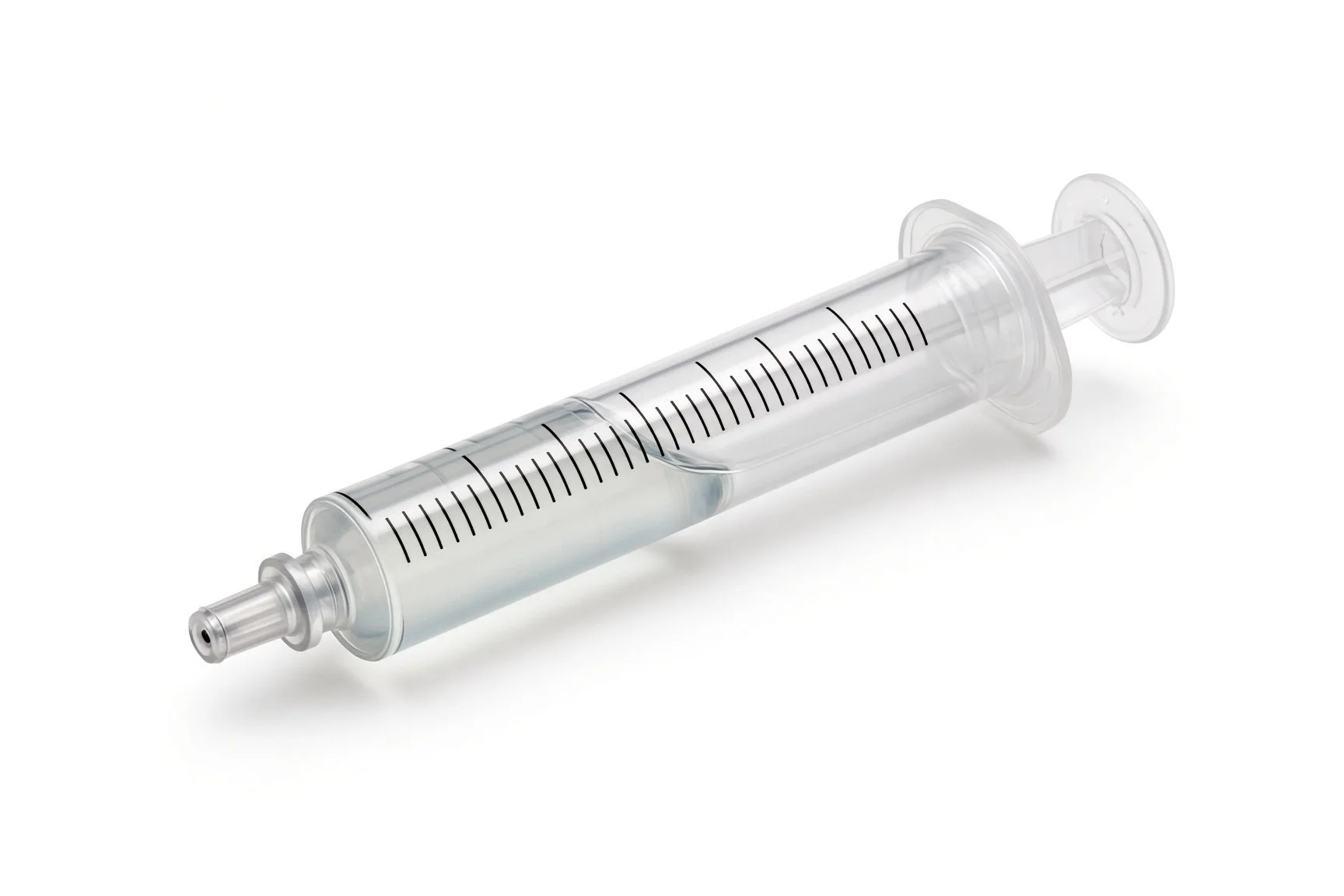
Contrast syringe.
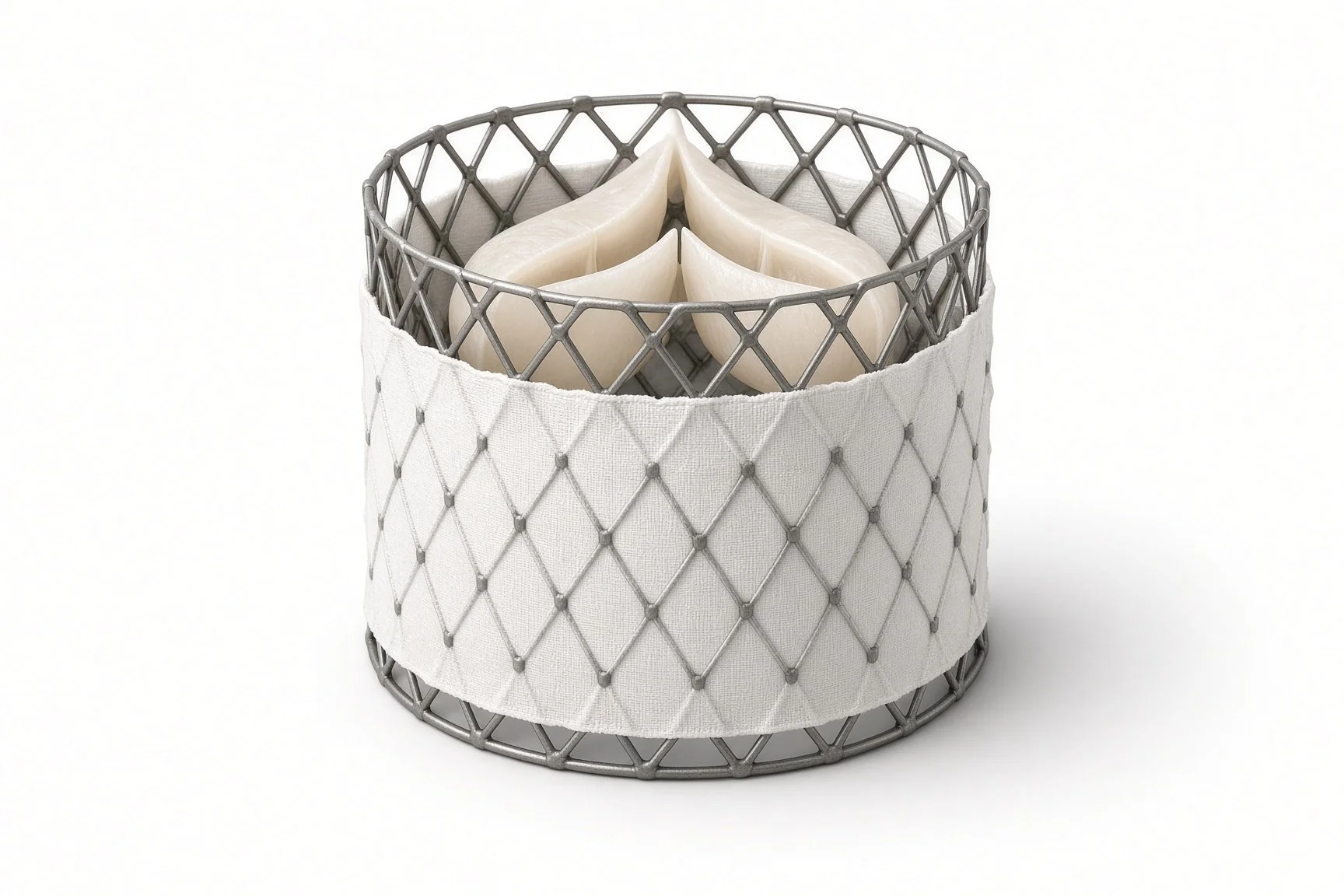
TAVI kit as usual.
Contrast.
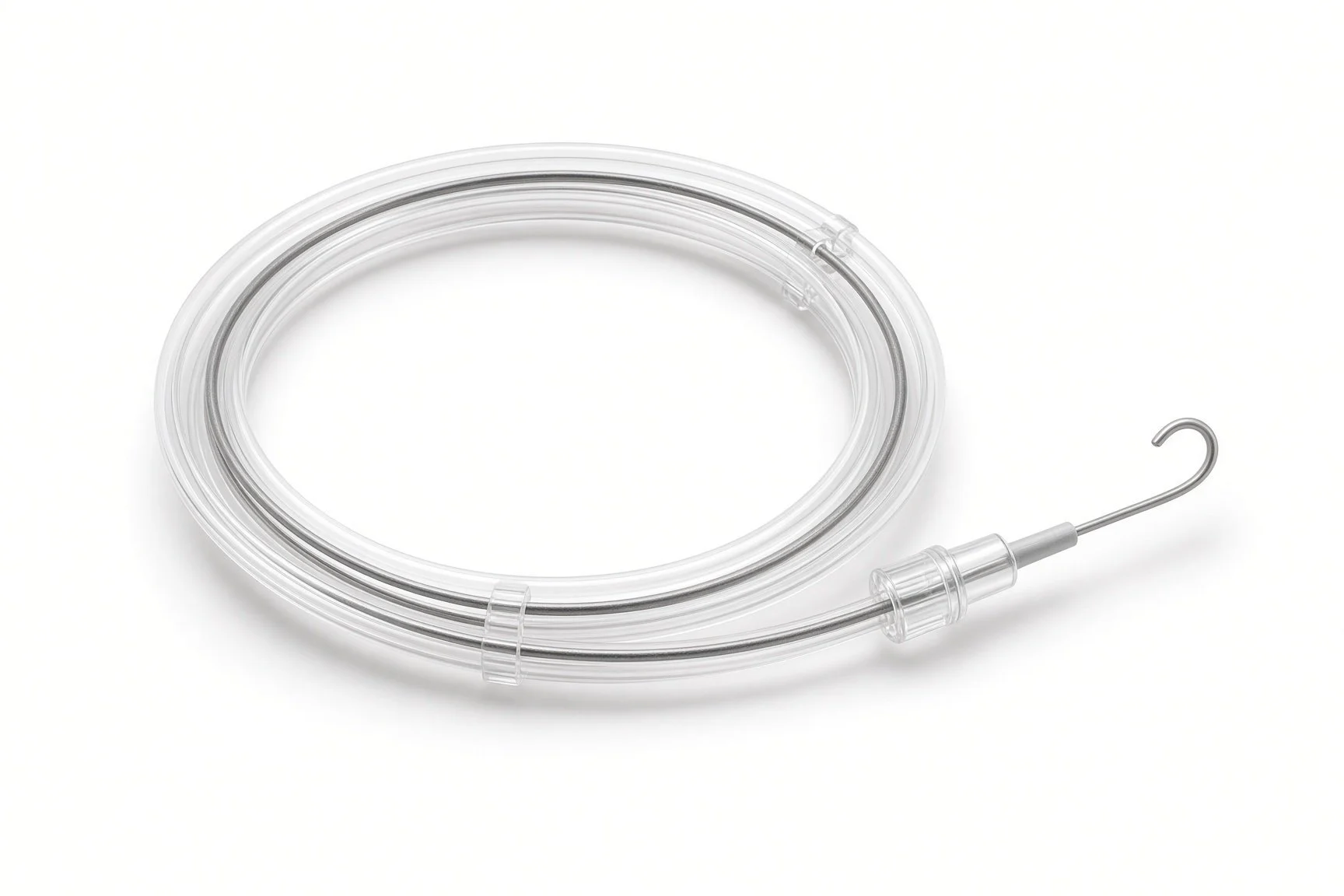
Guidewire.
Procedural steps (Barts example)
Getting ready
Access
Placing the filters
The TAVI
Finishing
First time in the cath lab?
Keep the right wrist free. Ask ward teams not to use the right radial artery for cannulas on the day.
Move the arterial line. Invasive pressure usually comes from another site.
Look at the filters. Debris is often visible; some centres photograph or send it for review.
Neuro checks matter. Know your centre's stroke pathway for after the case.
Arterial pressure monitoring usually comes from another site, because the right radial carries the filter sheath.
FAQ
Does the filter stop strokes?
It catches debris, but BHF PROTECT-TAVI found it did not reduce strokes overall in the 72 hours after TAVI.
Why is my wrist used?
The filters reach the brain arteries most easily from the right arm.
Will I always have one?
No. It is used selectively, as decided by the heart team.
Is the debris dangerous?
Small pieces often cause no symptoms. Larger pieces can cause a stroke, which is uncommon after TAVI.
Related Cath Lab 101 guides
TAVI for aortic regurgitation (coming soon)
Sources
All checked on 12 November 2026. Each page's own date is shown where it gives one.
Kharbanda RK, et al. Routine cerebral embolic protection during transcatheter aortic-valve implantation (BHF PROTECT-TAVI). N Engl J Med 2025
Praz F, et al. 2025 ESC/EACTS Guidelines for the management of valvular heart disease. Eur Heart J 2025
StatPearls (NCBI Bookshelf), search: transcatheter aortic valve replacement. ncbi.nlm.nih.gov/books
Disclaimer
Education only. This page is for general education for healthcare students, cath lab staff and curious readers. It isn't medical advice and doesn't replace advice from your own doctor, heart team or local unit protocols. Equipment and medicines are described generically. No product or manufacturer is recommended. If you think someone is having a heart emergency, call 999.
Disclosure: I work in the medical device industry. This page is independent education and isn't sponsored or reviewed by any company.
All diagrams on this page are original illustrations created for rodnieoro.com.