Redo TAVI (TAV-in-TAV) and coronary access after TAVI: a Cath Lab 101 guide
Reviewed by Rodnie Oro, cath lab charge nurse · Last reviewed: November 2026 · Education only, not medical advice
Redo TAVI and coronary access after TAVI in one minute
What it is: When a TAVI valve wears out, a new valve can be placed inside it by catheter (TAV-in-TAV). The old leaflets are pinned up by the new frame, which can block a coronary artery, so CT planning decides whether a leaflet needs splitting first.
Who it is for: People whose TAVI valve has narrowed or leaks, chosen by a heart team. As more people live longer after TAVI, redo procedures and coronary procedures through a TAVI frame are becoming more common.
Main risks: Blocked coronary artery, a high pressure drop across the new valve, stroke, heart block and bleeding at the groin artery. Your team will explain your own risk.
Usually: Under sedation or general anaesthetic, about 1 to 2 hours, home after 1 to 3 days for most.
On this page: What is redo TAVI and coronary access after TAVI? · Who is it for? · When is it done? · Step by step · Recovery · Risks · Kit list · First time in the lab? · FAQ
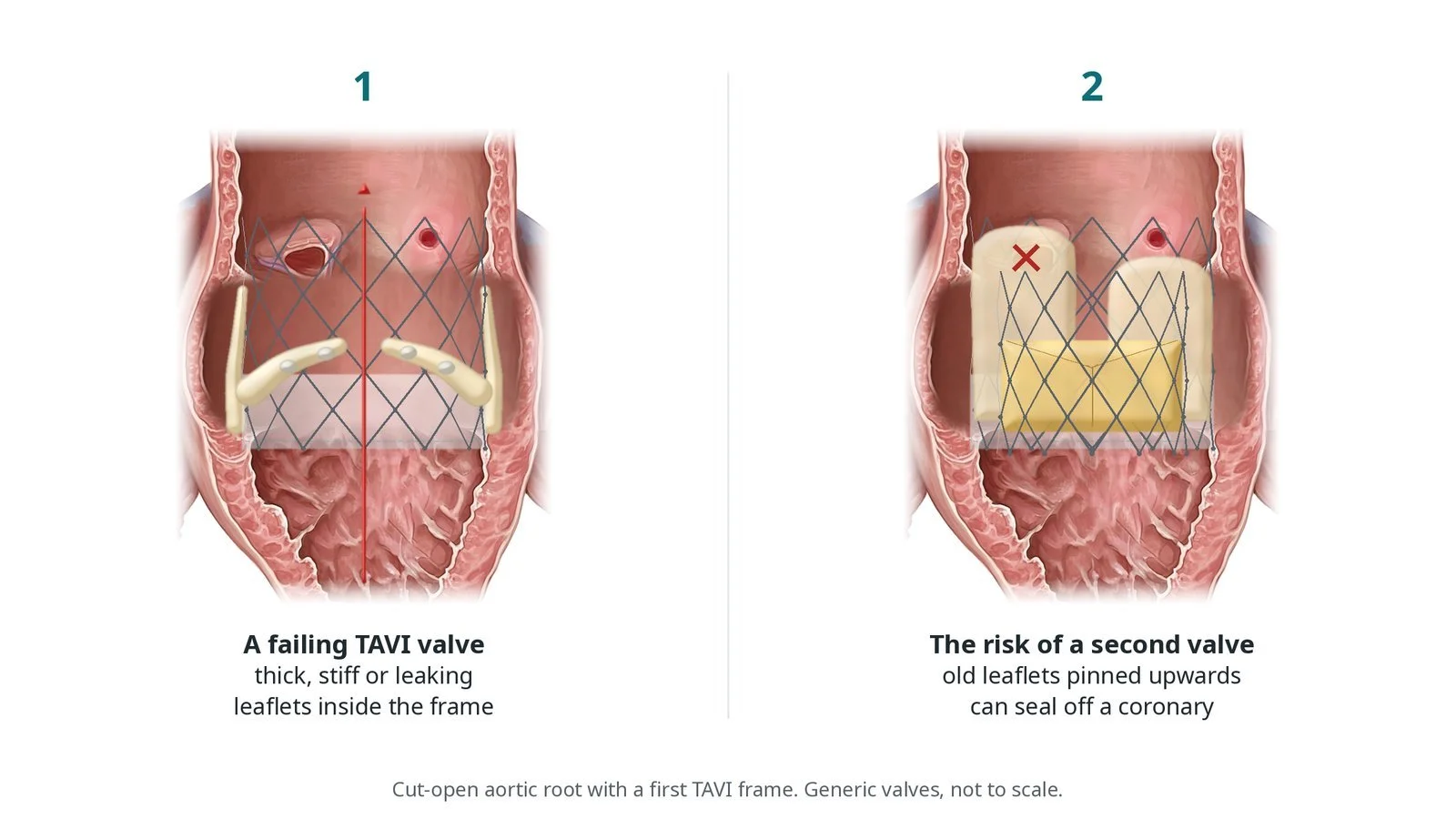
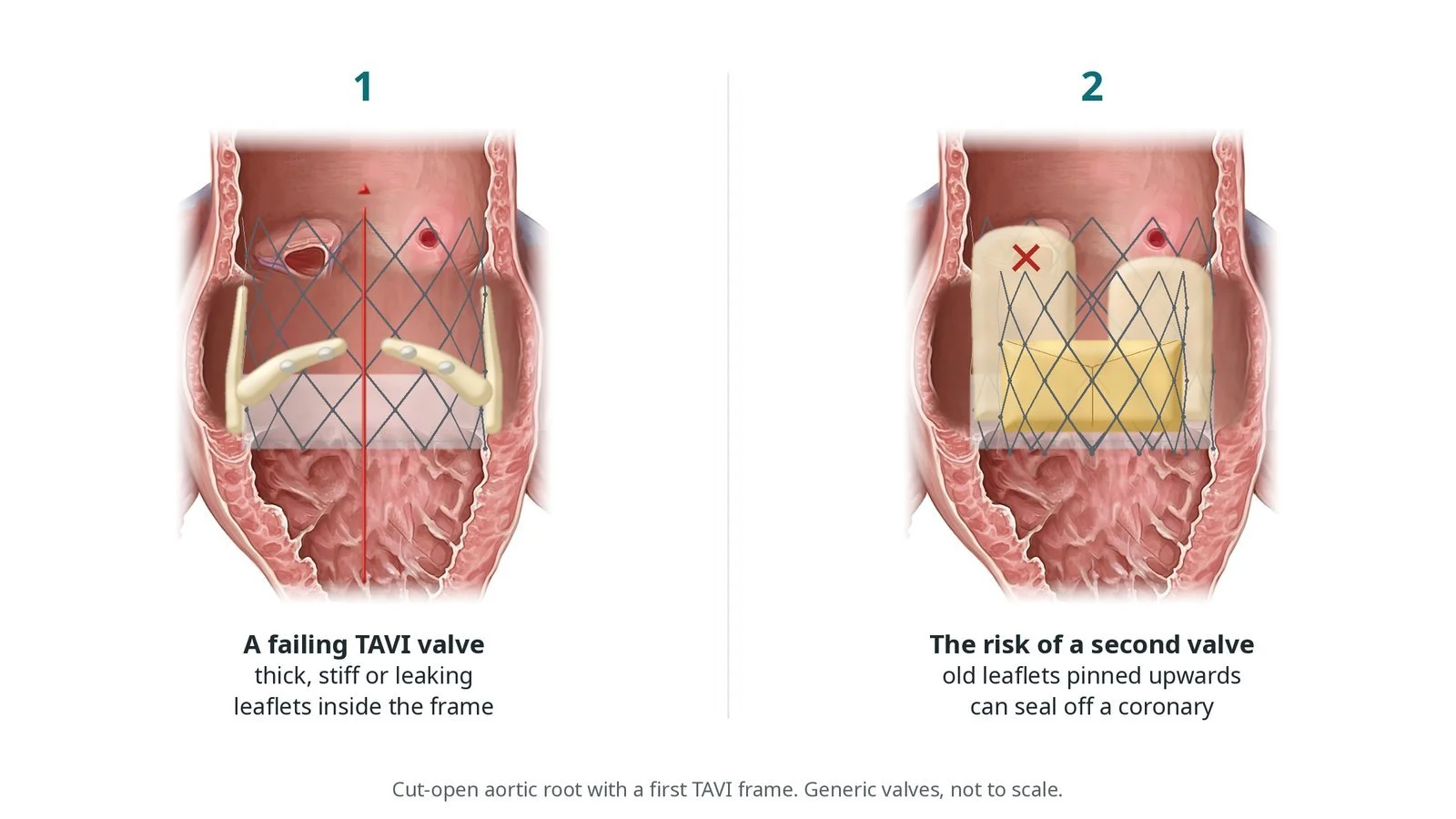
(1) A failing TAVI valve: thick, stiff or leaking leaflets inside the frame. (2) The risk with a second valve: the old leaflets are pinned upwards and can seal off a coronary artery.
What is redo TAVI and coronary access after TAVI?
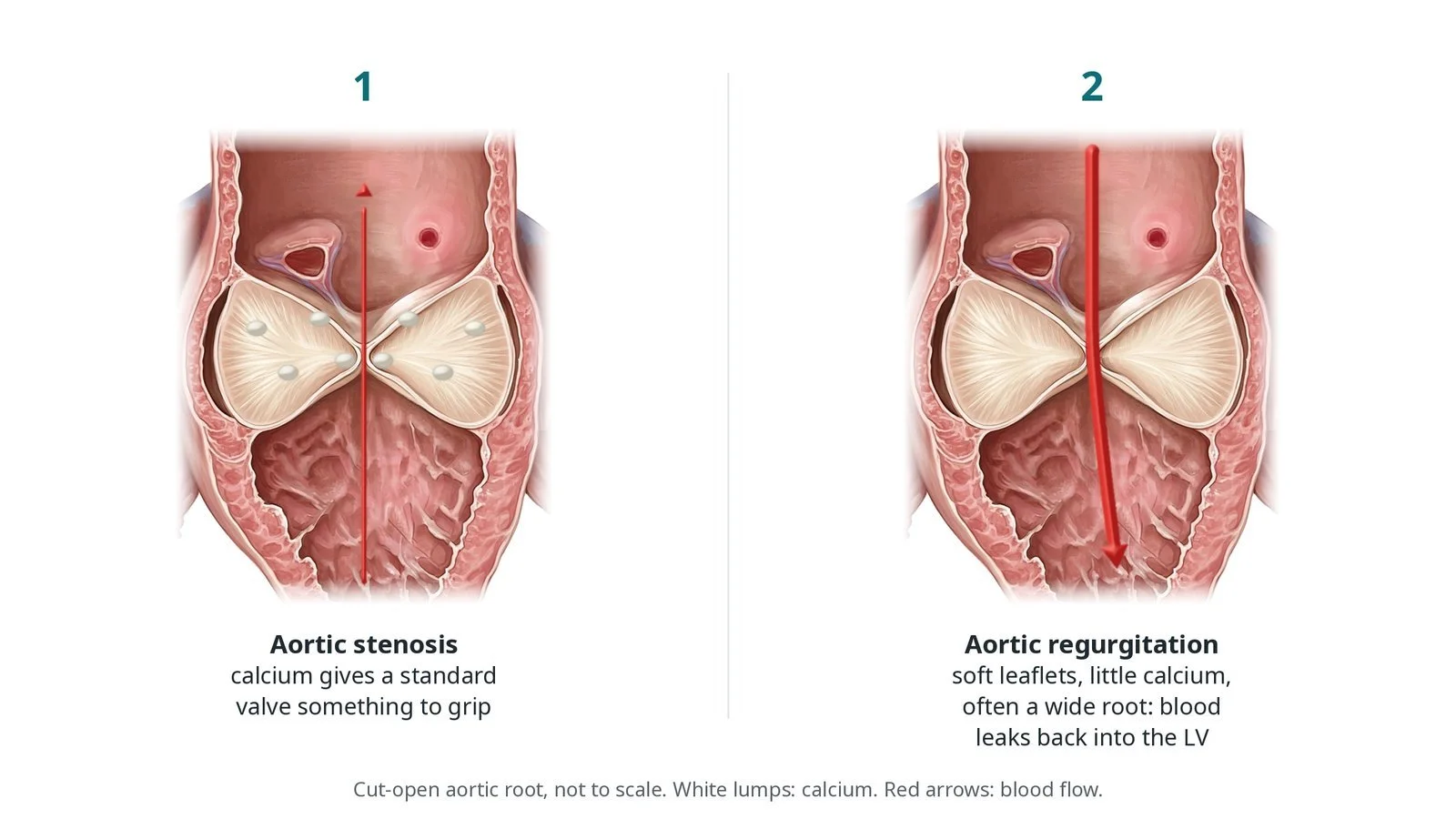
A TAVI valve has a metal frame with tissue leaflets inside. Over years the leaflets can thicken, stiffen or tear. This is called structural valve deterioration, and the valve may narrow, leak or both. A clot on the leaflets or infection can also cause failure.
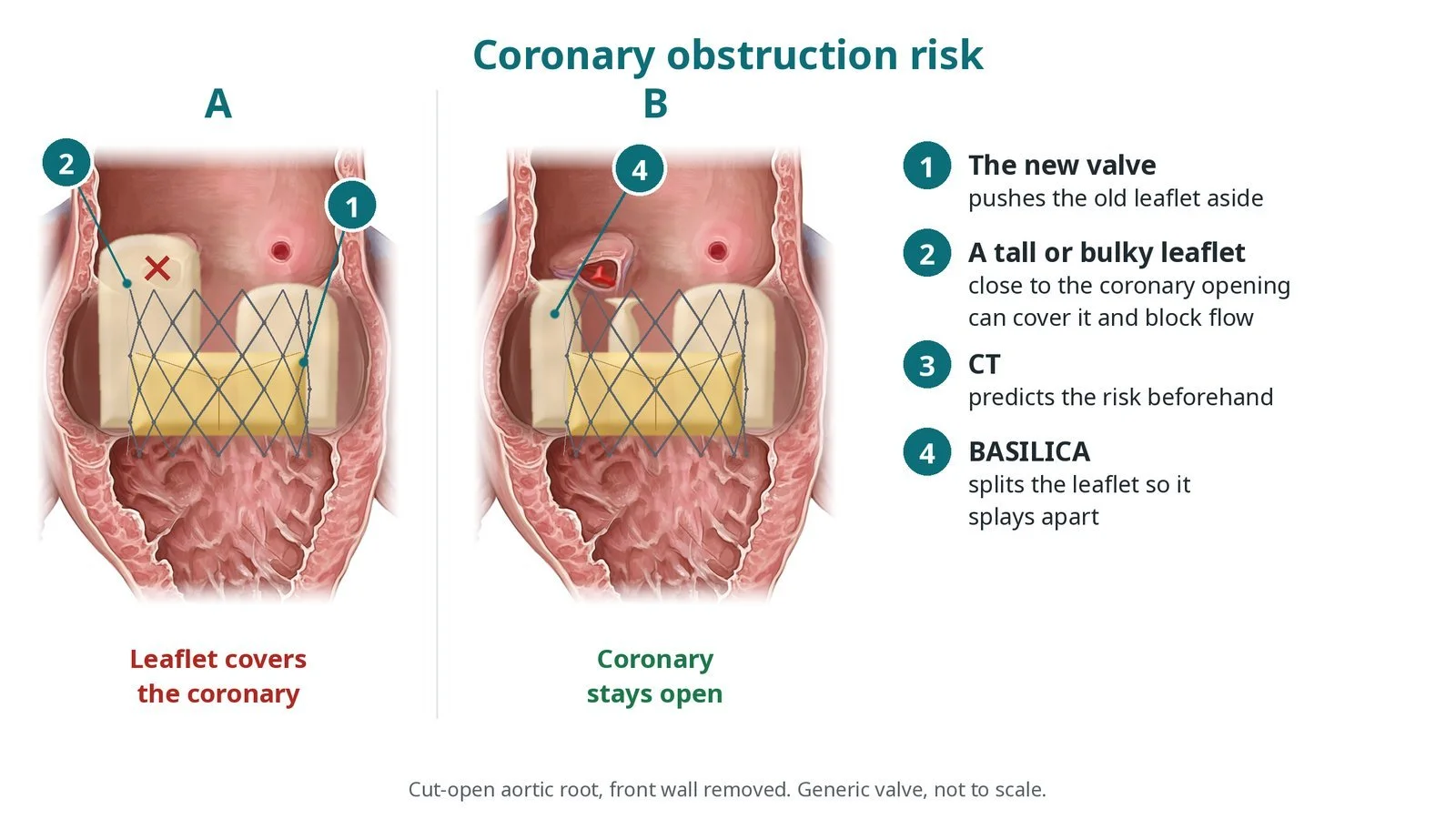
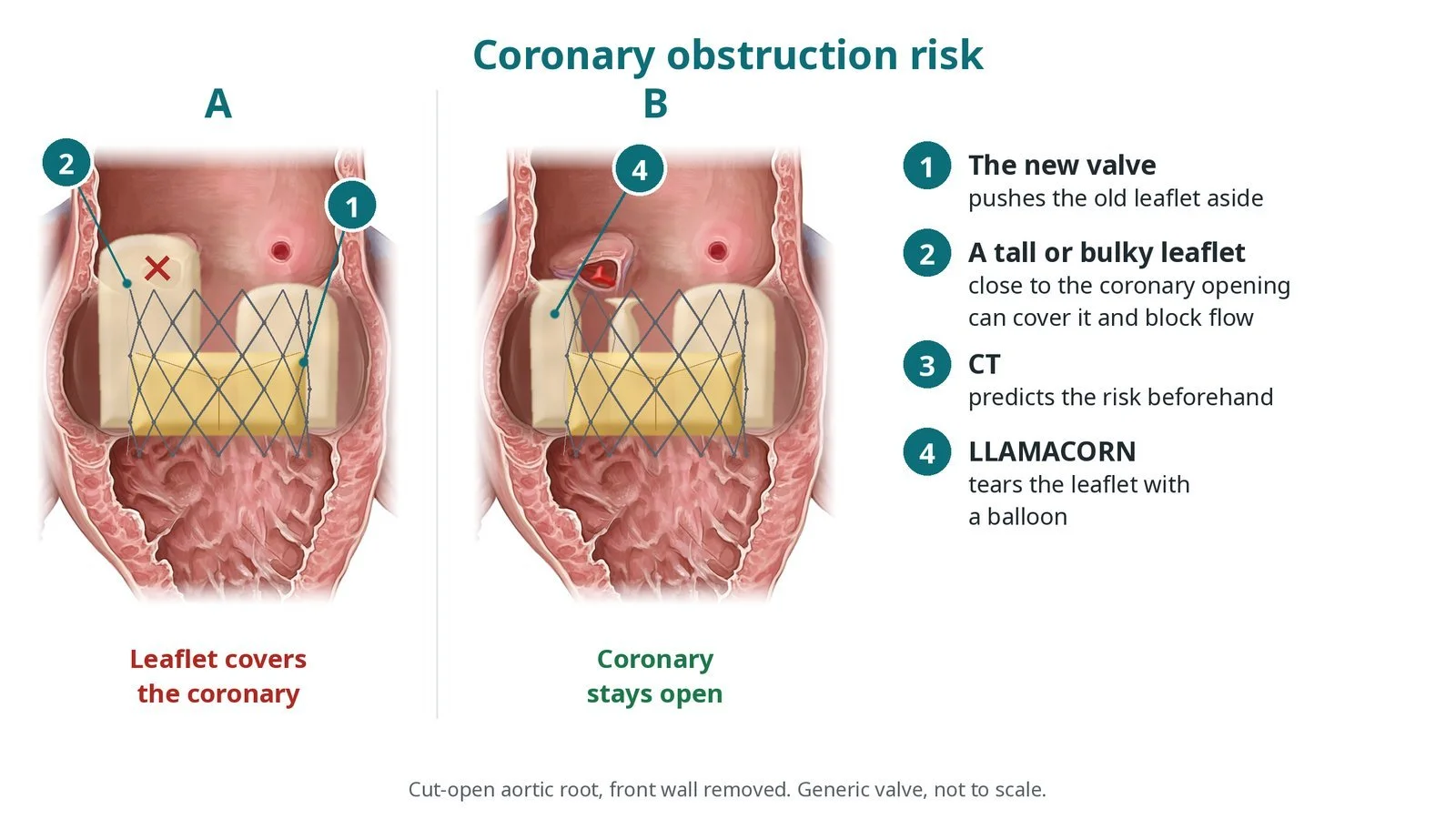
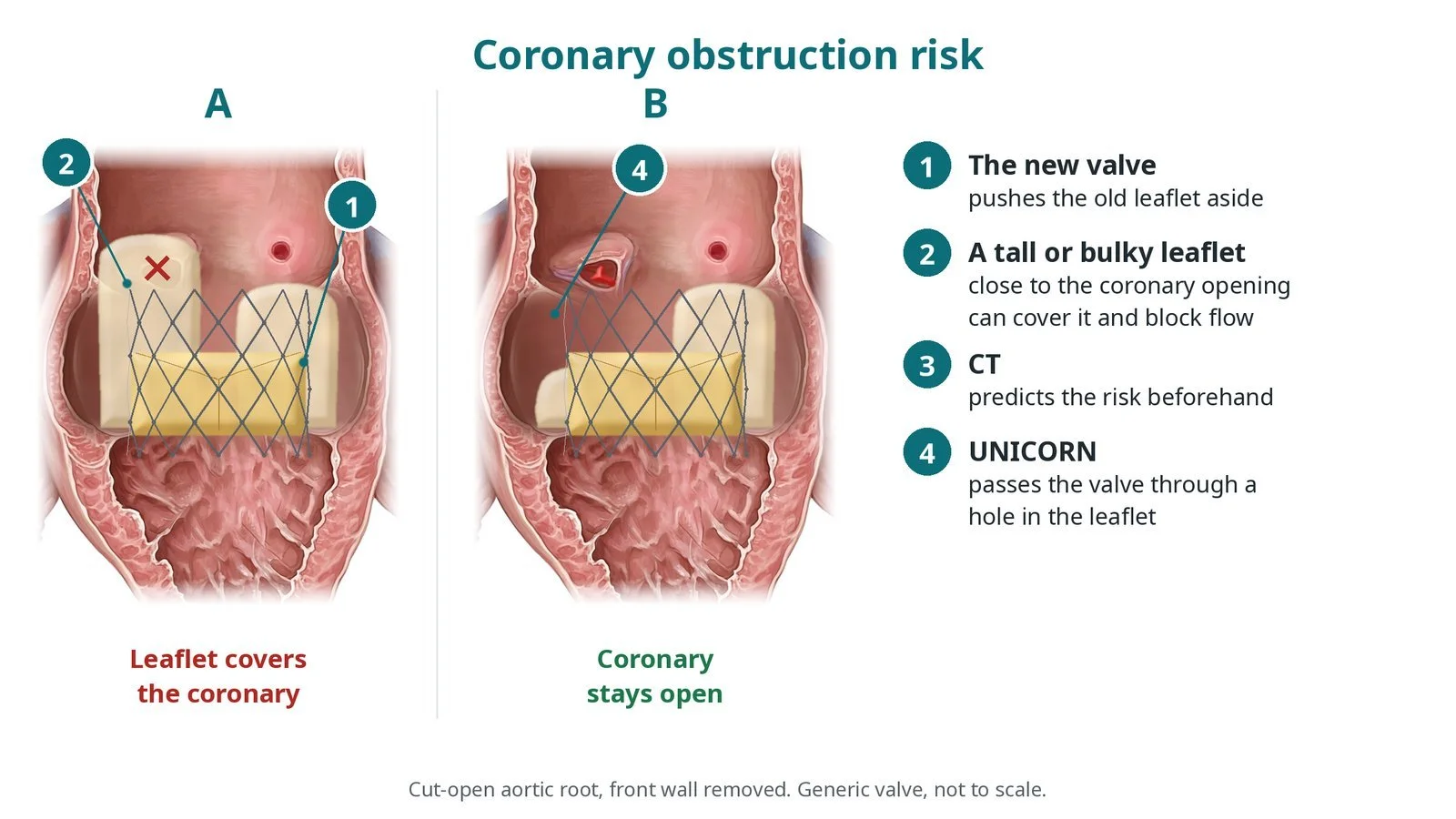
A second valve placed inside presses the old leaflets outwards and upwards against the old frame, forming a tube. If that tube reaches the top of the sinus, it can seal off the sinus (sinus sequestration) and stop blood reaching a coronary artery. CT measures the old frame, the leaflet height, the distance to the coronaries and the space in the sinuses.
If CT shows risk, the old leaflet can be split before the new valve (BASILICA-type leaflet modification). Aligning the commissures (the leaflet posts) with the coronaries at the first TAVI makes both redo TAVI and later coronary catheters easier, because the coronary opening then faces an open cell of the frame.
New to the acronyms? See the Cath Lab Abbreviations A–Z.
Who is it for?
People with a failing TAVI valve and symptoms, after the heart team has looked for treatable causes such as clot on the leaflets. The team checks on CT:
the type and size of the old valve and how high its leaflets reach
the risk to each coronary artery
whether leaflet splitting is needed
the access route
Who it may not suit: People at very high risk of coronary obstruction that cannot be reduced, or where the new valve would leave a high pressure drop. Surgery to remove the old valve may be considered.
The decision is made by your heart team, who will talk through the reasons, the alternatives and the risks with you.
When is it done?
A planned procedure in a TAVI centre. Coronary angiography or PCI through a TAVI frame can be needed at any time after TAVI, including in an emergency.
gives you a chance to ask questions and give consent
arranges blood tests, including kidney function and a blood count, and an ECG
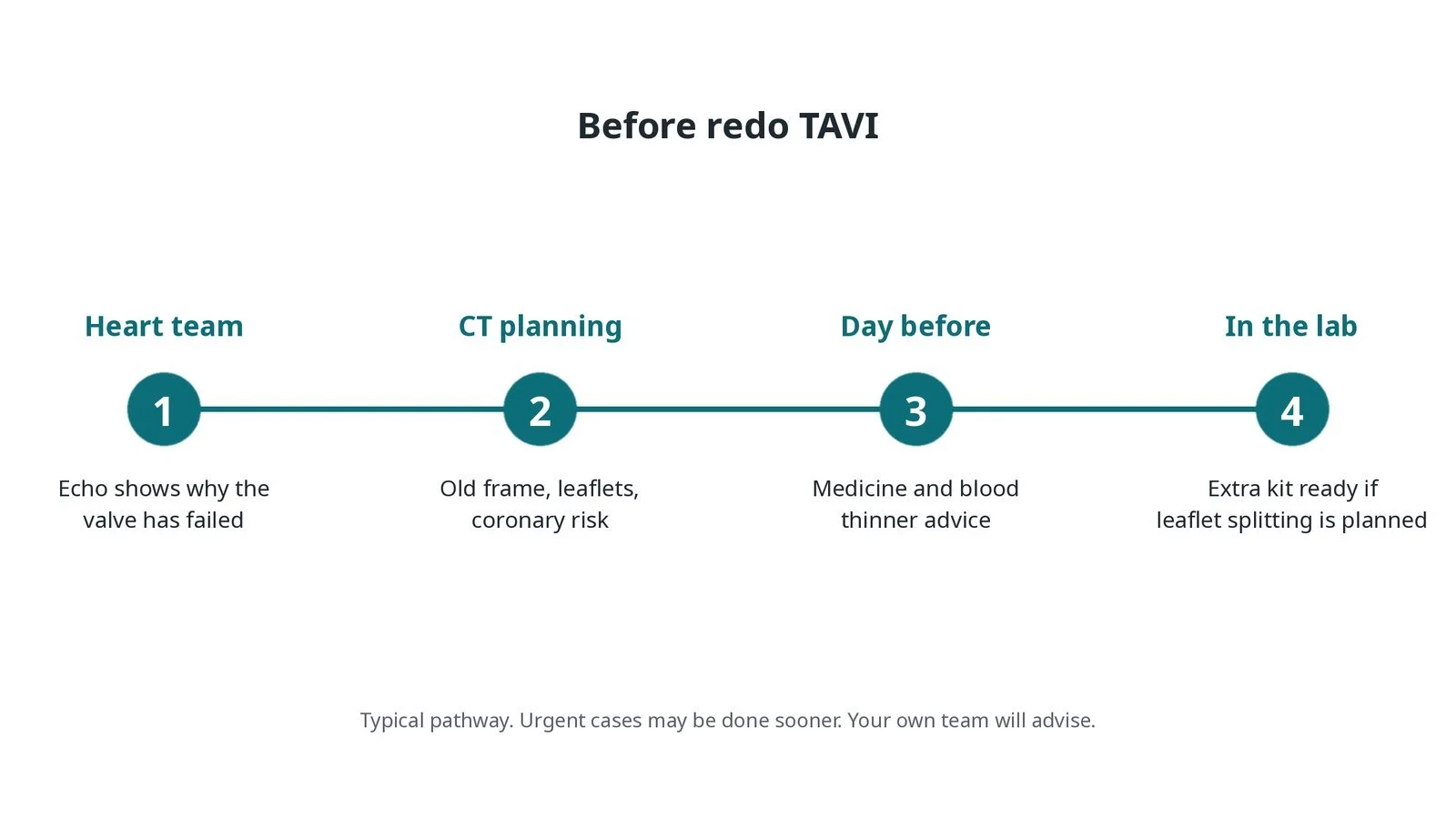
Before redo TAVI: echo shows why the valve has failed; CT plans the old frame, leaflets and coronary risk; medicine advice; extra kit ready if leaflet splitting is planned.
Step by step
1. Planning
CT and the details of the first valve (type, size and position) are reviewed by the heart team before the day. The plan states the risk to each coronary and whether leaflet splitting or coronary protection is needed.
2. Access
A large sheath is placed in the femoral artery under ultrasound. Extra arterial access is used for a pigtail, coronary protection or leaflet splitting, per operator, and a pacing wire is placed. Heparin is given as per centre protocol.
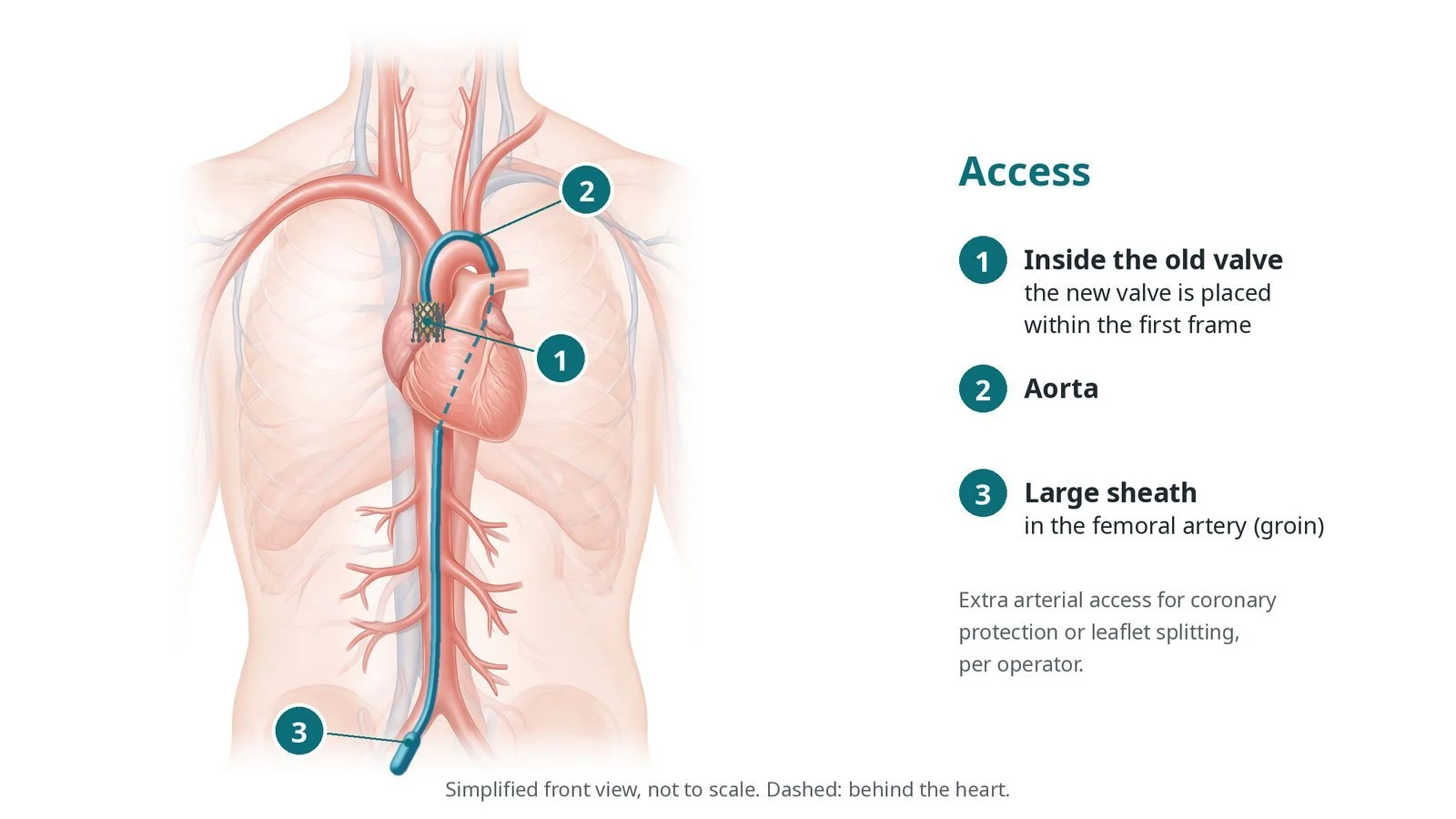
Access: (1) the new valve is placed inside the old one; (2) aorta; (3) large sheath in the femoral artery. Extra arterial access may be used for coronary protection or leaflet splitting.
3. The new valve
A. Cross. The old valve is crossed and a stiff wire is looped in the left ventricle.
B. Split a leaflet. If CT shows coronary risk, the old leaflet is split with an electrified wire (BASILICA-type technique).
C. Deploy. The new valve is positioned inside the old frame at the planned height and released, with pacing as per device and operator.
D. Check. Echo, pressures and an aortogram check the valve and that both coronaries fill.
Watch: ST changes, falling blood pressure or a coronary not filling after deployment: possible coronary obstruction. Call out at once; the operator may need to stent the coronary.
4. Coronary access after TAVI
To reach a coronary through a TAVI frame, the operator chooses catheters that can pass through an open cell near the coronary opening. Tall self-expanding frames and misaligned posts make this harder. CT and the first implant's images guide the choice of catheter and angle.
5. Finishing
The sheaths are removed and the arteries closed with closure devices or pressure, per operator. The patient is given an updated valve card.
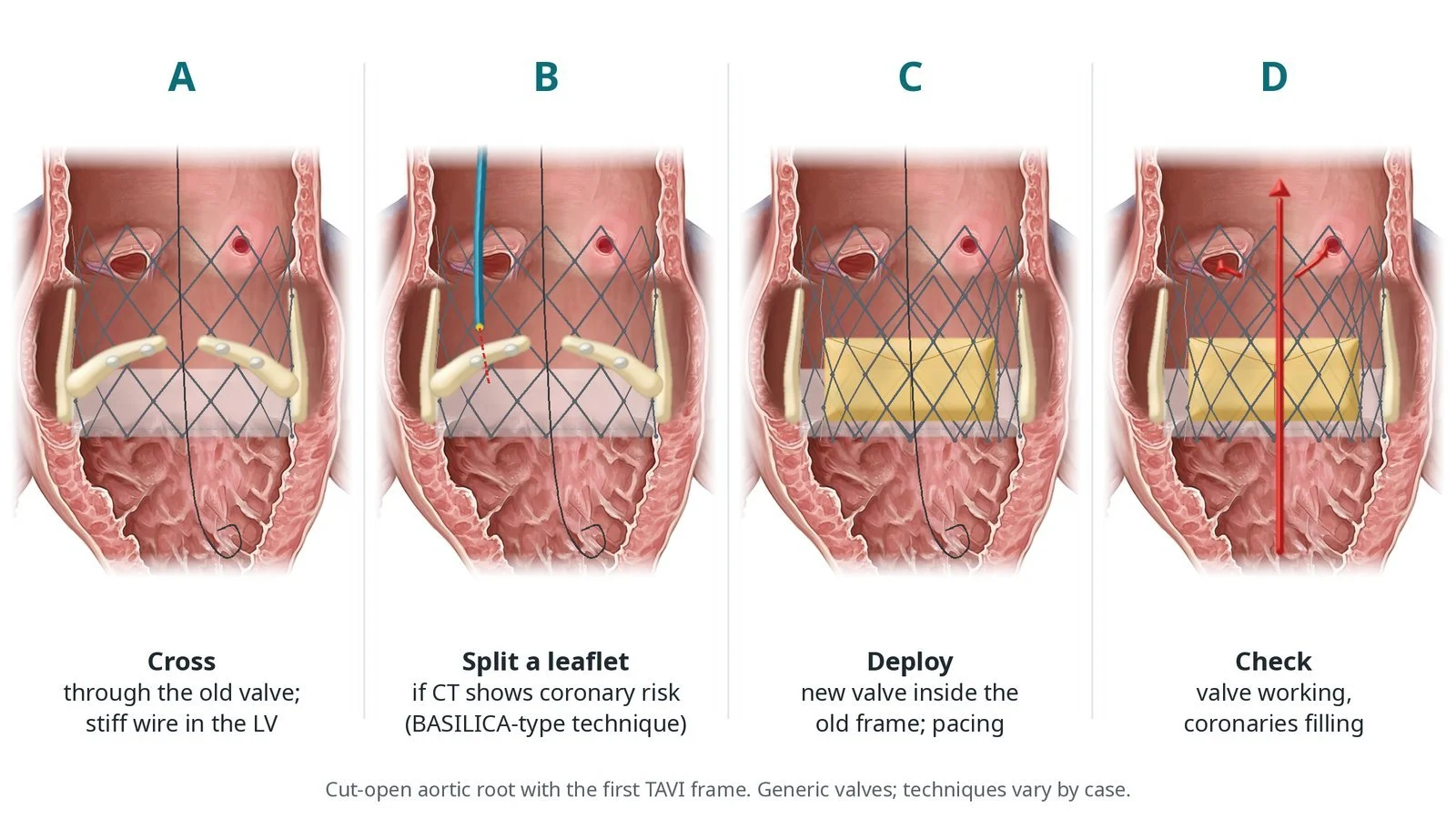
A: cross the old valve and place a stiff wire in the left ventricle. B: split a leaflet if CT shows coronary risk. C: deploy the new valve inside the old frame. D: check the valve and coronary flow.
Recovery and aftercare
First hours: bed rest with checks of the groin, leg pulses, heart rhythm and blood pressure, as per centre protocol.
Going home: after 1 to 3 days for most.
Medicines: an antiplatelet or anticoagulant, as your team advises.
Activity: walk the next day; avoid heavy lifting for about a week, or as advised.
Driving: do not drive for at least a week, or as your team advises; check DVLA rules.
Follow-up: echo and clinic review; keep your updated valve card with you.
Call 999 if you have chest pain, sudden breathlessness, fainting, signs of a stroke, or heavy bleeding from the groin.
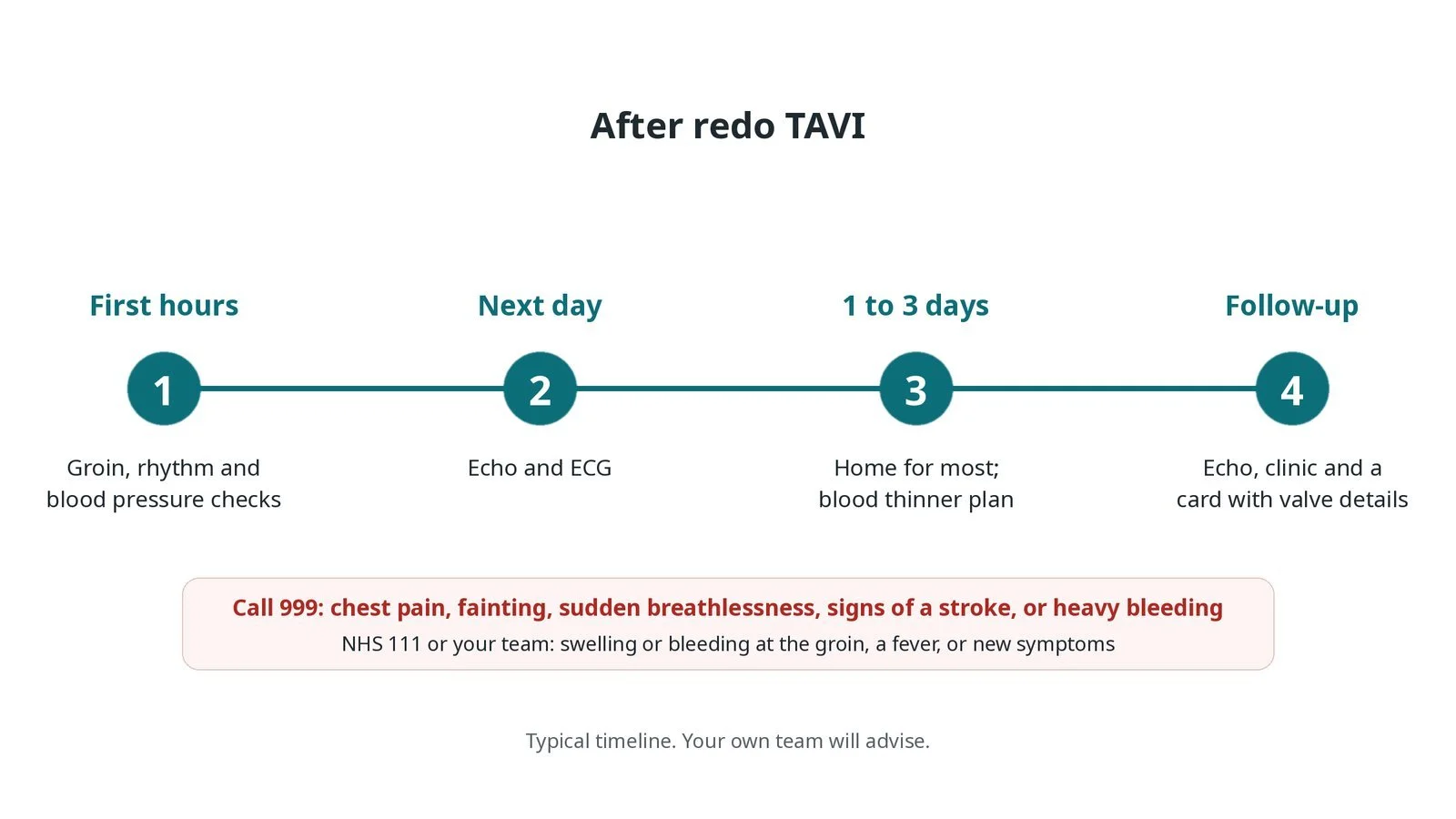
After redo TAVI: (1) groin, rhythm and blood pressure checks; (2) echo and ECG the next day; (3) home for most in 1 to 3 days; (4) echo, clinic and a card with valve details.
Risks and complications
Your team will explain the risks that apply to you. Possible problems include:
Blocked coronary artery (uncommon): Planning and leaflet splitting aim to prevent it.
High pressure drop across the new valve
Stroke (uncommon)
Heart block needing a pacemaker
Bleeding or damage at the groin artery
Kidney strain from contrast
Cath lab kit list (printable)
Barts example kit list
An example from one UK centre, written generically. Every lab has its own protocol, and sizes and doses vary.
large-bore femoral arterial sheath and closure devices, per operator
stiff pre-shaped left ventricular guidewire
pigtail catheter
new transcatheter valve and delivery system, size per CT plan
temporary pacing wire and pacing box
guide catheters, coronary wires and stents for coronary protection, per operator
leaflet splitting kit (BASILICA): electrosurgery generator, wires and snares, if planned
coronary catheters suitable for access through a TAVI frame
contrast; heparin, as per centre protocol
Procedural steps (Barts example)
Planning
Access
The new valve
Coronary access after TAVI
Finishing
First time in the cath lab?
Know the first valve. Its type, size and height matter more than anything else in the plan.
Read the CT plan. It says which coronary is at risk and what the bail-out is.
Watch the ST segments. Coronary obstruction shows quickly; call it out.
Coronary cases after TAVI take longer. Have a range of catheters ready and expect more contrast.
Have the first valve's details and implant images available. The valve type changes the plan.
For urgent angiograms after TAVI, ask early which valve the patient has. It changes the catheters the operator wants.
FAQ
Why has my TAVI valve worn out?
Tissue valves can wear over years. Clot or infection can also affect them. Your team will look for the cause.
Can it be done more than once?
Sometimes, but each new valve is smaller inside. CT shows what is possible.
Can I still have stents in my heart arteries after TAVI?
Yes. It can be harder to reach the arteries through the frame, but it is usually possible.
What is commissural alignment?
Lining up the valve's posts away from the coronary openings at the first TAVI, which makes later coronary procedures and redo TAVI easier.
Related Cath Lab 101 guides
TAVI for aortic regurgitation (coming soon)
Sources
All checked on 12 November 2026. Each page's own date is shown where it gives one.
Praz F, et al. 2025 ESC/EACTS Guidelines for the management of valvular heart disease. Eur Heart J 2025
StatPearls (NCBI Bookshelf), search: transcatheter aortic valve replacement. ncbi.nlm.nih.gov/books
Disclaimer
Education only. This page is for general education for healthcare students, cath lab staff and curious readers. It isn't medical advice and doesn't replace advice from your own doctor, heart team or local unit protocols. Equipment and medicines are described generically. No product or manufacturer is recommended. If you think someone is having a heart emergency, call 999.
Disclosure: I work for a company that makes a device used in this procedure. This page is independent education, isn't sponsored or reviewed by any company, and doesn't recommend any product.
All diagrams on this page are original illustrations created for rodnieoro.com.