LLAMACORN (balloon leaflet laceration before TAVI): a Cath Lab 101 guide
Reviewed by Rodnie Oro, cath lab charge nurse · Last reviewed: October 2026 · Education only, not medical advice
LLAMACORN in one minute
What it is: LLAMACORN stands for Leaflet Laceration with Balloon-Mediated Annihilation to prevent Coronary Obstruction with Radiofrequency Needle. Before TAVI, an electrified wire makes a small hole at the base of an old valve leaflet, and balloons are then used to widen and tear the leaflet, so it cannot cover a coronary artery when the new valve is expanded.
Who it is for: selected people having TAVI, mostly valve-in-valve TAVI inside a failed surgical valve, whose CT shows a high risk of a leaflet blocking a coronary artery, as decided by an experienced heart team.
Evidence: an emerging technique, first described in humans in 2024, with evidence so far limited to case reports and small case series. Longer-term results and comparisons with established methods are not yet known.
Main risks: stroke, a large leak once the leaflet is torn, an unpredictable tear, coronary obstruction despite the procedure, and the usual TAVI risks. Your team will explain your own risk.
On this page: What is LLAMACORN? · Who is it for? · When is it done? · Step by step · Recovery · Risks · Kit list · First time in the lab? · FAQ
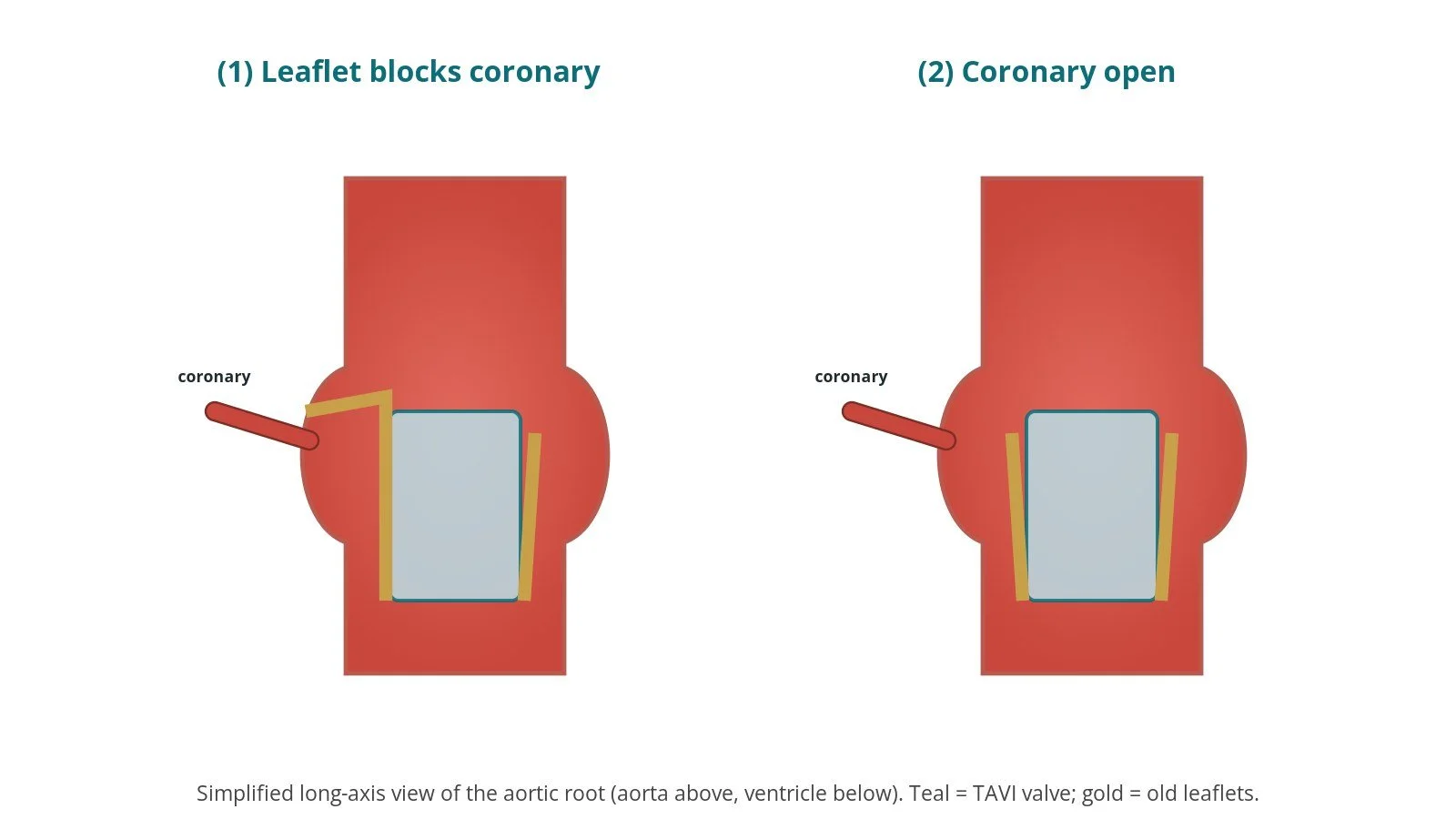
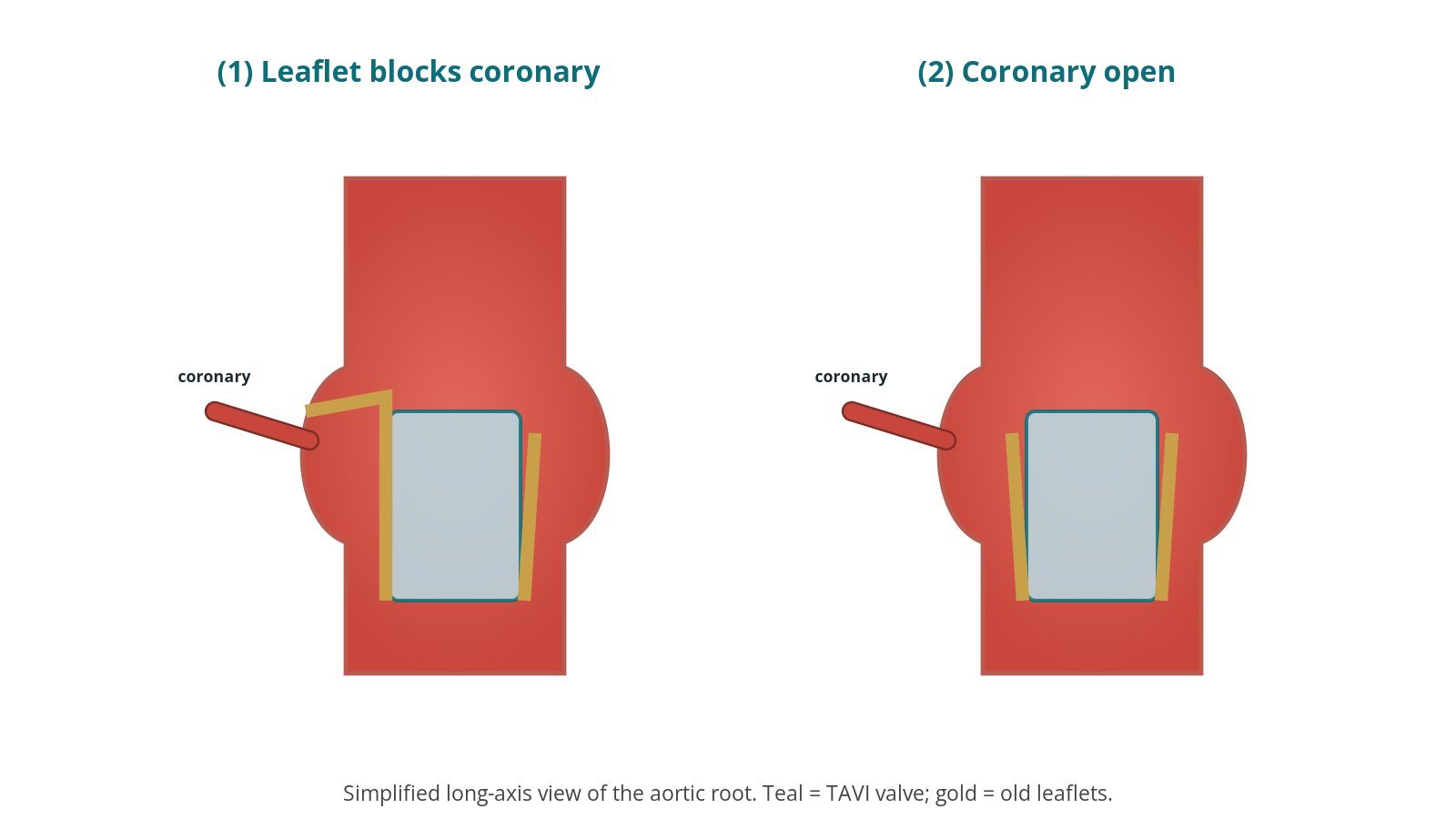
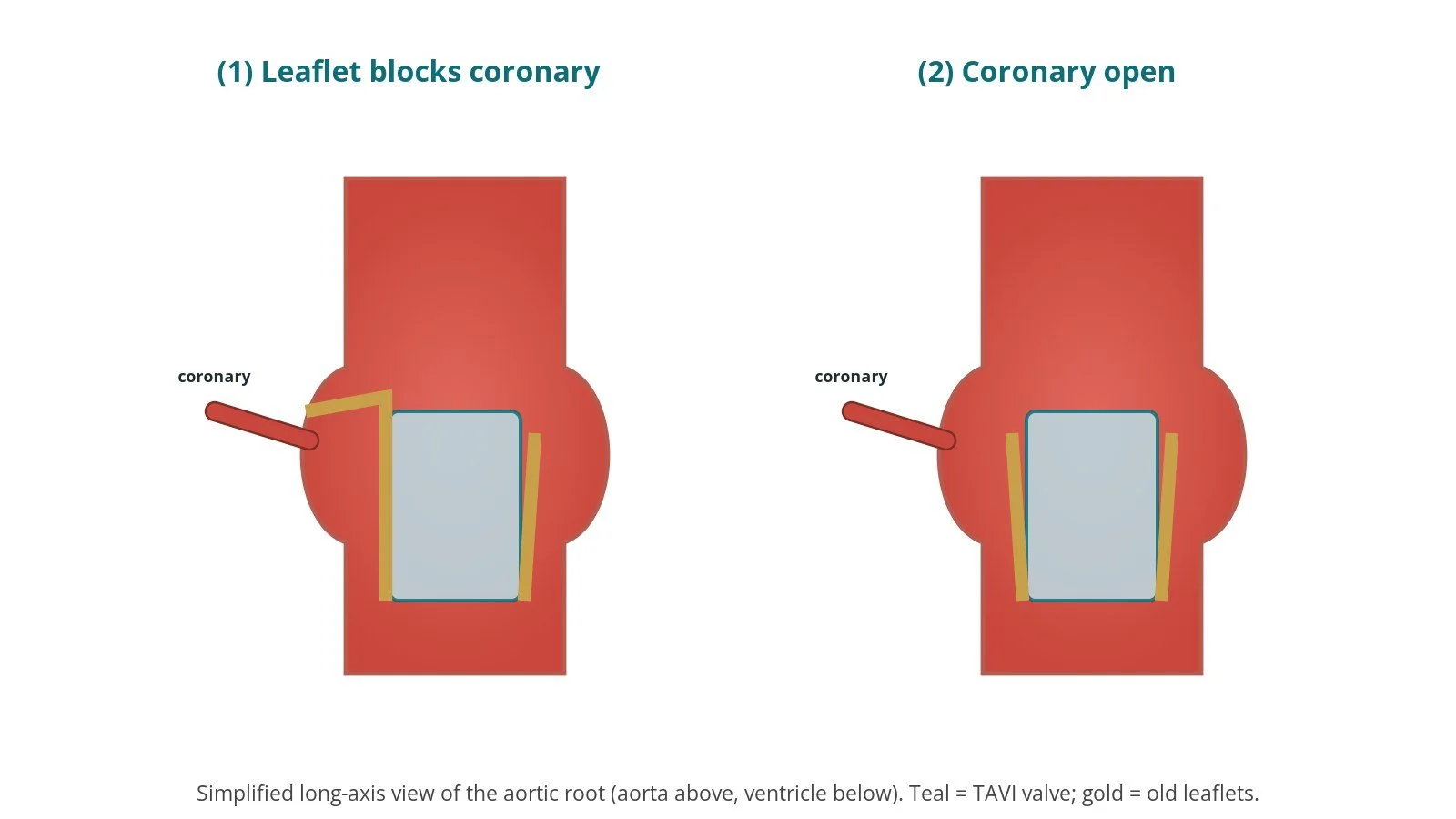
Coronary obstruction risk: (1) the old leaflet, pushed aside by the new valve, can cover the coronary opening; (2) coronary open.
What is LLAMACORN?
During TAVI, the new valve pushes the old valve leaflets outwards against the aortic wall. In some people, especially with valve-in-valve TAVI inside a worn-out surgical valve, a leaflet can end up covering a coronary artery opening or sealing off the space around it. This coronary obstruction is rare but life-threatening. Teams assess the risk on CT before TAVI.
Several techniques aim to modify the leaflet in front of the at-risk coronary artery before the new valve goes in:
BASILICA splits the leaflet from base to tip by pulling an electrified wire loop through it. See the BASILICA guide.
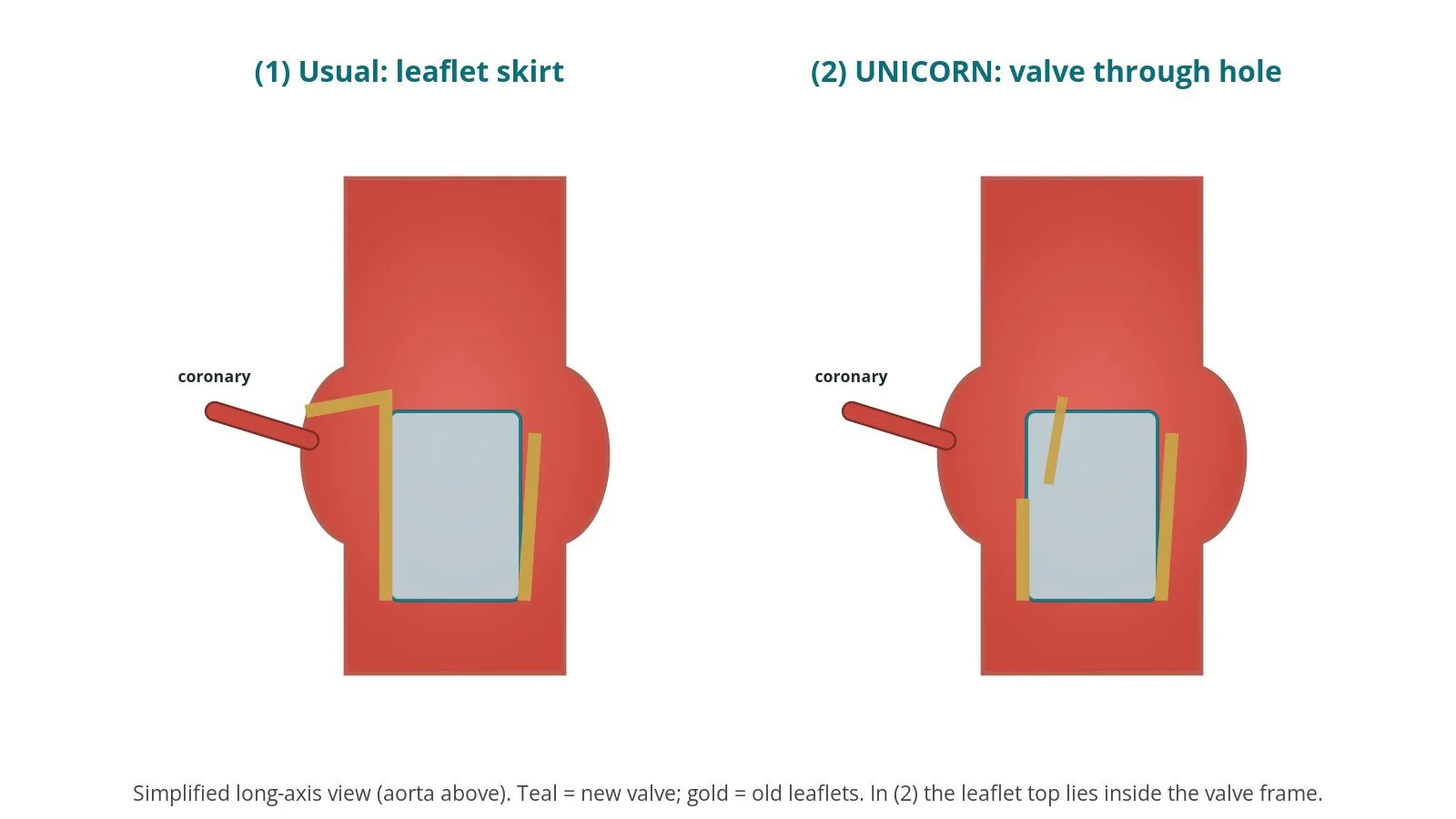
UNICORN (undermining iatrogenic coronary obstruction with radiofrequency needle) makes a hole at the leaflet base with a radiofrequency wire and widens it with balloons; in its original description the new valve was then expanded through the leaflet.
LLAMACORN is a variation of the UNICORN approach. After the hole is made with an electrified wire and widened with small balloons, a large balloon, sized to the valve, is inflated through the hole to tear the leaflet open before the new valve is implanted. It was first described with a self-expanding valve, extending the balloon-based approach beyond the balloon-expandable valves used with the original UNICORN method.
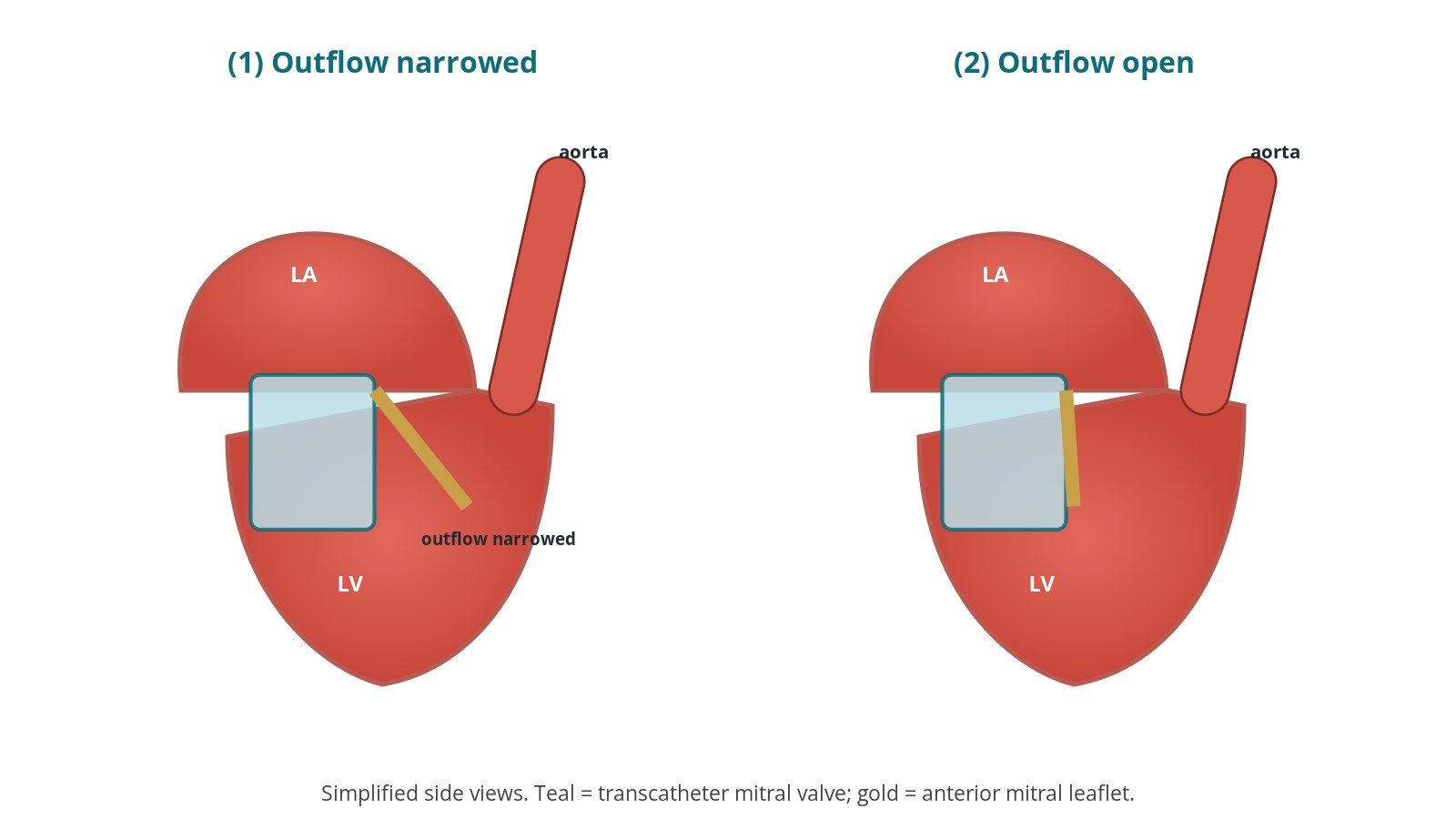
LLAMACORN belongs to the same family of electrosurgical leaflet modification techniques as BASILICA and LAMPOON (which splits the front mitral leaflet before a transcatheter mitral valve). Unlike BASILICA, it does not need a snare or a "flying V" wire loop, but the balloon tear is less directional.
New to the acronyms? See the Cath Lab Abbreviations A–Z.
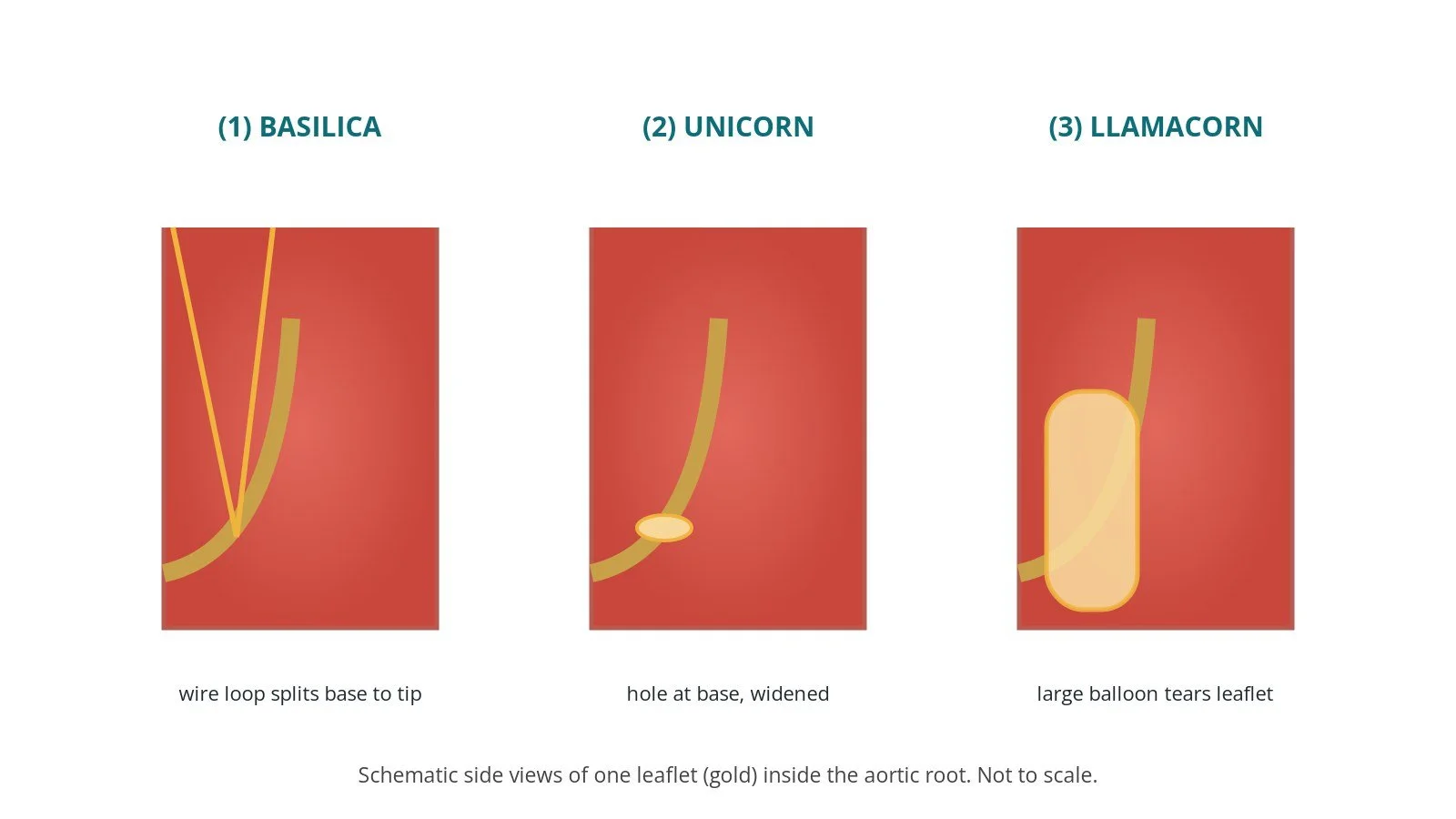
(1) BASILICA: wire loop splits the leaflet. (2) UNICORN: hole at the base widened by balloons. (3) LLAMACORN: large balloon tears the leaflet open.
Who is it for?
LLAMACORN may be considered by an experienced heart team for people having TAVI, usually valve-in-valve, whose CT predicts a high risk of coronary obstruction, for example a short distance between the expected leaflet position and the coronary opening, or a narrow aortic root. Published reports describe its use:
on a single leaflet, often where BASILICA would be technically difficult (for example the right leaflet)
combined with BASILICA on the other leaflet
on both leaflets ("double LLAMACORN")
as a bail-out when BASILICA has not achieved enough laceration
Evidence, stated plainly: LLAMACORN is new. The published literature (2024 to 2026) consists of a first-in-human report, case reports and technique papers. There are no trials and no long-term data, and no guideline specifically recommends it. The ESC/EACTS valvular guidelines and NICE guidance on valve-in-valve TAVI (HTG518) recognise coronary obstruction as a risk to assess; the choice of technique (BASILICA, a balloon-based method such as LLAMACORN, coronary stent protection, or surgery) rests with the heart team. Consent should include this uncertainty.
When is it done?
It is planned with the TAVI, after:
detailed CT planning of the aortic root, the old valve, the leaflets and the coronary arteries, including the X-ray angles needed to see each leaflet side-on and face-on
echo, ECG, blood tests and a group and save
a review of blood thinners, as per centre protocol
Step by step
1. Anaesthetic and access
Usually under general anaesthetic with TOE. Sheaths are placed in both femoral arteries (one for the leaflet catheters, one for the TAVI sheath, or both used for leaflet work in double procedures) and a femoral vein for temporary pacing. Sizes per device and operator. Cerebral embolic protection may be used, per operator. Heparin is given, dose as per centre protocol.
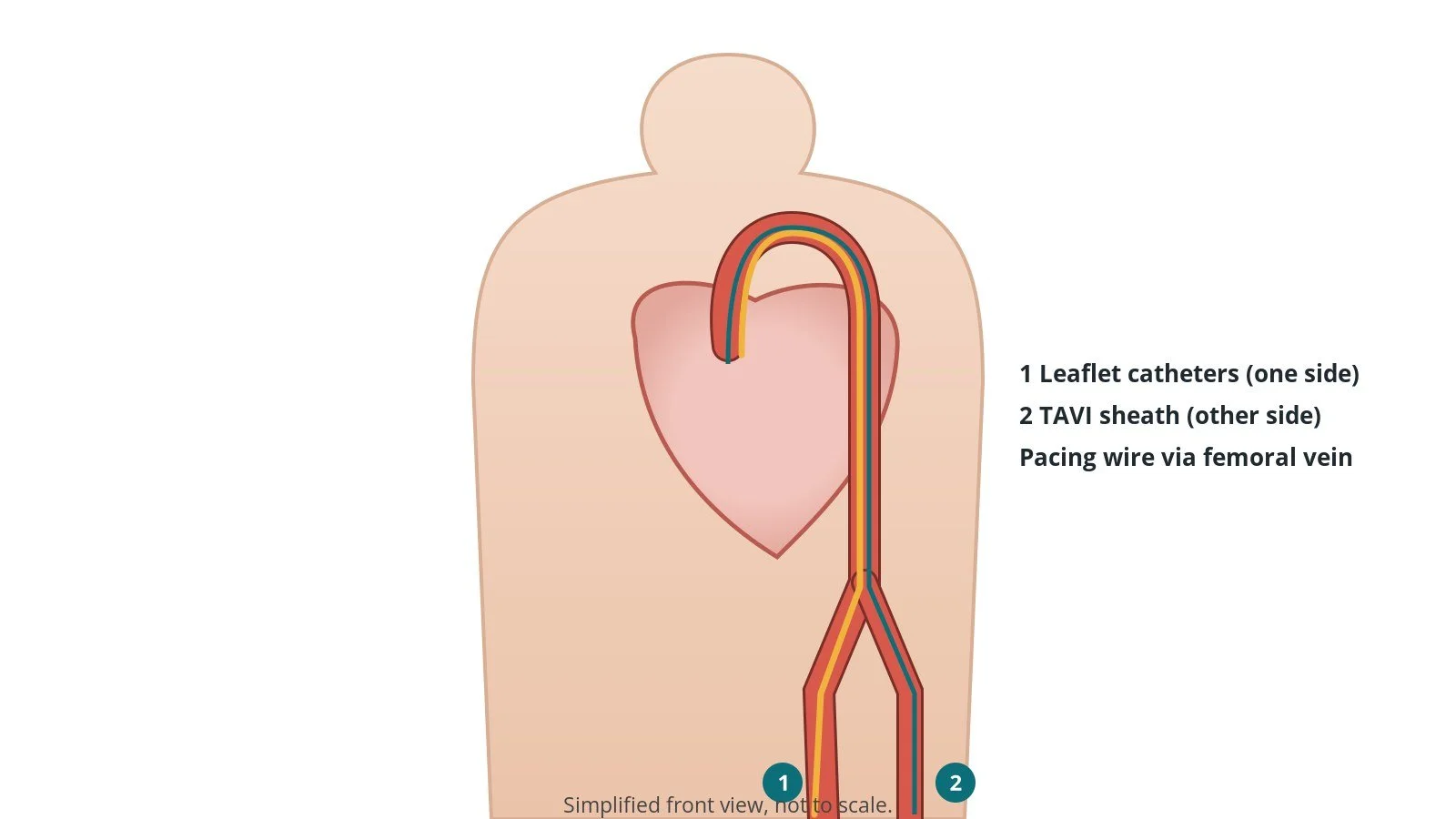
Access: (1) leaflet catheters from one femoral artery; (2) TAVI sheath from the other; pacing via a femoral vein.
2. Leaflet modification
A. Traverse. A guide catheter, often with an inner catheter and a microcatheter, is aimed at the base of the target leaflet, confirmed with TOE and X-ray. A thin wire connected to an electrosurgery pen crosses the leaflet with a brief burst of energy (settings per operator) into the left ventricle.
B. Make a track. The microcatheter is advanced through the hole and the wire exchanged for a supportive wire. Small balloons of increasing size widen the hole, per device and operator, and a stiff wire is placed through the leaflet into the left ventricle.
C. Tear. A large balloon, sized to the valve, is inflated through the hole under rapid pacing. The balloon "waist" disappearing shows the leaflet has torn. A leak (aortic regurgitation) starts at this point, so the new valve must follow promptly.
D. TAVI. The new valve is positioned and deployed in the usual way, often with the valve already waiting in the aorta.
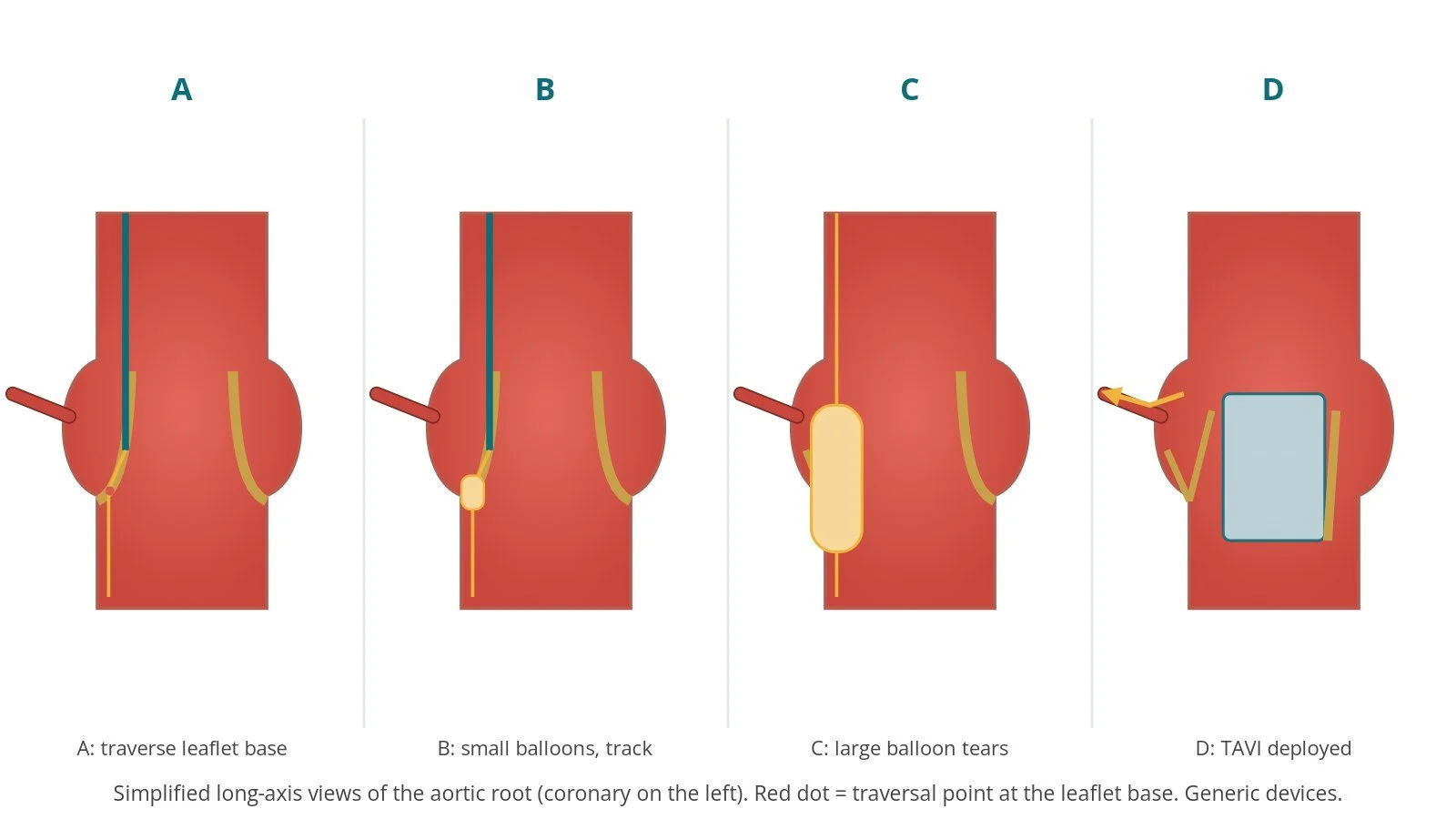
A: traverse the leaflet base. B: small balloons make a track. C: large balloon tears the leaflet. D: TAVI deployed.
3. Checking
Coronary angiography, echo and pressures check that both coronary arteries fill and the new valve works well.
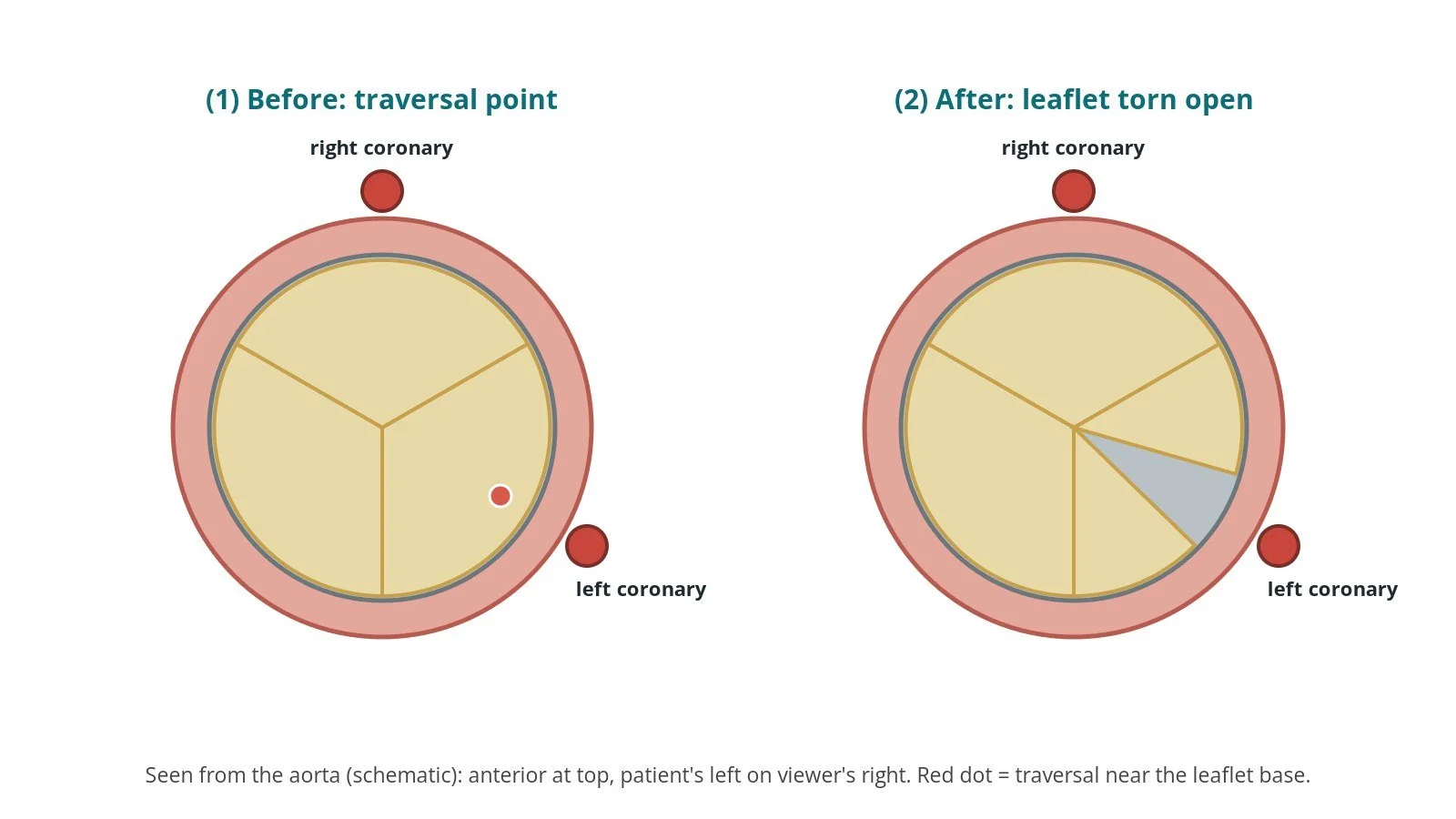
Seen from above: (1) traversal point at the base of the leaflet in front of the at-risk coronary; (2) after the tear, the leaflet opens and the coronary is uncovered.
Recovery and aftercare
First hours: recovery, often in coronary care, high-dependency or intensive care, with checks of the groins, heart rhythm (including for heart block) and blood pressure, as per centre protocol.
Echo and blood tests: before discharge.
Going home: often after a few nights.
Medicines: antiplatelet or anticoagulant medicines, as per your team's plan.
Driving: DVLA guidance after a percutaneous valve procedure for a car licence is not to drive for 2 weeks; bus and lorry drivers must tell the DVLA. Ask your team.
Call 999 if you have chest pain, sudden breathlessness, fainting, signs of a stroke, or bleeding from the groin.
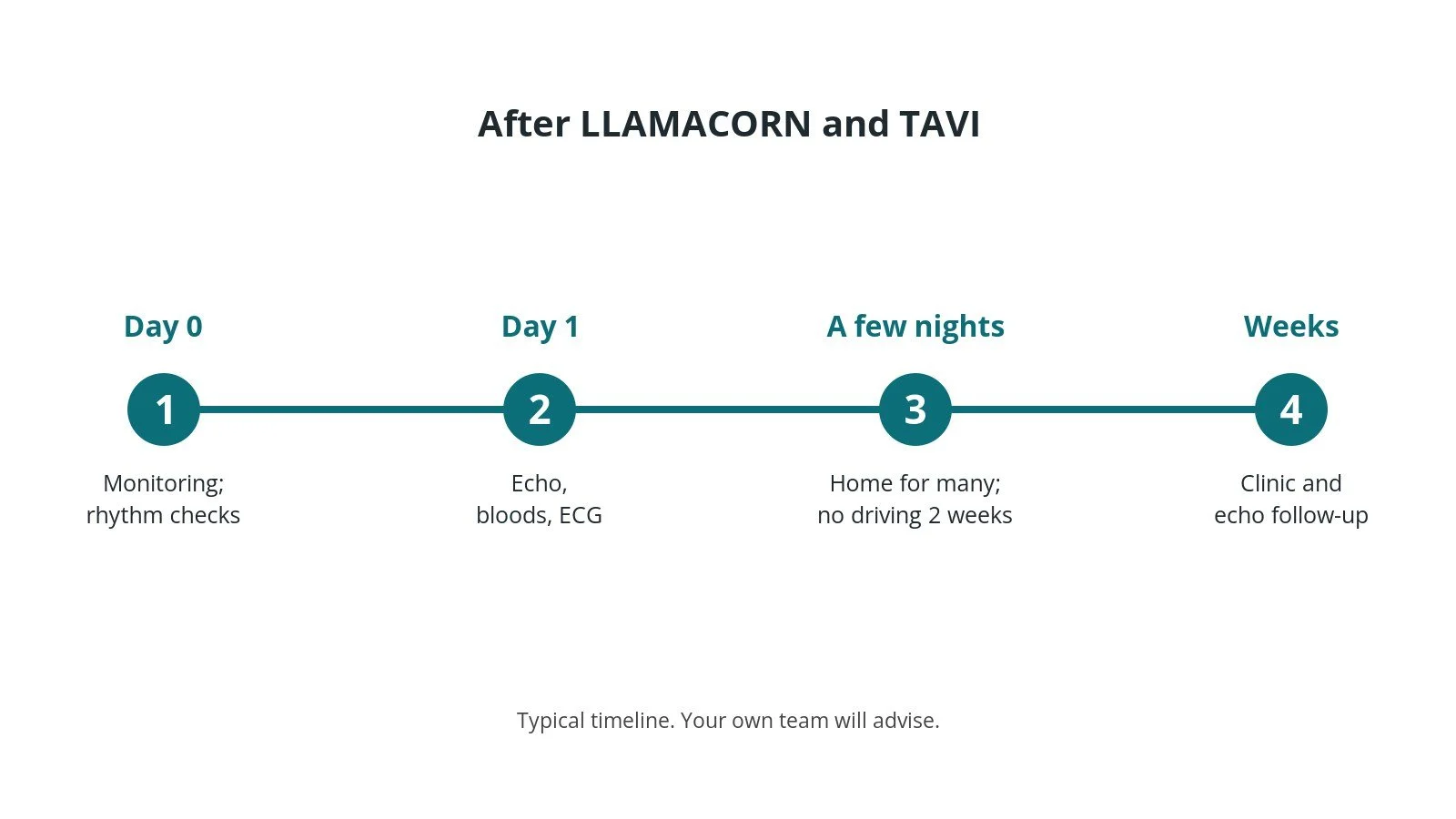
After LLAMACORN and TAVI: (1) monitoring; (2) echo and bloods; (3) home after a few nights; (4) follow-up.
Risks and complications
Your team will discuss your own risks. Reported and expected problems include:
stroke, from debris or air
a severe leak after the leaflet is torn, which can drop the blood pressure until the new valve is in place
an unpredictable or long tear, because a balloon cannot control the direction of the split; caution is advised with heavily calcified or long leaflets, where a loose flap could itself block a coronary artery
coronary obstruction despite leaflet modification
catheter or wire entanglement, especially in small aortic roots
injury to the aortic root or other structures
bleeding or injury at the access arteries
the usual TAVI risks, including heart block needing a pacemaker
Cath lab kit list (printable)
Example kit list
Written generically from published technique descriptions. Every lab has its own protocol, and sizes and doses vary.
Access
femoral arterial sheaths on both sides (large-bore for TAVI), femoral venous sheath for pacing; sizes per device and operator
suture-based closure devices, per operator
cerebral embolic protection device, if used
Leaflet traversal
guide catheters (right coronary and left coronary/AL shapes), with long inner catheters, per operator
microcatheter, per operator
stiff-tipped 0.014" traversal wire (back end prepared for the electrosurgery pen), per operator
0.014" supportive exchange wire, per operator
diathermy pen and generator, settings per operator; non-conducting flush, as per centre protocol
Balloon modification
non-compliant coronary balloons in increasing sizes, per device and operator
extra-stiff pre-shaped LV wire(s), per operator
large valvuloplasty balloon sized to the valve, per device and operator; inflation device
Usual TAVI equipment, valve per device and operator
Procedural steps (example)
General anaesthetic and TOE; both femoral arteries and a femoral vein; pacing wire; heparin
CT-derived X-ray angles; angiogram of the target cusp
Guide and microcatheter at the leaflet base; TOE confirms position; energised traversal into the LV
Microcatheter across; exchange wire; small balloons to make a track; stiff wire into the LV
TAVI valve prepared and ready
Large balloon through the leaflet under rapid pacing until the waist disappears
TAVI deployed promptly; coronary angiography and echo
First time in the cath lab?
💡 First-time tip
Valve ready first. Once the leaflet is torn there is a big leak; the TAVI valve must be prepared and close by. Diathermy only on command. Activate the pen only when the operator asks. Pacing ready. Rapid pacing is used for the large balloon and the valve. Label every wire. Several wires and catheters come from both groins; keep the table organised. Watch the pressure. A drop after the tear is expected; tell the team at once if it is severe.
FAQ
Is LLAMACORN the same as BASILICA?
No. Both aim to stop a leaflet blocking a coronary artery. BASILICA splits the leaflet with a wire loop; LLAMACORN tears it with a balloon through a small hole.
Why is it called LLAMACORN?
It is an acronym: Leaflet Laceration with Balloon-Mediated Annihilation to prevent Coronary Obstruction with Radiofrequency Needle. It builds on an earlier method called UNICORN.
Is it proven?
Not yet. It is an emerging technique reported in a small number of patients. Your team will explain why they suggest it and the alternatives.
What are the alternatives?
BASILICA, placing a stent in the coronary artery during TAVI, or surgery, depending on your situation.
Related Cath Lab 101 guides
Sources
All checked on 10 October 2026. Each page's own date is shown where it gives one.
Mew C, et al. First-in-human: leaflet laceration with balloon mediated annihilation to prevent coronary obstruction with radiofrequency needle (LLAMACORN) for valve-in-valve TAVR. Catheter Cardiovasc Interv 2024;104(5):1079–1085. PubMed 39224002
Fang JX, et al. Lacerate and macerate: the BASILICA–LLAMACORN/UNICORN combination to optimize bioprosthetic bileaflet modification. J Soc Cardiovasc Angiogr Interv 2025;4(5):102614. PMC12126080 (open access)
Ruberti A, et al. Double LLAMACORN: bilateral leaflet modification technique to prevent coronary obstruction. JACC Case Rep 2026;31(25):107649. PMC13332656 (open access)
Fargione L, et al. Bailout LLAMACORN for BASILICA failure. JACC Cardiovasc Interv 2026;19(11):1528–1530. PubMed 42264650
Chan KYE, et al. First-in-human undermining iatrogenic coronary obstruction with radiofrequency needle (UNICORN) procedure during valve-in-valve TAVR. Circ Cardiovasc Interv 2022;15(11):928–931. PubMed 36268707
NICE. Valve-in-valve TAVI for aortic bioprosthetic valve dysfunction (HTG518). nice.org.uk/guidance/htg518
Vahanian A, et al. 2021 ESC/EACTS Guidelines for the management of valvular heart disease. Eur Heart J 2022;43(7):561–632. PubMed 34453165
DVLA / GOV.UK. Cardiovascular disorders: assessing fitness to drive. gov.uk
Disclaimer
Education only. This page is for general education for healthcare students, cath lab staff and curious readers. It isn't medical advice and doesn't replace advice from your own doctor, heart team or local unit protocols. Equipment and medicines are described generically. No product or manufacturer is recommended. If you think someone is having a heart emergency, call 999.
Disclosure: I work for a company that makes a device used in this procedure. This page is independent education, isn't sponsored or reviewed by any company, and doesn't recommend any product.
All diagrams on this page are original illustrations created for rodnieoro.com.