Coronary sinus reducer: a Cath Lab 101 guide
Reviewed by Rodnie Oro, cath lab charge nurse · Last reviewed: November 2026 · Education only, not medical advice
Coronary sinus reducer in one minute
What it is: A small hourglass-shaped metal mesh placed in the coronary sinus, the heart's main vein, through a vein in the neck. It narrows the vein, which may help blood reach the parts of the heart muscle that are short of it.
Who it is for: Adults with troublesome angina despite medicines, who cannot have further stents or bypass surgery (refractory angina), as decided by the heart team.
Main risks: Bleeding or bruising at the neck, damage to the coronary sinus, the device moving (rare), rhythm disturbance, and reaction to contrast. Your team will explain your own risk.
Usually: Awake, under local anaesthetic, about 30 to 60 minutes; home the same or next day. Any benefit builds over weeks to months.
On this page: What is coronary sinus reducer? · Who is it for? · When is it done? · Step by step · Recovery · Risks · Kit list · First time in the lab? · FAQ
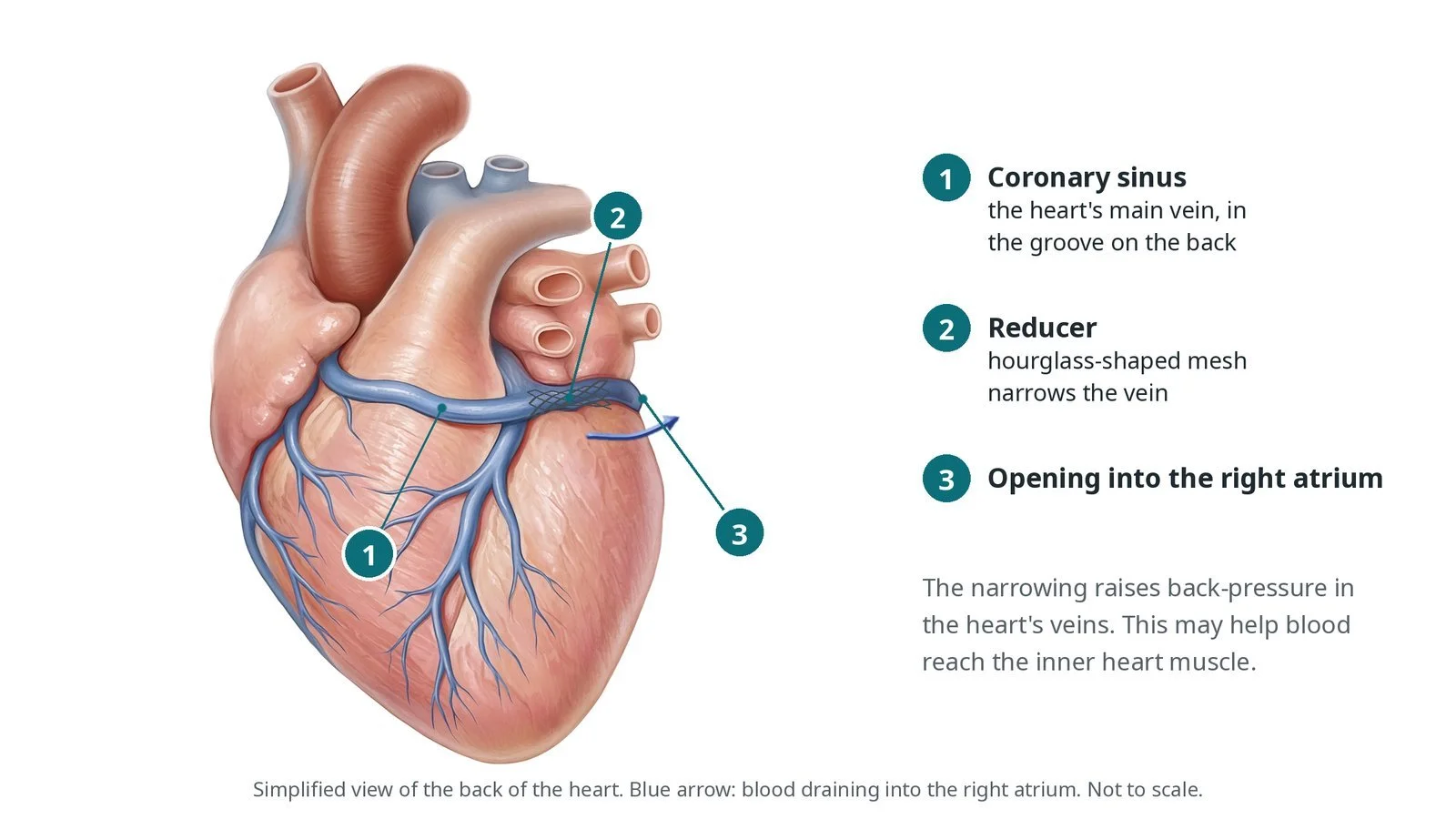
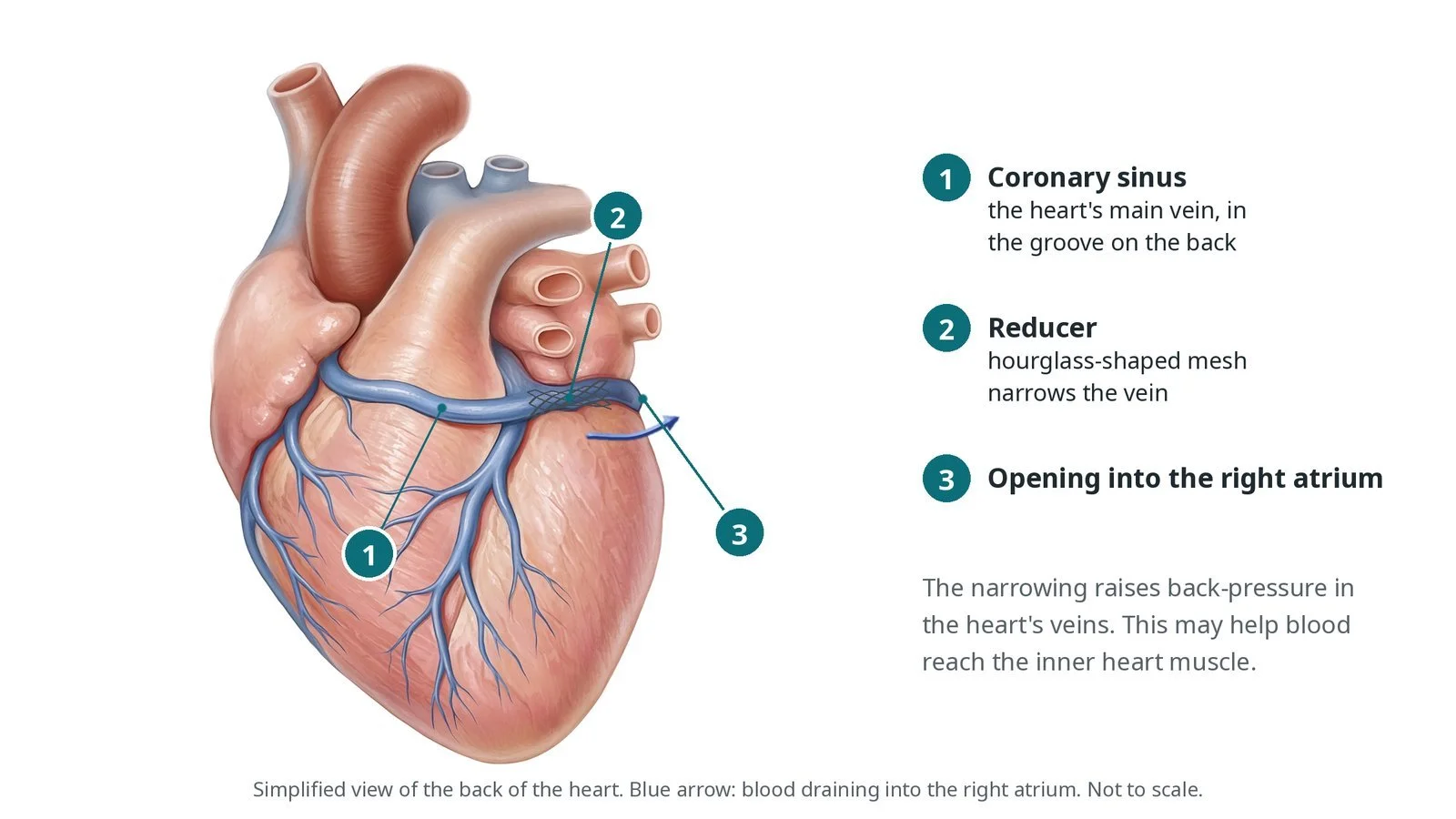
Back of the heart: (1) the coronary sinus, the heart's main vein, runs in the groove on the back and drains into the right atrium at (3). (2) The reducer is an hourglass-shaped mesh that narrows the vein, raising back-pressure in the heart's veins; this may help blood reach the inner heart muscle.
What is coronary sinus reducer?
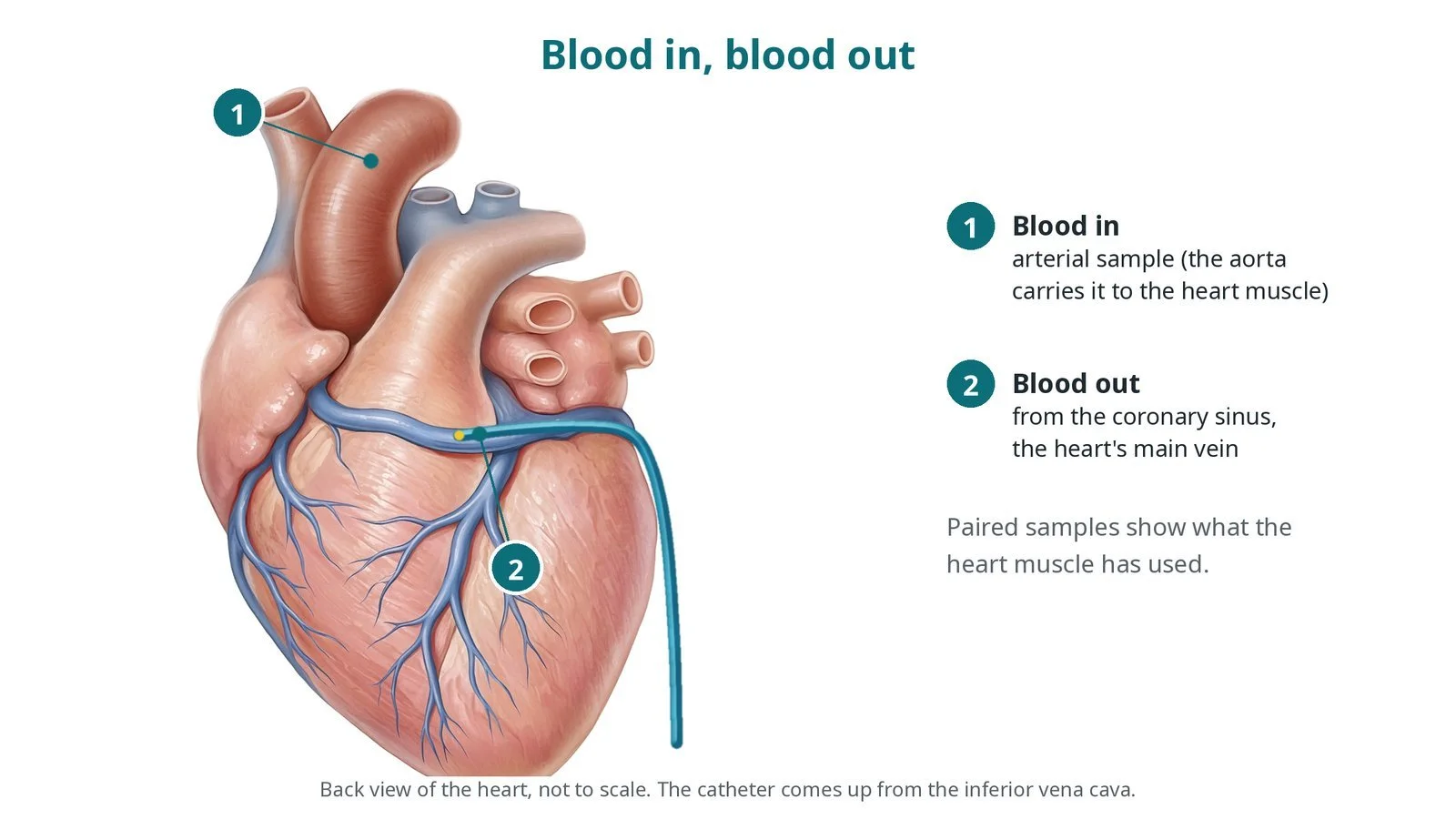
The coronary arteries bring blood to the heart muscle. After it has been used, the blood drains through the heart's veins into the coronary sinus, a large vein in the groove at the back of the heart. The coronary sinus empties into the right atrium.
When arteries are narrowed, the inner layer of heart muscle (the subendocardium) is usually the first to run short of blood. The reducer creates a fixed narrowing in the coronary sinus. This raises the back-pressure in the heart's veins slightly, which is thought to redistribute blood towards the inner, short-of-blood muscle.
The device is a balloon-expandable steel mesh with an hourglass shape. Over the following weeks tissue grows over it and the narrow waist forms fully, so any improvement in angina is gradual.
New to the acronyms? See the Cath Lab Abbreviations A–Z.
Who is it for?
Adults with angina that limits daily life despite the best medicines, evidence of reduced blood flow to the heart muscle, and no option for further stents or bypass surgery, as agreed by the heart team.
The ORBITA-COSMIC trial (2024) found fewer angina episodes with the reducer than with a placebo procedure. The 2024 ESC chronic coronary syndromes guideline gives it a class IIb recommendation (may be considered). NICE has published interventional procedure guidance on it.
Who it may not suit: People with high pressure in the right atrium, a pacing lead already in the coronary sinus, or unsuitable coronary sinus anatomy. The team checks this before and during the procedure.
The decision is made by your heart team, who will talk through the reasons, the alternatives and the risks with you.
When is it done?
As a planned procedure, often a day case. Before it, the team checks the heart scans, kidney function and blood thinners, and that the coronary sinus is suitable.
gives you a chance to ask questions and give consent
arranges blood tests, including kidney function and a blood count, and an ECG
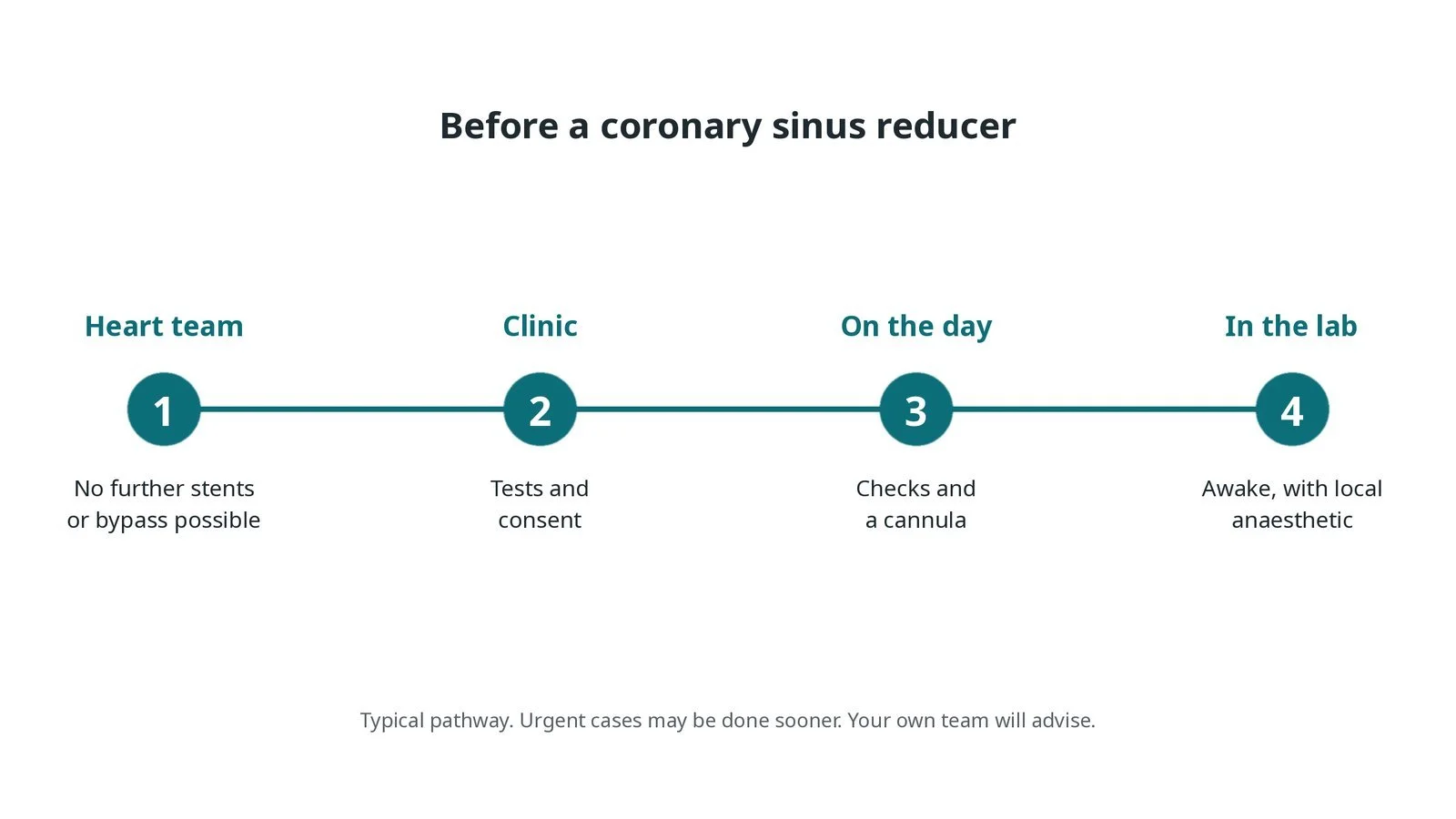
Before a coronary sinus reducer: the heart team agrees no further stents or bypass are possible; tests and consent; checks and a cannula on the day; awake with local anaesthetic.
Step by step
1. Getting ready
You lie on the X-ray table with ECG, blood pressure and oxygen monitoring. The right side of the neck is cleaned and covered with sterile drapes.
2. Access
Under ultrasound and local anaesthetic, a sheath is placed in the right internal jugular vein in the neck. Heparin is given as per centre protocol. A catheter passes down the superior vena cava into the right atrium.
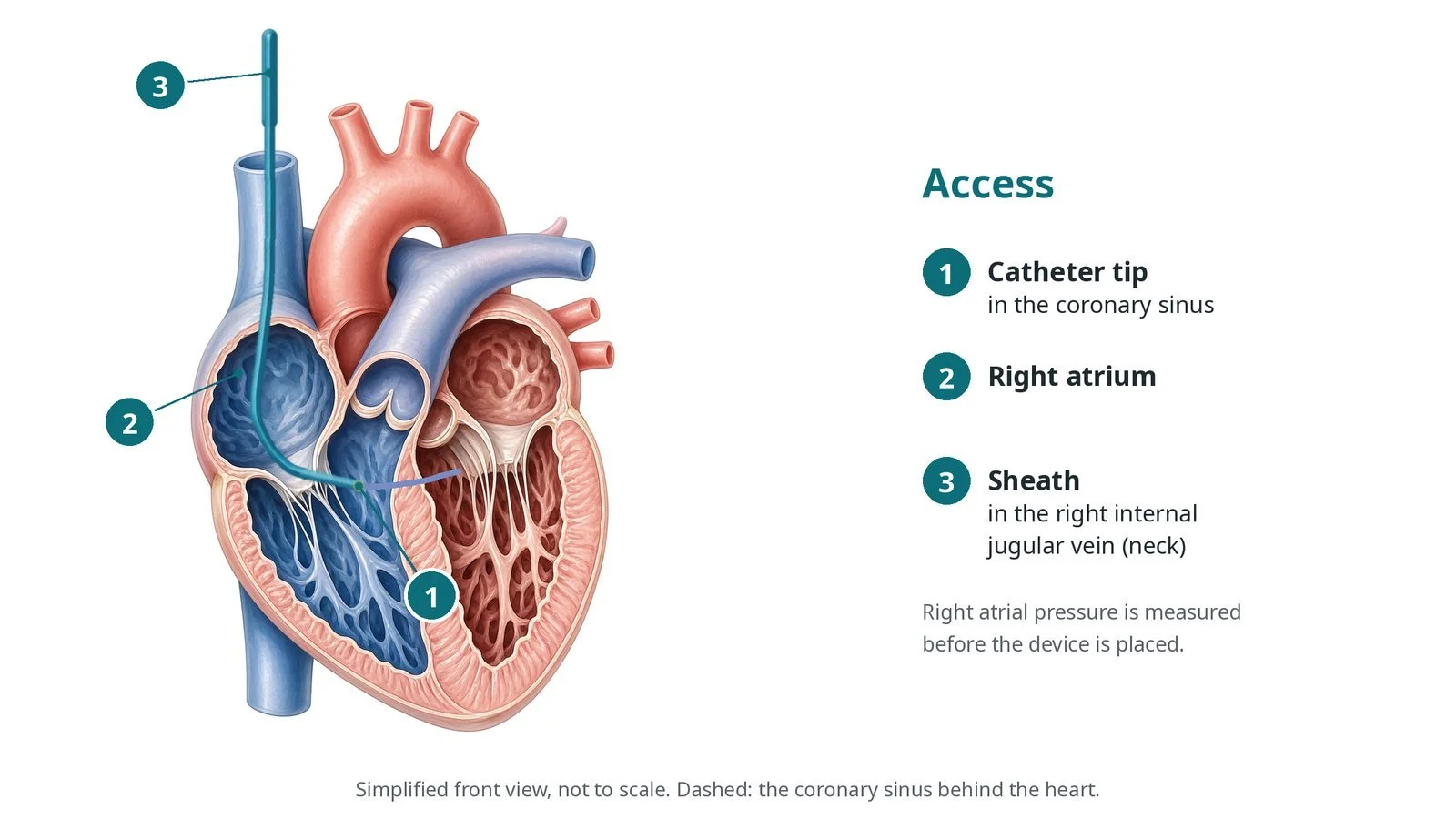
Access: (1) catheter tip in the coronary sinus; (2) right atrium; (3) sheath in the right internal jugular vein in the neck. Right atrial pressure is measured before the device is placed.
3. Placing the reducer
A. Right atrial pressure. The pressure in the right atrium is measured first. If it is high, the device is not placed.
B. Venogram. A catheter is passed into the coronary sinus and contrast is injected to outline it and measure its size.
C. Device on a balloon. Over a wire, a guide is advanced into the coronary sinus. The reducer, mounted on its hourglass-shaped balloon, is positioned and the balloon inflated to the pressure the maker states.
D. Reducer in place. The balloon is deflated and removed, leaving the reducer with its narrow waist. A final venogram checks the position.
Watch: Contrast leaking outside the coronary sinus suggests a tear. Tell the operator at once and watch the blood pressure.
4. Finishing
The catheters are removed. The neck sheath is taken out and pressure is applied until bleeding stops. You sit up gradually.
Watch: Swelling in the neck or breathing difficulty after sheath removal needs urgent review.
5. After the procedure
Antiplatelet medicines are usually continued for some months, as advised. Angina is reviewed in clinic; the effect is judged over months, not days.
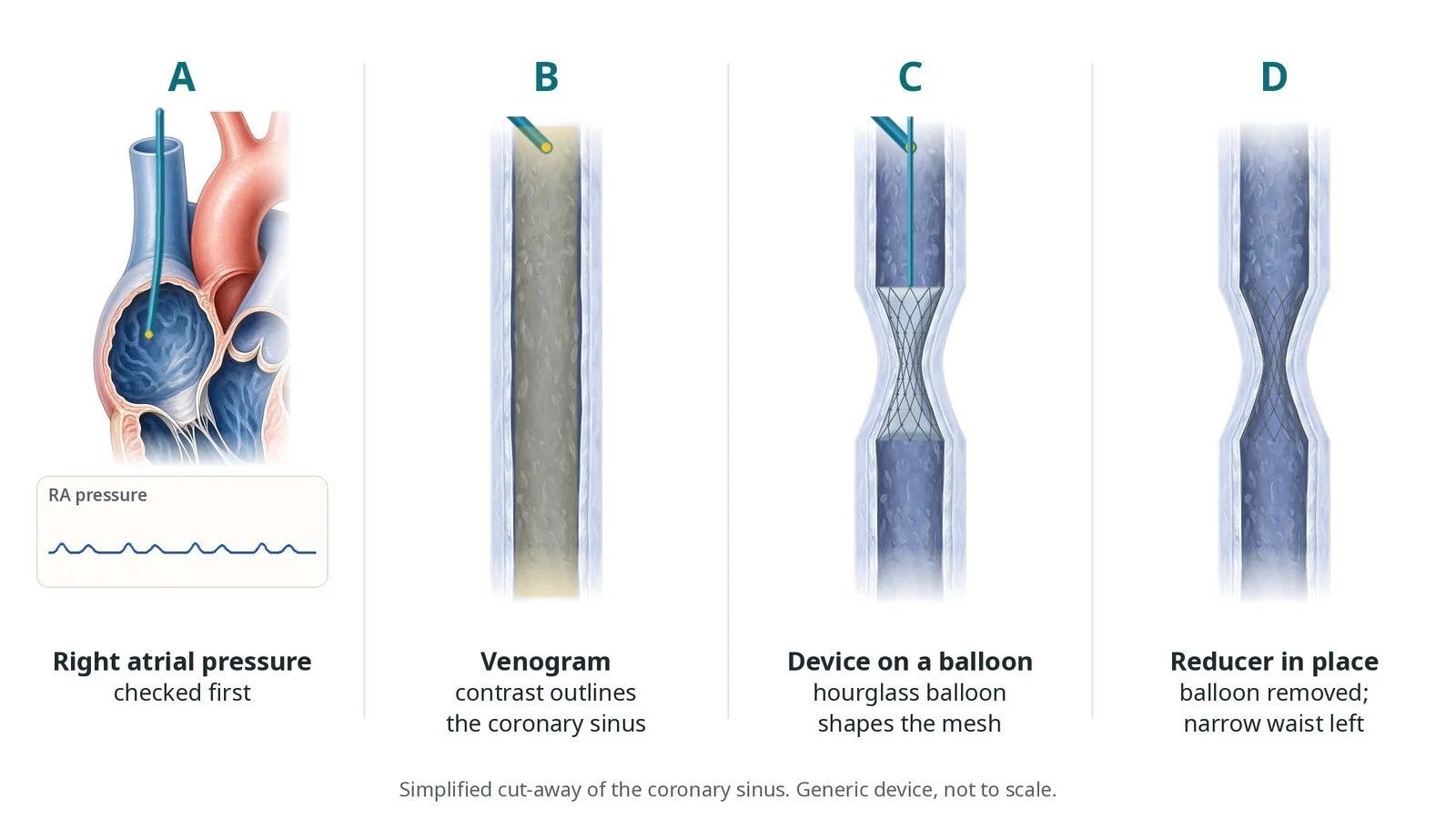
A: right atrial pressure is checked first. B: a venogram outlines the coronary sinus. C: the device is expanded on an hourglass-shaped balloon. D: the balloon is removed, leaving the narrow waist.
Recovery and aftercare
First hours: neck, heart rhythm and blood pressure checks, as per centre protocol.
Going home: the same or next day for most.
Medicines: antiplatelet medicines for some months, as advised; keep taking your angina medicines unless told otherwise.
Activity: avoid heavy lifting and strenuous activity for a few days, or as advised.
Driving: ask your team; DVLA rules depend on your angina and how you feel.
Follow-up: angina is reviewed in clinic over the following months.
Call 999 if you have chest pain that does not settle with your GTN, breathlessness, fainting, or swelling or heavy bleeding at the neck.
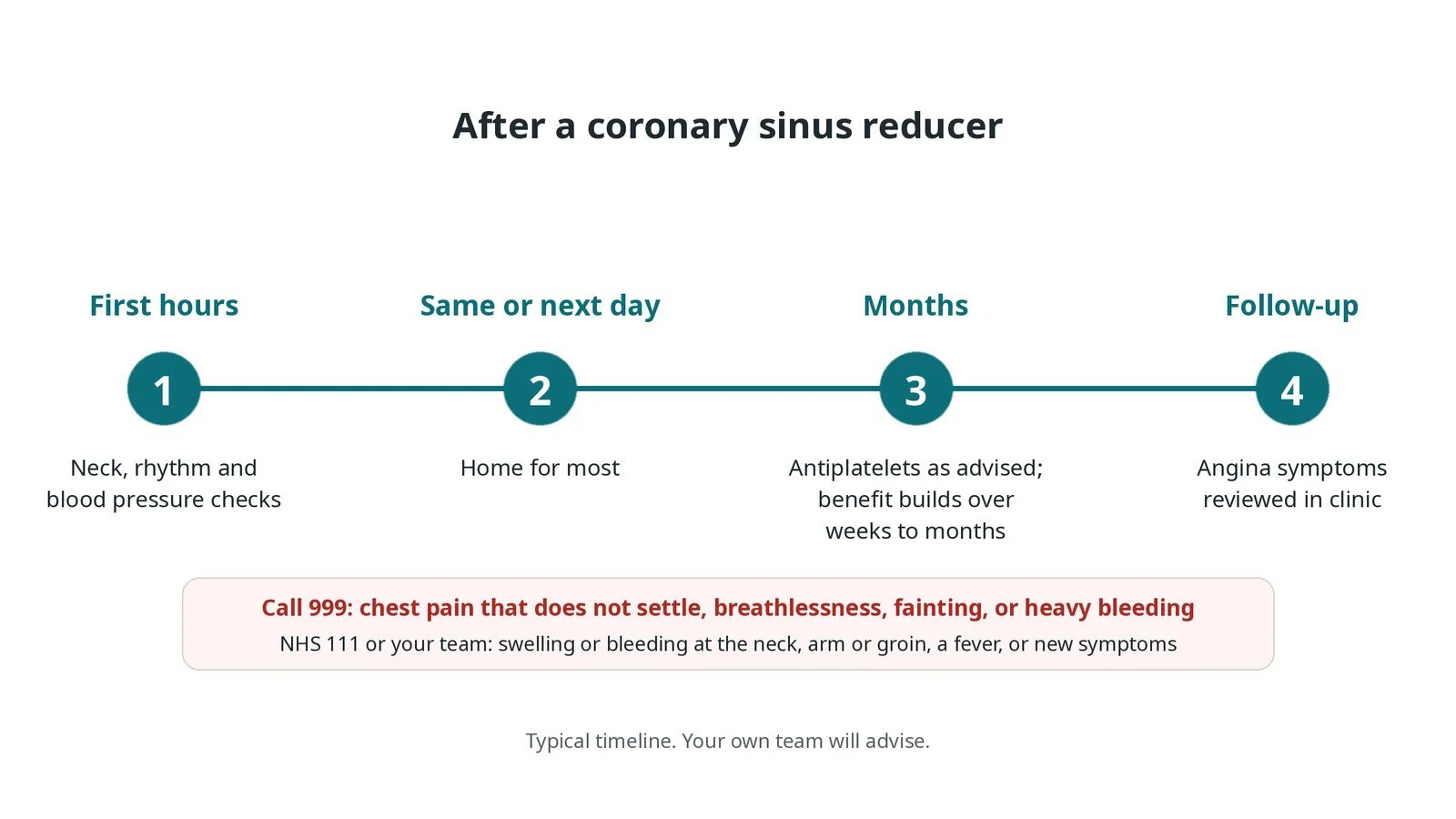
After a coronary sinus reducer: (1) neck, rhythm and blood pressure checks; (2) home the same or next day for most; (3) antiplatelets as advised, with benefit building over weeks to months; (4) angina reviewed in clinic.
Risks and complications
Your team will explain the risks that apply to you. Possible problems include:
Bleeding or bruising at the neck
Tear or perforation of the coronary sinus (rare)
Device moving out of position (rare)
Heart rhythm disturbance during the procedure (uncommon)
Puncture of the artery or lung during neck access (rare)
Angina not improving: Not everyone benefits.
Cath lab kit list (printable)
Barts example kit list
An example from one UK centre, written generically. Every lab has its own protocol, and sizes and doses vary.
ultrasound with a sterile probe cover
venous sheath for the jugular vein, size per device
multipurpose or other shaped catheter to enter the coronary sinus
guidewires, per operator
coronary sinus guide catheter, per device
coronary sinus reducer on its balloon, size per measurements
inflation device
pressure transducer and monitoring
contrast and heparin, as per centre protocol
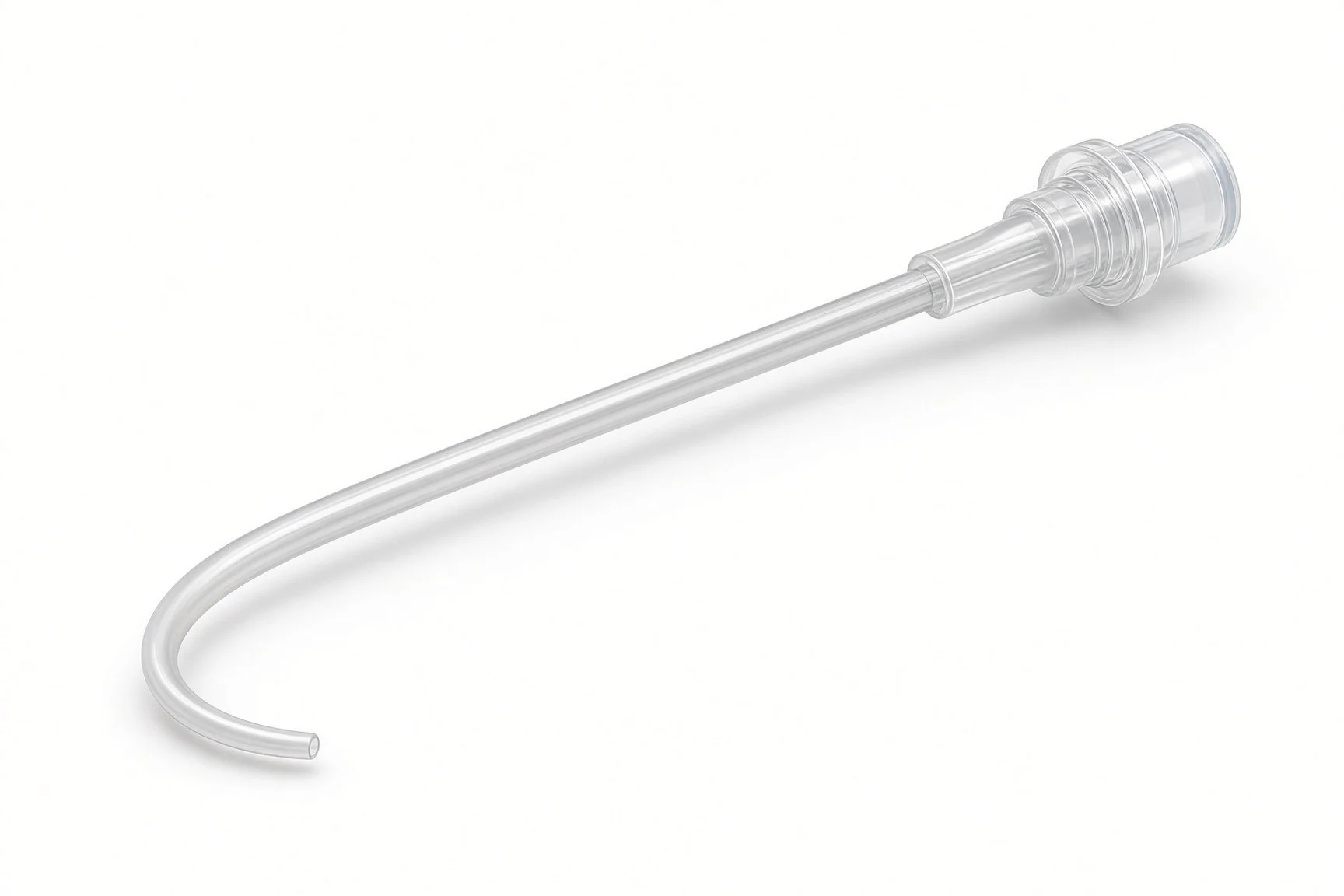
Multipurpose catheter.
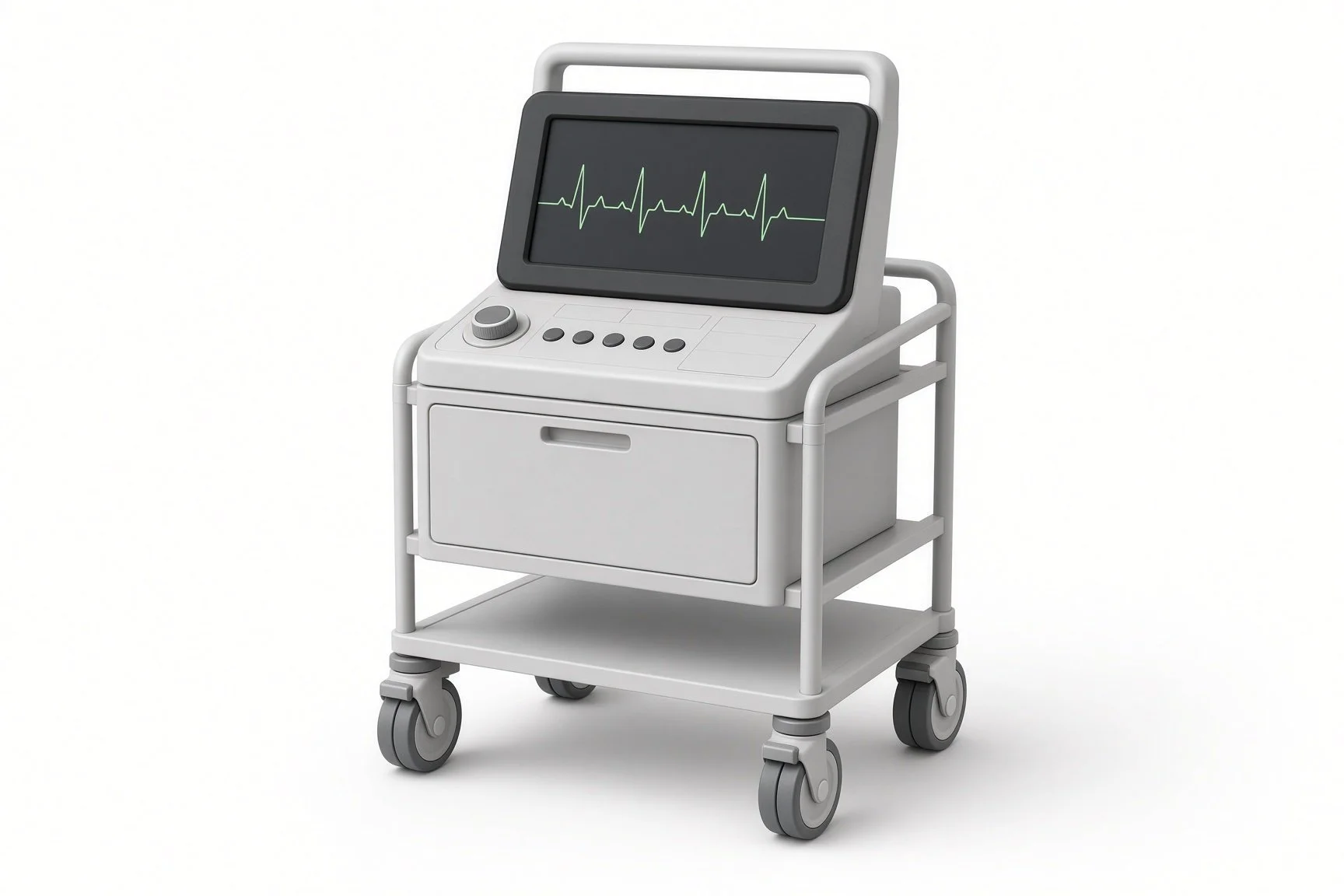
Pressure transducer.
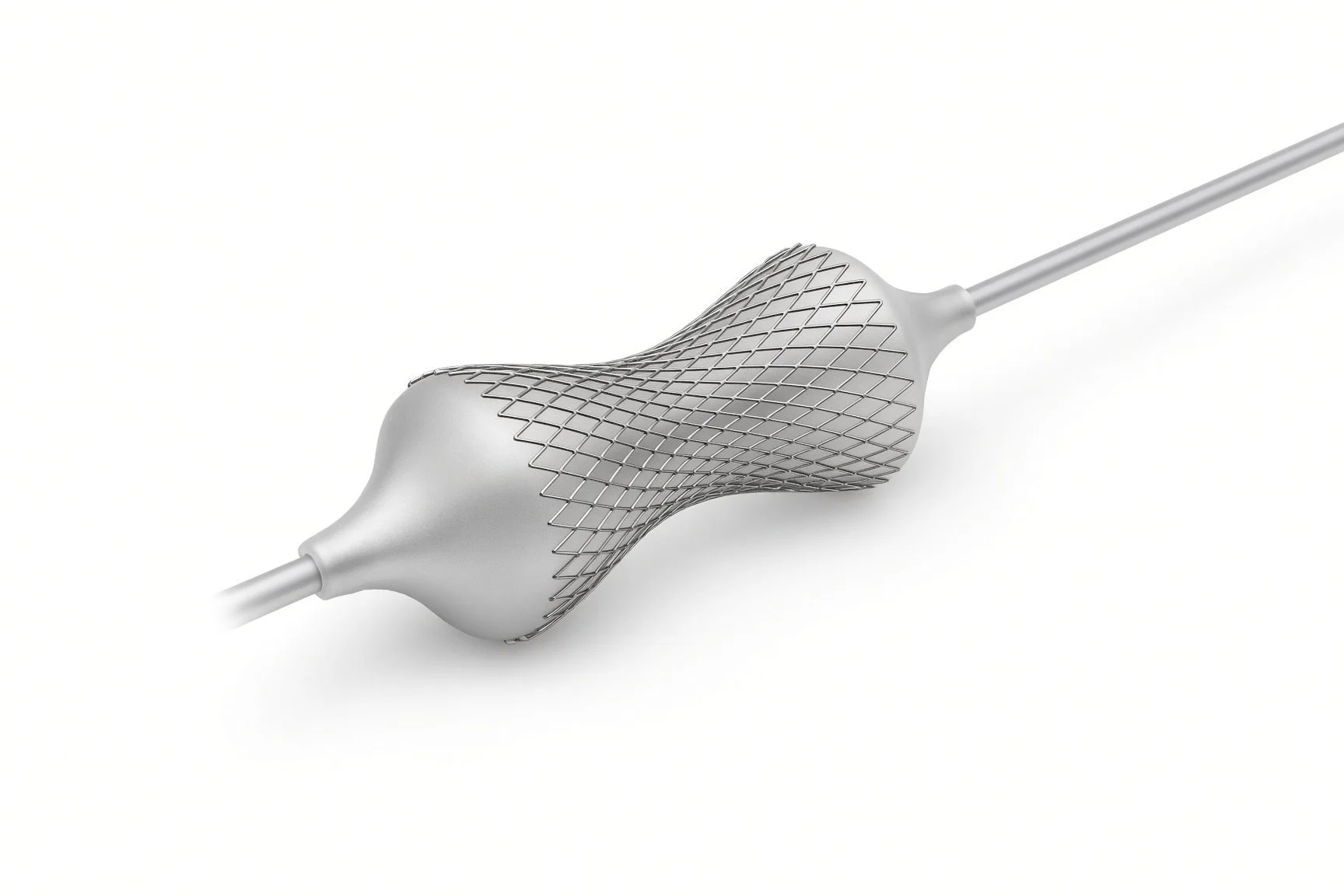
Reducer on its balloon.
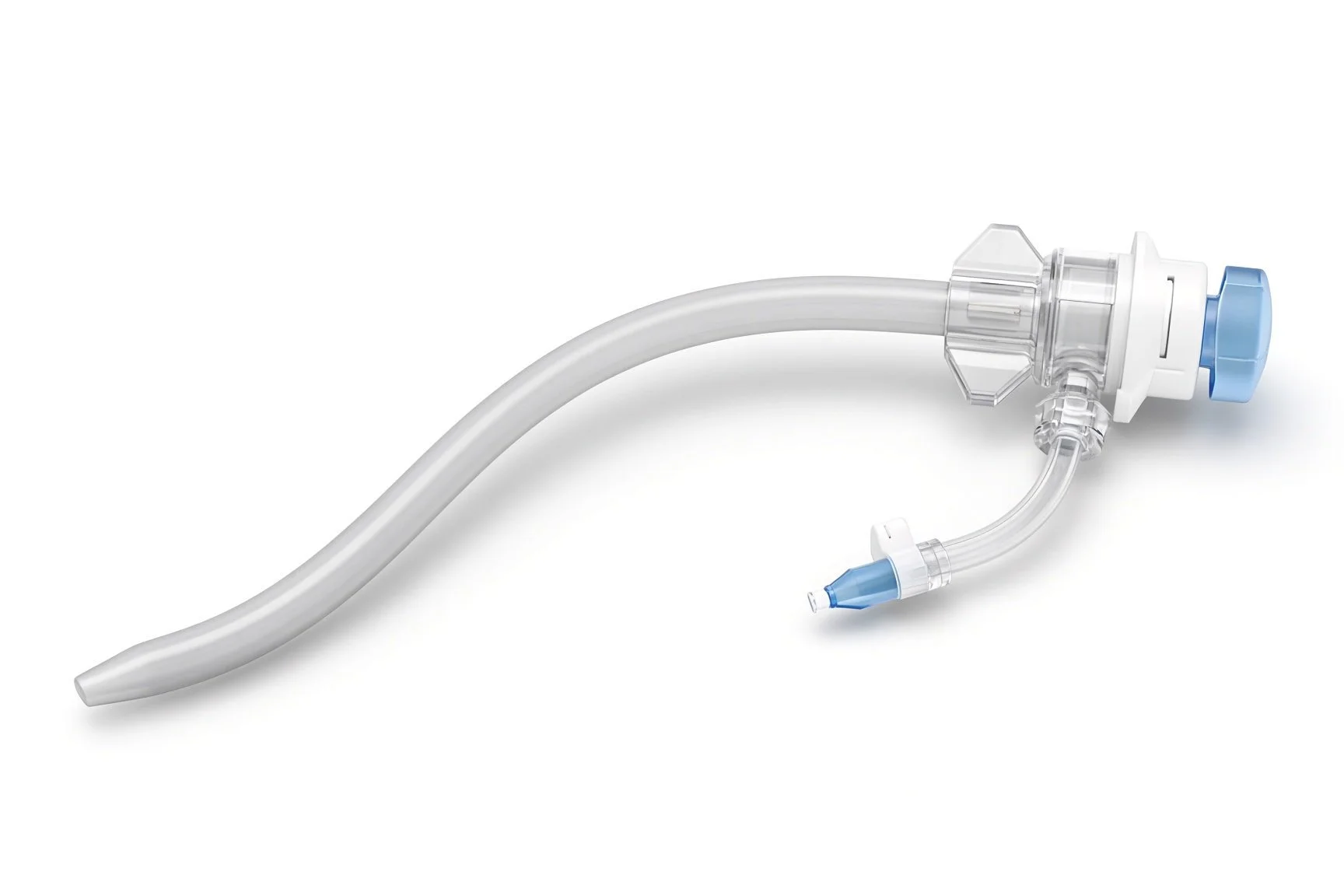
Coronary sinus guide catheter.
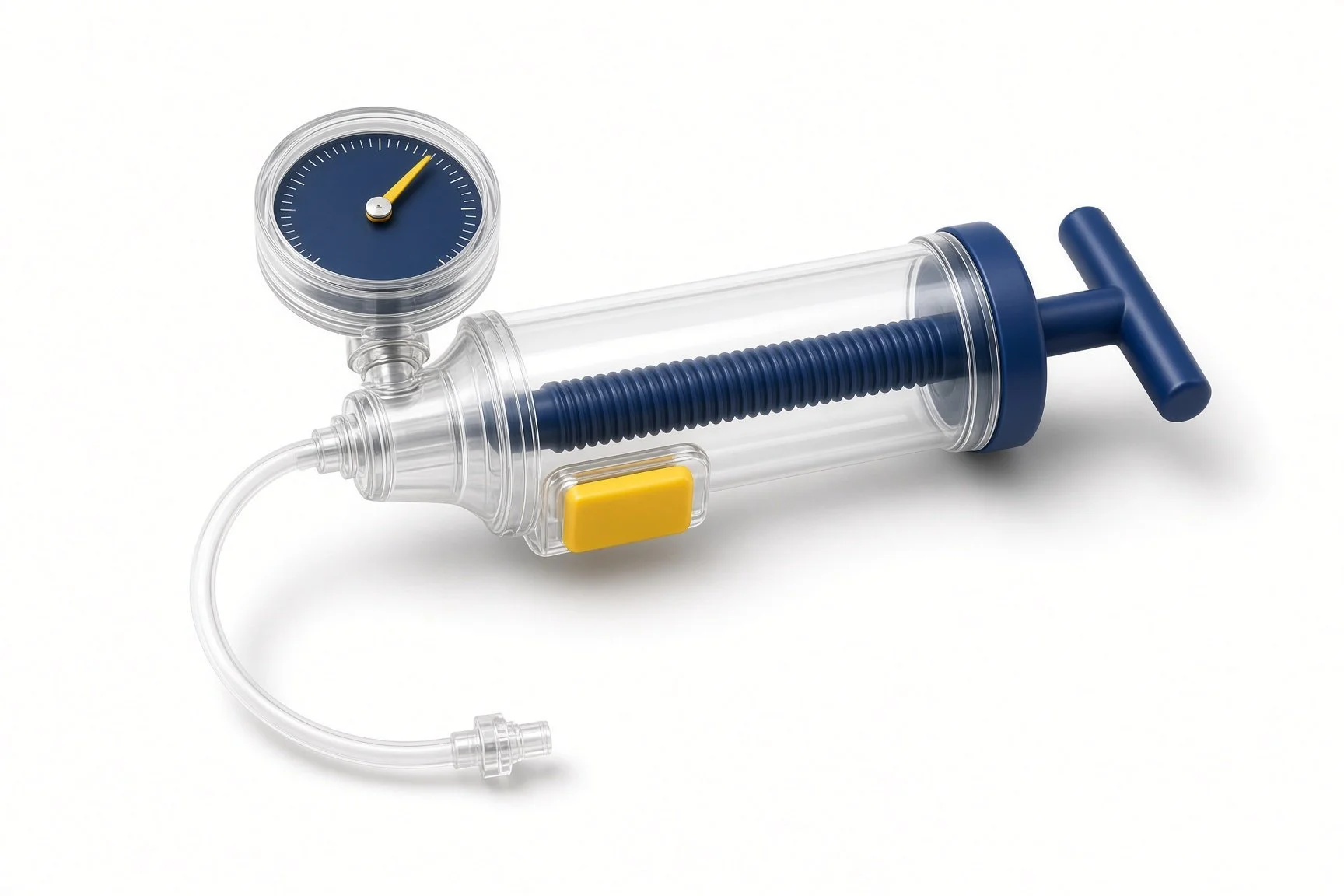
Inflation device.
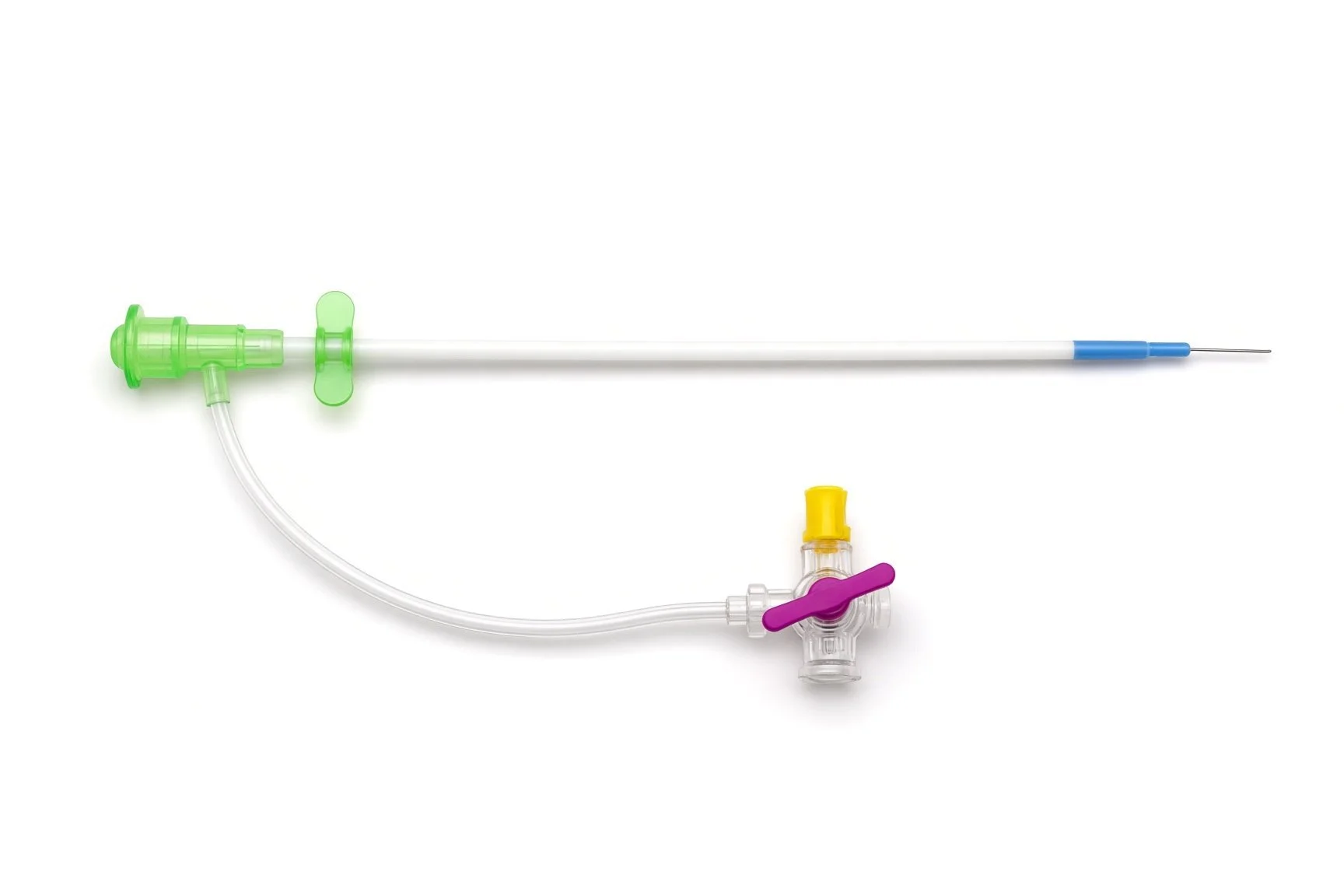
Venous sheath.

Contrast.
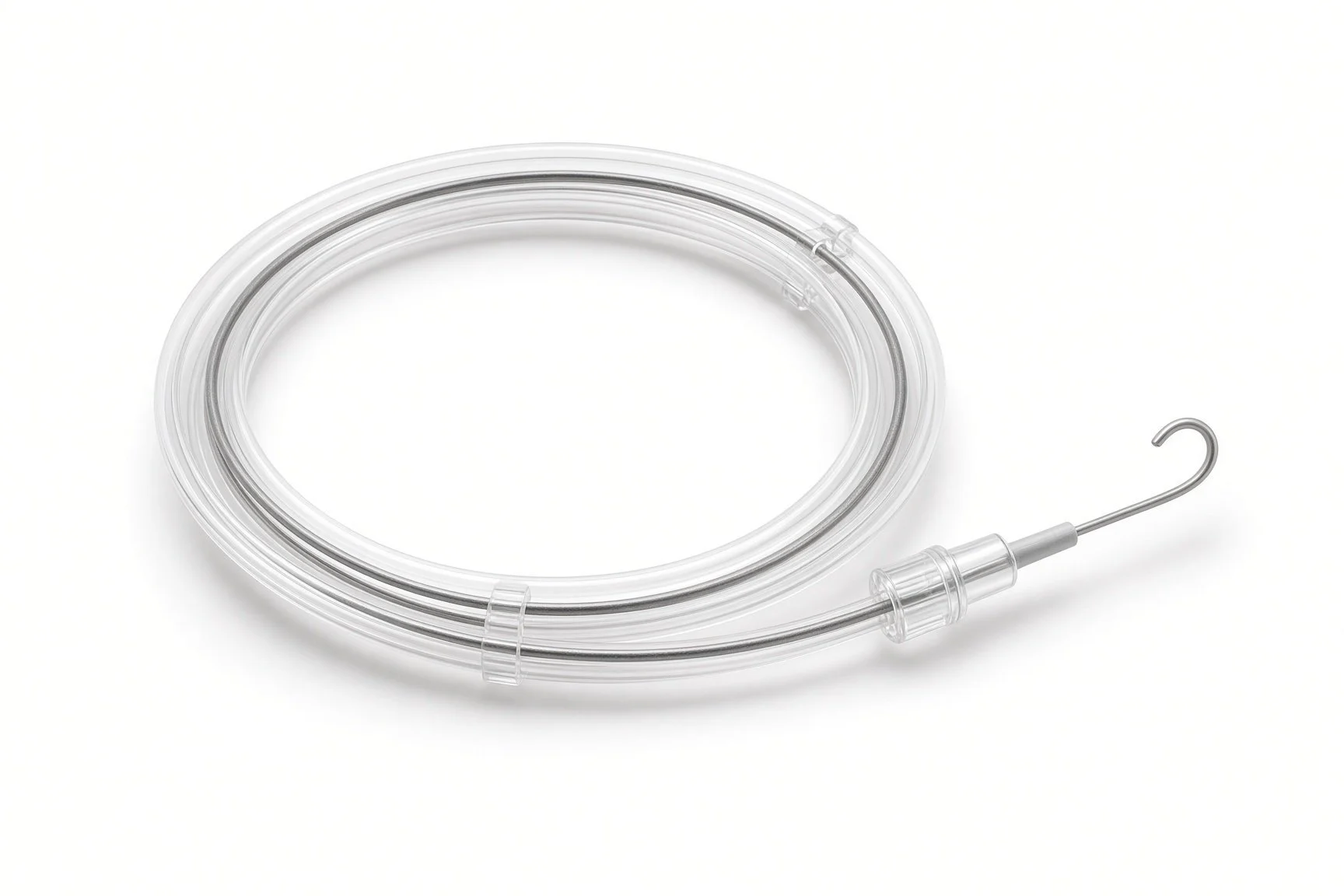
Guidewire.
Procedural steps (Barts example)
Getting ready
Access
Placing the reducer
Finishing
After the procedure
First time in the cath lab?
The pressure matters. Right atrial pressure is measured before the device is placed, and a high value can stop the procedure; zero and level carefully.
Neck access means a different set-up. Position the patient's head, the ultrasound and the screens before scrubbing.
Benefit is slow. Explain to the patient that angina may not improve for weeks to months.
Watch the neck afterwards. Bleeding from the jugular site is usually easy to control with pressure, but check for swelling.
Have the ultrasound probe covered and ready. Ultrasound guidance lowers the risk of puncturing the artery or lung.
Zero and level the transducer before the right atrial pressure is measured. The decision to go ahead depends on it.
Record the measured coronary sinus size and the inflation pressure as they happen.
FAQ
How soon will I feel better?
Any improvement usually builds over weeks to months as the device settles in.
Does it replace my medicines?
No. Most people continue their angina medicines; some may need fewer over time.
Can it be removed?
It is designed to stay in place permanently.
Will everyone benefit?
No. Trials show fewer angina episodes on average, but not everyone improves.
Related Cath Lab 101 guides
Coronary function testing (CFR, IMR and acetylcholine) (coming soon)
Sources
All checked on 12 November 2026. Each page's own date is shown where it gives one.
Vrints C, et al. 2024 ESC Guidelines for the management of chronic coronary syndromes. Eur Heart J 2024;45(36):3415–3537. PubMed 39210710
Foley MJ, et al. Coronary sinus reducer for the treatment of refractory angina (ORBITA-COSMIC): a randomised, placebo-controlled trial. Lancet 2024
Verheye S, et al. Efficacy of a device to narrow the coronary sinus in refractory angina. N Engl J Med 2015
StatPearls (NCBI Bookshelf), search: refractory angina. ncbi.nlm.nih.gov/books
Disclaimer
Education only. This page is for general education for healthcare students, cath lab staff and curious readers. It isn't medical advice and doesn't replace advice from your own doctor, heart team or local unit protocols. Equipment and medicines are described generically. No product or manufacturer is recommended. If you think someone is having a heart emergency, call 999.
Disclosure: I work in the medical device industry. This page is independent education and isn't sponsored or reviewed by any company.
All diagrams on this page are original illustrations created for rodnieoro.com.