Fractional flow reserve (FFR) and pressure wire tests: a Cath Lab 101 guide
Reviewed by Rodnie Oro, cath lab charge nurse · Last reviewed: October 2026 · Education only, not medical advice
FFR in one minute
What it is: a pressure wire test that measures how much a narrowing in a heart artery reduces blood flow.
Who it is for: people having an angiogram where it is unclear whether a narrowing needs a stent.
Main risks: the risks of the angiogram, plus brief flushing, breathlessness or chest tightness from the medicine sometimes used, and rare artery injury.
Usually: a few extra minutes during an angiogram or PCI.
On this page: What is FFR? · Who is it for? · When is it done? · Step by step · Recovery · Risks · Kit list · First time in the lab? · FAQ
What is FFR?
Not every narrowing seen on an angiogram reduces blood flow.
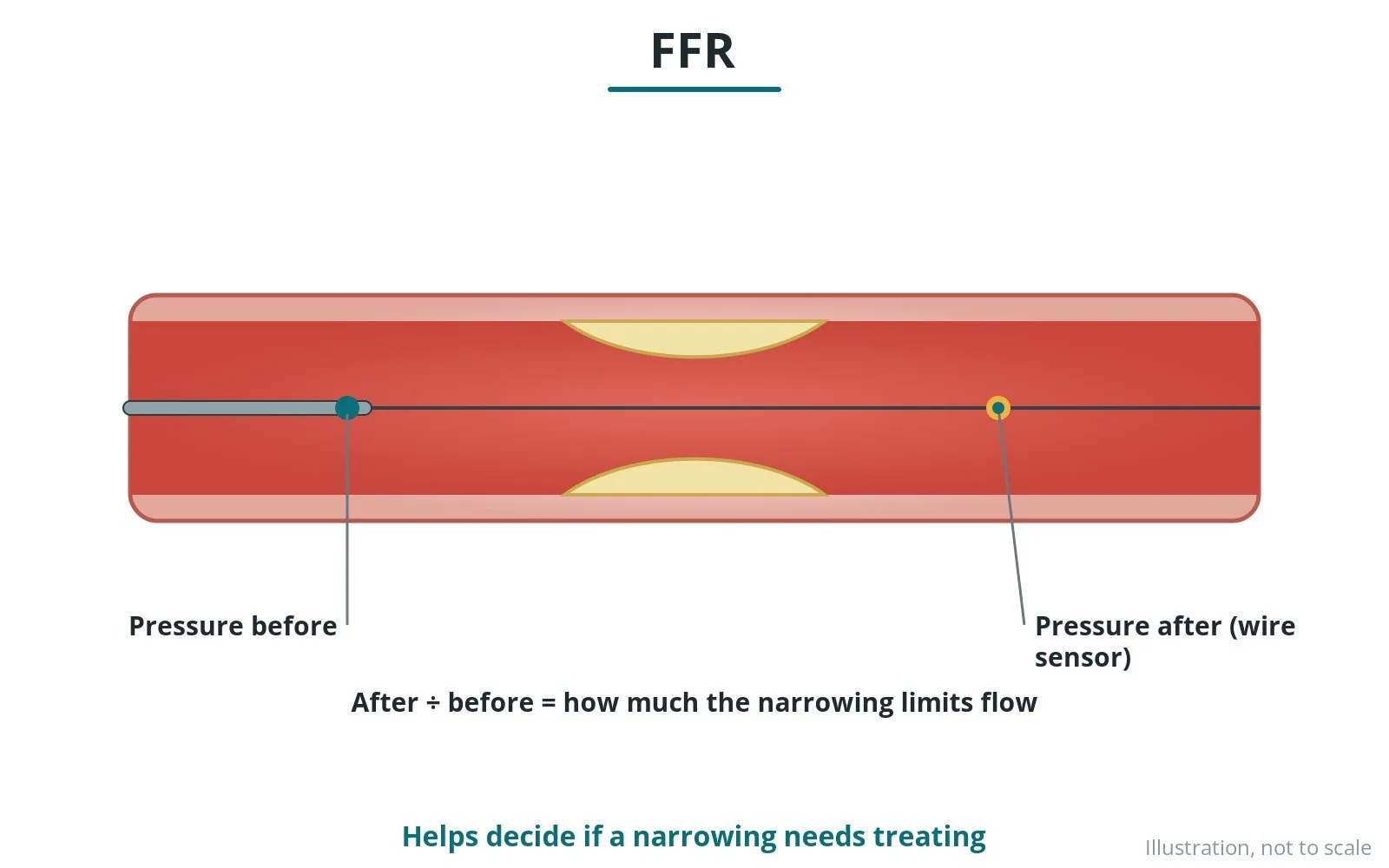
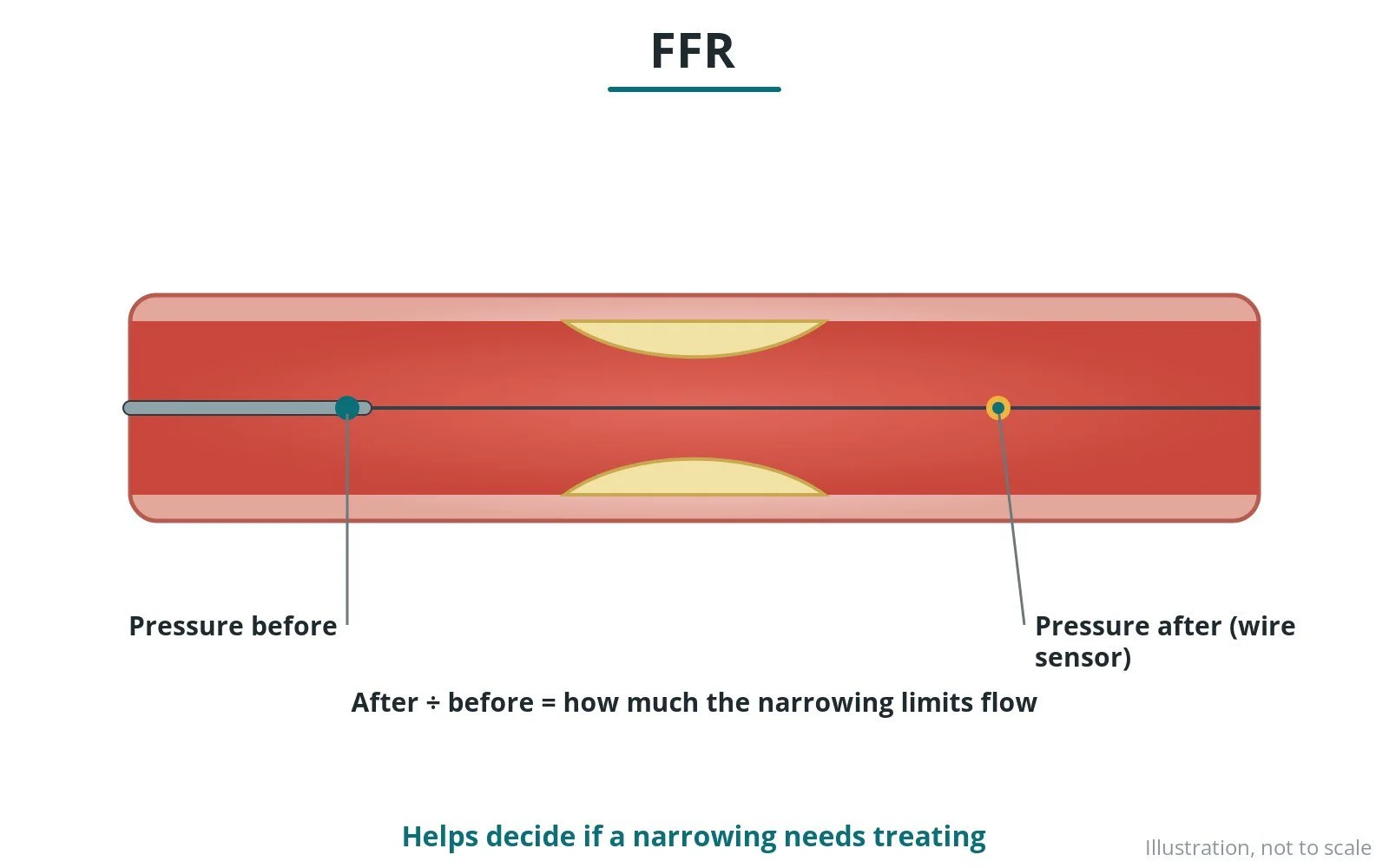
- a thin pressure wire is passed beyond the narrowing
- it compares pressure beyond the narrowing with pressure in the aorta
- for FFR, a medicine is given to widen the small vessels, dose as per centre protocol
- some tests (resting indices) don't need the medicine
The result helps the team decide whether to stent.
New to the acronyms? See the Cath Lab Abbreviations A–Z.
Who is it for?
It may be considered for people with:
- narrowings of uncertain importance
- several narrowings, to decide which to treat
- checking the result after PCI
The decision is made by your heart team, who will talk through the reasons, the alternatives and the risks with you.
When is it done?
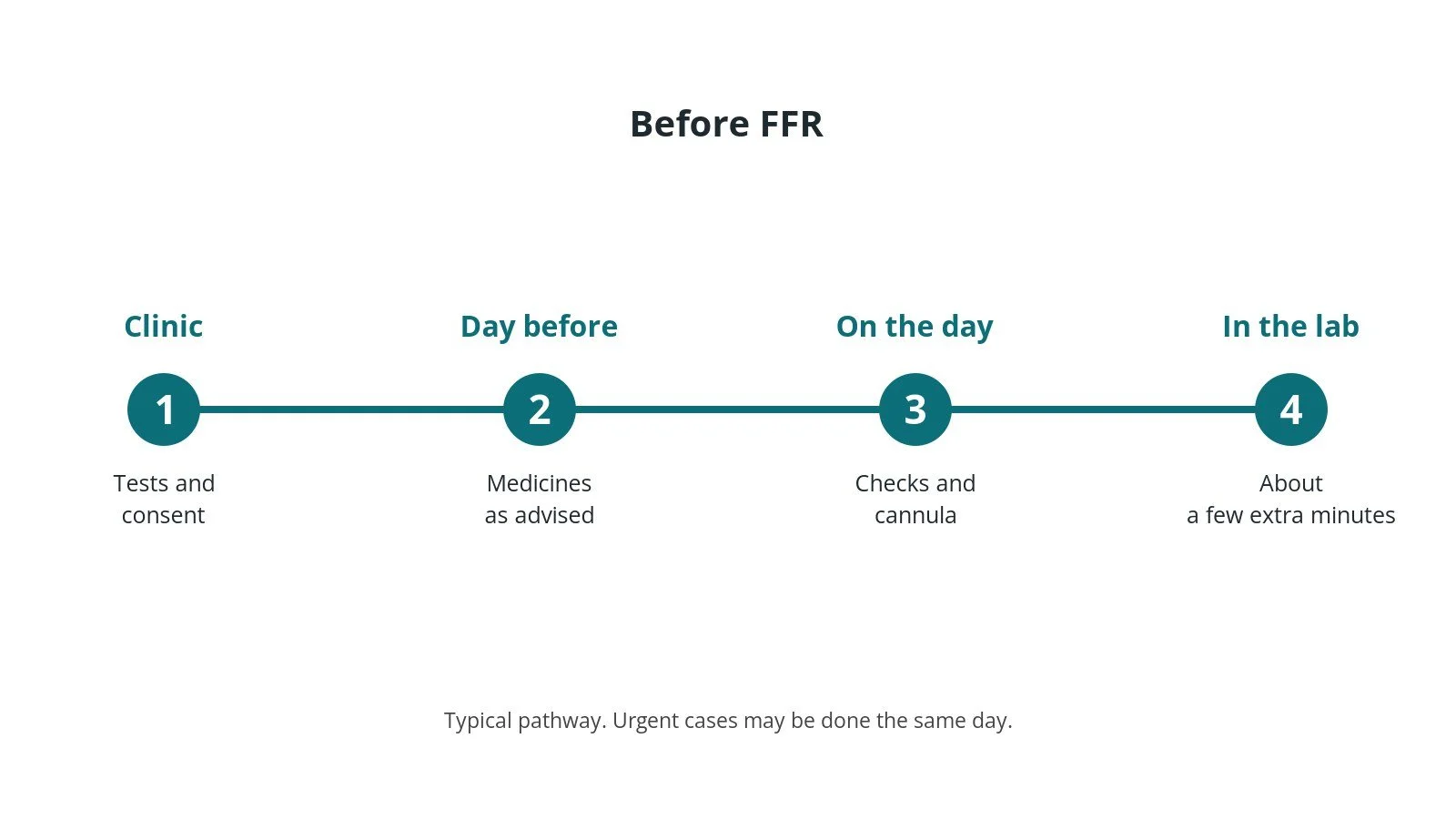
It can be planned in advance or done urgently. Before it, you usually have:
- blood tests, including kidney function and blood count
- an ECG, and often an echo or other scan
- a review of your medicines, especially blood thinners and diabetes medicines, as per centre protocol
- a chance to ask questions and give consent
Step by step
1. Getting ready
You lie on the X-ray table. The wrist (or groin) is numbed with local anaesthetic. ECG, blood pressure and oxygen levels are monitored. You may be given medicines to thin the blood, as per centre protocol.
2. Access
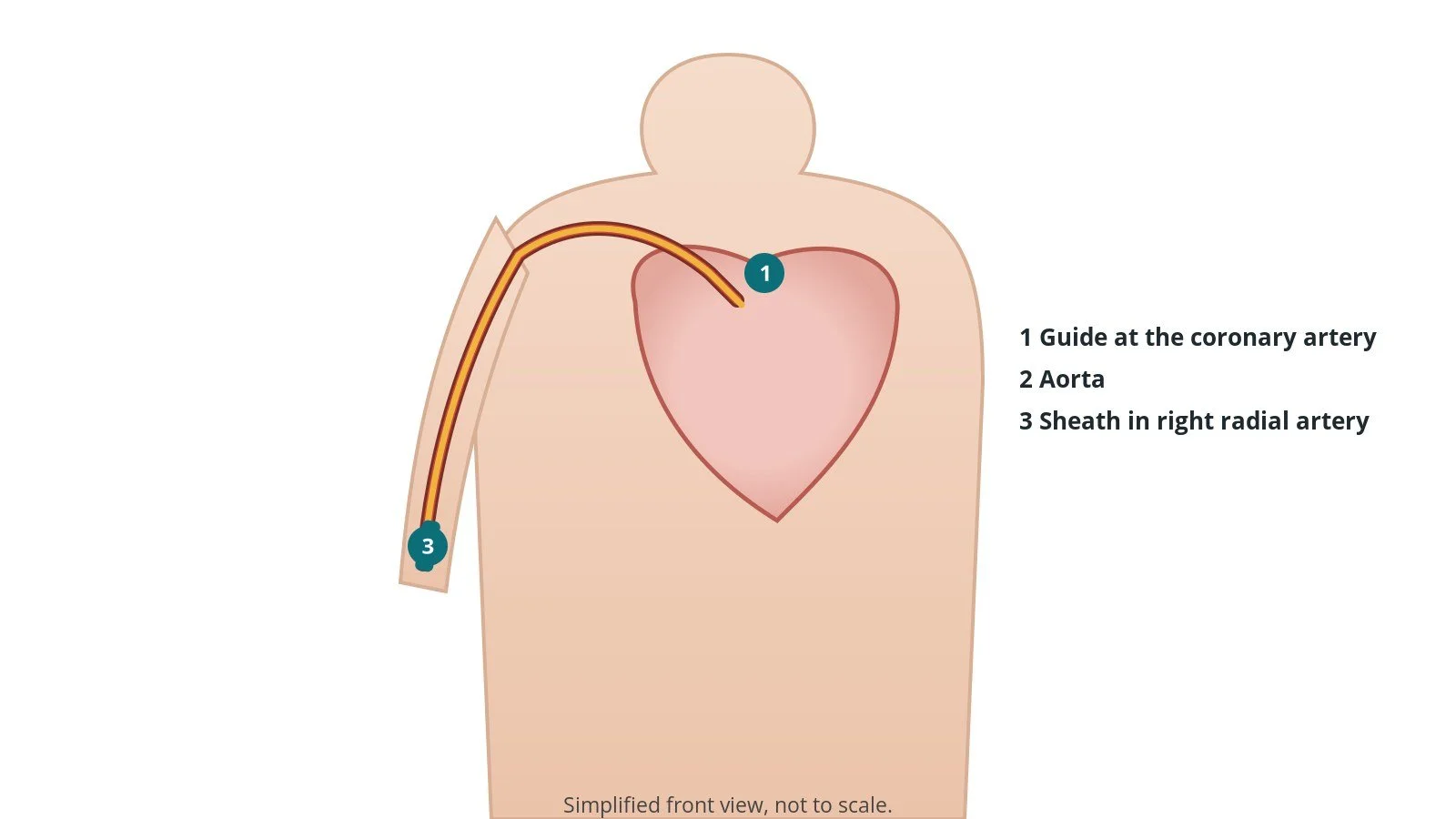
A sheath is placed in the radial artery at the wrist or the femoral artery in the groin, sizes per device and operator. A guide catheter is placed at the opening of the coronary artery and heparin is given, dose as per centre protocol. A thin guidewire is passed across the narrowing.
3. Measurement
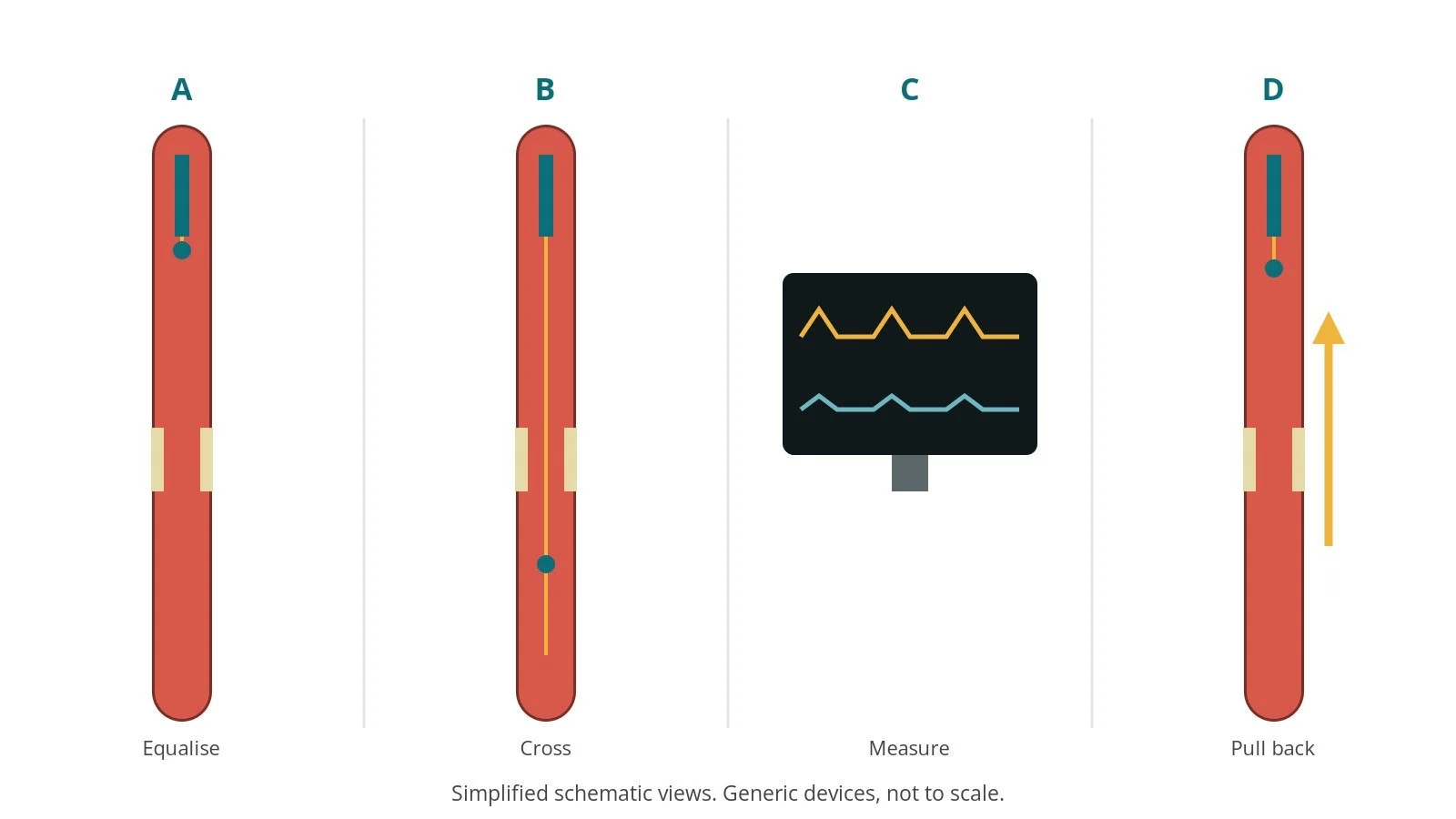
- A. Equalise. The wire is equalised at the tip of the guide.
- B. Cross. It is passed beyond the narrowing.
- C. Measure. Pressures are compared, with or without medicine.
- D. Pull back. The wire is pulled back to check for drift.
If the medicine is used you may feel flushed, short of breath or tight in the chest for a minute.
4. Finishing
A final angiogram checks the result. The sheath is removed and the wrist closed with a pressure band, or the groin with pressure or a closure device, per device and operator.
Recovery and aftercare
- After the procedure: recovery depends on the main procedure (usually an angiogram or PCI).
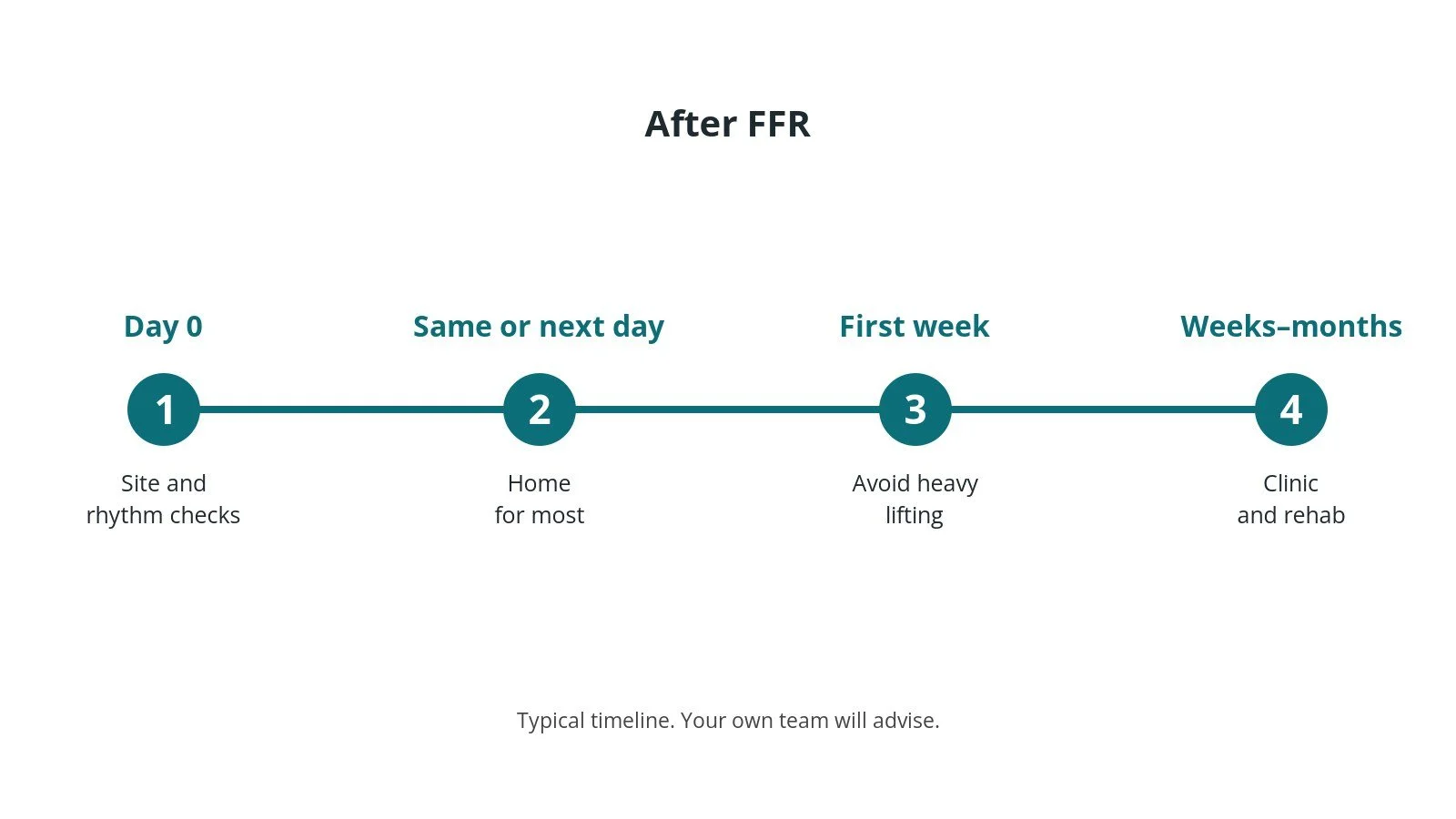
- Going home: often the same day.
- Results: the images are stored and used to guide treatment.
- Medicines: take your blood thinners exactly as prescribed; don't stop them without talking to your heart team.
- Activity: avoid heavy lifting with the treated arm or leg for a few days.
Call 999 if you have chest pain, breathlessness, fainting, signs of a stroke, or heavy bleeding or swelling at the access site.
Risks and complications
Your team will explain the risks that apply to you. Possible problems include:
- the risks of the angiogram or PCI it is part of
- artery spasm, usually relieved with medicines
- artery tear or blockage (rare)
- rhythm disturbances (rare)
Cath lab kit list (printable)
Barts example kit list
An example from one UK centre, written generically. Every lab has its own protocol, and sizes and doses vary.
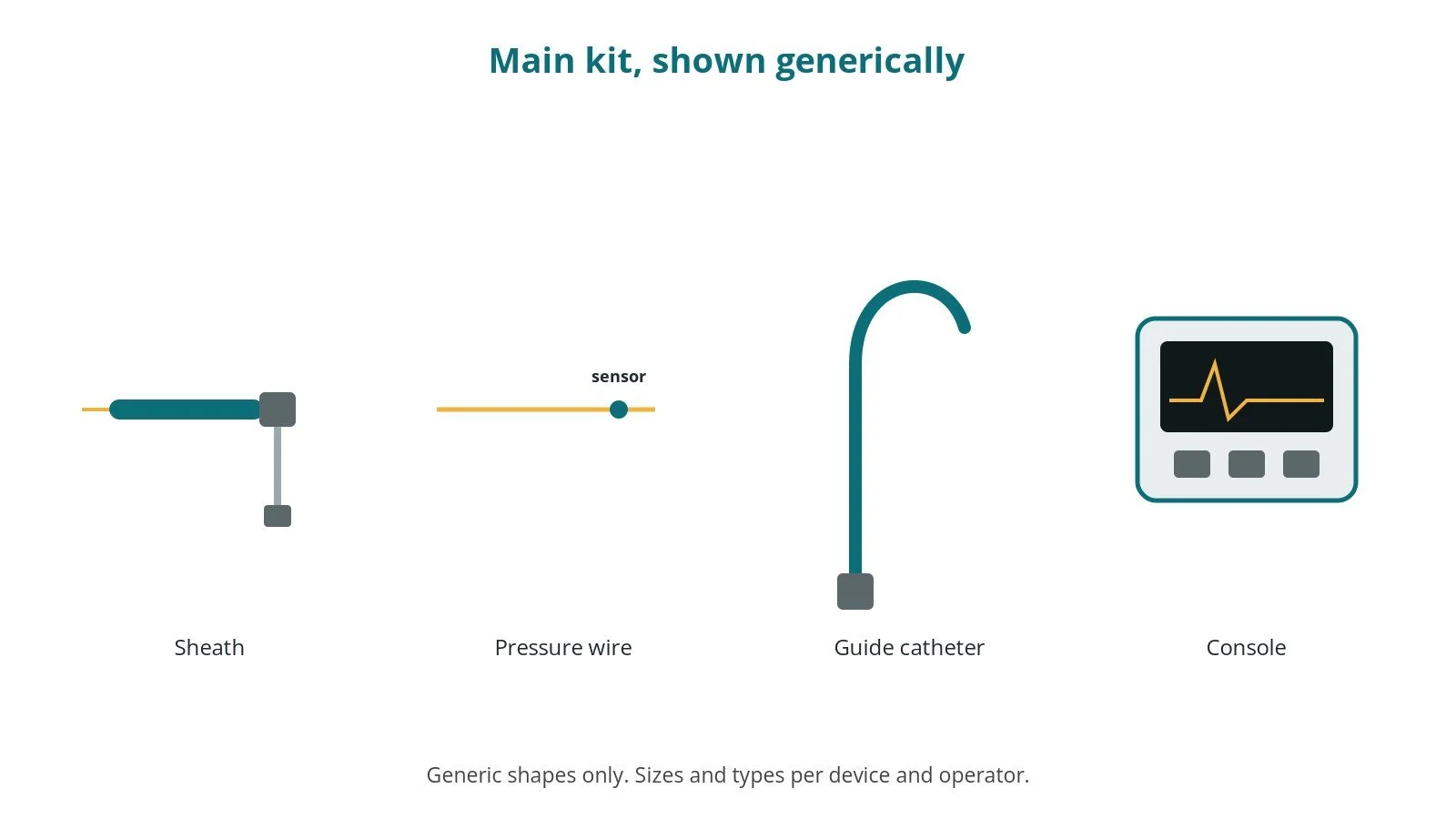
- radial or femoral arterial sheath, size per device and operator
- guide catheter, shape per operator
- coronary guidewire, per operator
- Y-connector and flush set
- heparin, as per centre protocol
- pressure wire and console, per device and operator
- hyperaemia medicine, as per centre protocol
- nitrate, as per centre protocol
Procedural steps (Barts example)
- Guide engaged; heparin and nitrate
- Pressure wire equalised
- Wire beyond lesion
- Resting index and/or hyperaemia
- Pull-back; drift check
- Decision
First time in the cath lab?
💡 First-time tip
- Equalise properly. At the guide tip.
- Warn the patient. About flushing with the medicine.
- Check drift. Pull back at the end.
- Introducer out. Remove it from the Y-connector during readings.
FAQ
Is it the same as an angiogram?
It's an extra test during one.
Does it hurt?
The medicine can cause brief discomfort.
Will I need a stent?
It helps decide.
Related Cath Lab 101 guides
- PCI (coronary angioplasty and stents)
- Coronary angiogram
- Chronic total occlusion (CTO PCI)
- Cath Lab Abbreviations A–Z
Sources
All checked on 10 October 2026. Each page's own date is shown where it gives one.
- Knuuti J, et al. 2019 ESC Guidelines for the diagnosis and management of chronic coronary syndromes. Eur Heart J 2020;41(3):407–477. PubMed 31504439
- StatPearls (NCBI Bookshelf), search: fractional flow reserve. ncbi.nlm.nih.gov/books
Disclaimer
Education only. This page is for general education for healthcare students, cath lab staff and curious readers. It isn't medical advice and doesn't replace advice from your own doctor, heart team or local unit protocols. Equipment and medicines are described generically. No product or manufacturer is recommended. If you think someone is having a heart emergency, call 999.
Disclosure: I work for a company that makes a device used in this procedure. This page is independent education, isn't sponsored or reviewed by any company, and doesn't recommend any product.
All diagrams on this page are original illustrations created for rodnieoro.com.